Carrier Air Conditioner Installation
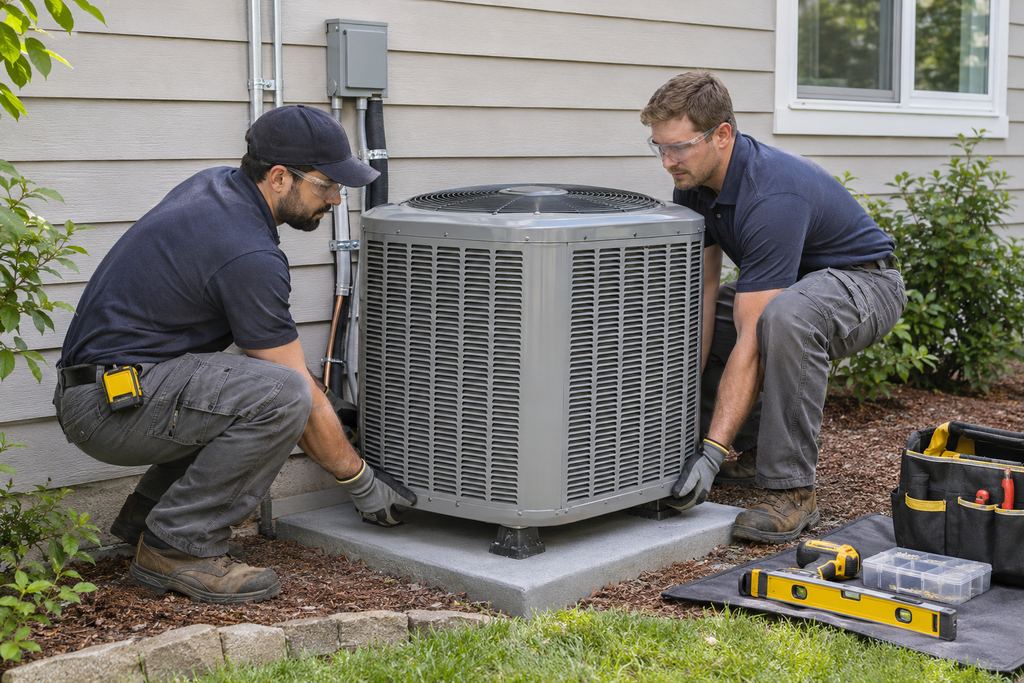
A Carrier air conditioner installation should begin with a load calculation for your house, not with the size of the old unit. The installer then sets the outdoor unit, matches an indoor coil, connects and evacuates the refrigerant lines, wires the circuit and commissions the system. Request a quote and an independent contractor near you can follow up. We are not Carrier and are not one of its dealers.
- Central air, heat pumps and ductless mini-splits
- Quotes from independent installers in your area
- New systems must meet DOE SEER2 minimums
Tell us the home's size, the current system and whether ductwork is in place. A local installer follows up.
Please keep this page open.
- Your request is matched with an independent contractor or partner network that serves your ZIP code.
- The contractor contacts you to confirm details and schedule a visit.
- They diagnose the system and quote the work. You decide whether to go ahead.
Read how requests are handled.
We're still setting up the contractor network that receives online requests, so your details were not sent to anyone and were not stored. Please call to request service, or check back soon.
Call (888) 555-0199What the installation price usually covers
A full Carrier AC installation quote normally includes the outdoor condenser, a matched indoor evaporator coil (or air handler), a new or flushed refrigerant line set, a pad or brackets, the electrical disconnect and whip, a condensate drain, a thermostat if needed, the permit, removal of the old unit and a startup check. Carrier's current residential lineup covers air conditioners, heat pumps, furnaces, ductless mini-splits, thermostats and the communicating Infinity system, so the quote should name exact model numbers for each piece.
A quick reminder of who we are: AC Service Near Me is not affiliated with, endorsed by or authorized by Carrier. We use the Carrier name only to identify equipment, and installers who receive requests are independent companies.
From sizing to startup
- Load calculation
A room-by-room heat gain calculation, typically ACCA Manual J, sets the capacity. Bigger is not better; an oversized unit short cycles and leaves humidity behind.
- Duct check
Leaky or undersized ducts can waste a new system's capacity. Ask whether static pressure was measured and whether duct sealing is worth adding.
- Equipment match
The outdoor unit, indoor coil and furnace or air handler should be a matched combination so the rated efficiency applies.
- Old unit removal
Refrigerant must be recovered by an EPA Section 608 certified technician before the old equipment is hauled away.
- Line set, vacuum and charge
Lines are brazed or replaced, pressure tested, evacuated and charged to the manufacturer's specification.
- Permit and inspection
Most jurisdictions require one for a system replacement or new install.
- Commissioning and registration
The installer records operating readings and should register the equipment with Carrier or show you how.
Federal minimum efficiency for new split central AC
Set by the U.S. Department of Energy for equipment installed from January 1, 2023.
| Region | Split AC under 45,000 Btu/h | Split AC 45,000 Btu/h and up |
|---|---|---|
| North | 13.4 SEER2 | 13.4 SEER2 |
| Southeast and Southwest | 14.3 SEER2 | 13.8 SEER2 |
What changes the quote
Prices come from the installer, not from us. Expect quotes to differ on these items.
Tonnage from the load calculation, plus single-stage, two-stage or variable-speed equipment.
Replacing only the outdoor unit on an old coil is rarely possible with newer refrigerants.
Sealing, resizing or adding returns adds cost and often fixes comfort problems.
A new disconnect, breaker or panel work if the old circuit does not fit the new unit.
Attic air handlers, rooftop condensers and crane lifts take more labor.
Utility and state rebates vary. Check current offers with ENERGY STAR's rebate finder.
New refrigerants change the replacement math
Under the EPA's technology transitions rule, new residential split systems have moved from R-410A to lower global warming potential refrigerants such as R-454B and R-32. Those A2L refrigerants need equipment designed for them, so a new outdoor unit usually comes with a new matched indoor coil. Ask the installer which refrigerant the proposed Carrier system uses and whether the existing line set can be reused after flushing.
If your current system still runs and only one part failed, compare that repair against replacement before you sign. The Carrier repair page and the AC replacement guide cover the decision, and the installation cost guide has published price ranges.
Ask every installer the same questions
Then compare the answers side by side.
- Will you do a Manual J load calculation?
And can I see the result? - What are the exact model numbers for the outdoor and indoor units?
Look the combination up in the AHRI directory to confirm its rated efficiency. - Is the permit included?
It should be on the quote, not left to you. - Who registers the equipment, and when?
Registration can affect warranty coverage. Check Carrier's warranty terms for your model. - What labor warranty do you offer?
This is separate from the manufacturer's parts warranty. - Are you licensed and insured in this state?
Confirm with the state contractor licensing board.
How a service request works
AC Service Near Me is a referral service. We don't send our own technicians. We connect you with independent local contractors.
- Tell us what you need
Enter your ZIP code and choose the service. Add a few details about the problem or project.
- Your request is routed
It goes to an independent HVAC contractor or partner network that serves your area and handles that type of work.
- A contractor contacts you
The contractor reaches out to confirm details and schedule a visit.
- You decide
The contractor diagnoses the system and quotes the work. Pricing, scheduling and warranty terms are between you and them.
Frequently asked questions
Can I install a Carrier air conditioner myself?
Not legally in most cases. Central AC installation involves refrigerant handling, which requires EPA Section 608 certification, plus electrical work and a permit in most places. Carrier sells through contractors, and warranty terms generally assume professional installation. Some ductless brands market owner-installed kits; see the MRCOOL installation page for how those differ.
Is Carrier a good split system?
We do not rate brands. Carrier makes ducted and ductless split systems at several efficiency levels. Correct sizing, a matched indoor coil and careful installation affect results more than the badge.
How do I use a Carrier air conditioner after installation?
Ask the installer to walk you through the thermostat, including mode, fan setting and any schedule, and to show you the filter location and size. Keep the owner's manual and the startup readings with your warranty papers.
How long does a Carrier AC installation take?
A straight replacement on existing ducts is often a one-day job. Duct changes, electrical upgrades or a new system in a home without ducts take longer.
Does a new Carrier AC need a new indoor coil?
Usually, yes. The outdoor unit and coil are rated as a pair, and newer A2L refrigerant systems need matching components.
- Carrier Residential Heating and Cooling (Carrier)
- Manual J Residential Load Calculation (ACCA)
- Appliance and Equipment Standards Program (U.S. Department of Energy)
- Technology Transitions (U.S. EPA)
- Section 608 Technician Certification (U.S. EPA)
Last updated November 24, 2026. Editorial policy · Report an error
Related guides and services
Request a Carrier installation quote
Share the home's size and what you have now. An independent installer who covers your ZIP code follows up with next steps.
AC Service Near Me is an independent referral service. Work is performed by independent, locally owned contractors. How we earn money
Tell us the home's size, the current system and whether ductwork is in place. A local installer follows up.
Please keep this page open.
- Your request is matched with an independent contractor or partner network that serves your ZIP code.
- The contractor contacts you to confirm details and schedule a visit.
- They diagnose the system and quote the work. You decide whether to go ahead.
Read how requests are handled.
We're still setting up the contractor network that receives online requests, so your details were not sent to anyone and were not stored. Please call to request service, or check back soon.
Call (888) 555-0199