AC Blowing Warm Air: What Causes It and What to Do
When an AC is blowing hot air, the indoor fan is running but the refrigerant side is not removing heat. The cause is often simple, like a thermostat set to heat or a tripped outdoor breaker, and sometimes it is a failed part in the condenser.
Start with the thermostat: it should be on Cool, the fan on Auto, and the setpoint a few degrees below room temperature. Then go outside and see whether the condenser fan is spinning. If the indoor blower runs but the outdoor unit is silent or humming without its fan, the usual suspects are a tripped breaker, a failed capacitor or contactor, or a power problem that a technician should test. Warm air with ice on the lines points to low airflow or low refrigerant.
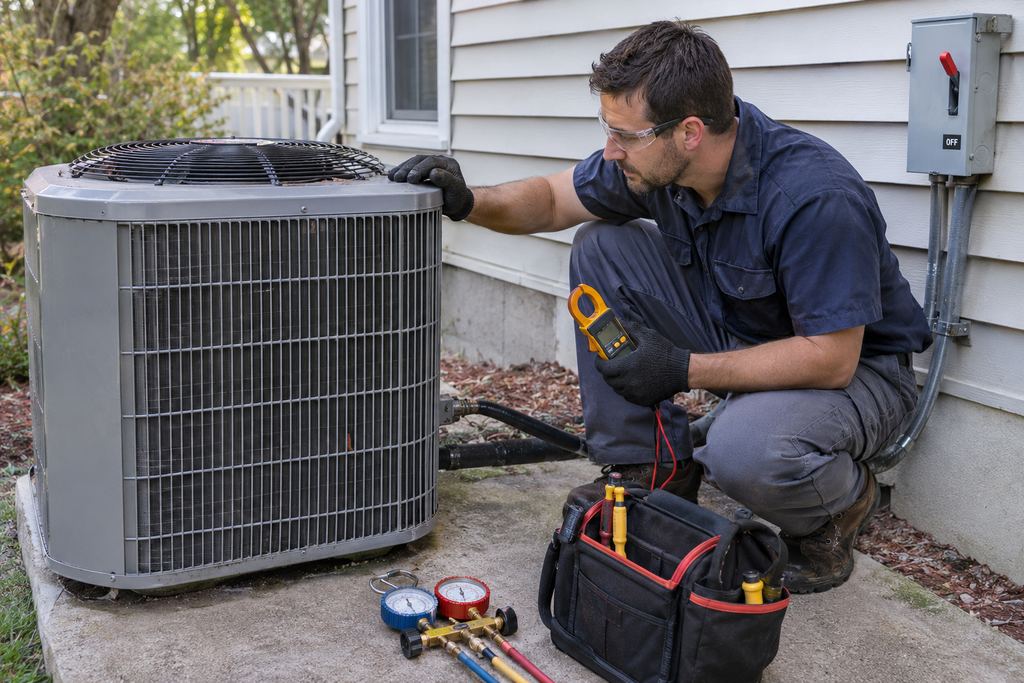
Match what you notice to the likely cause
Two quick observations narrow the problem: is the outdoor fan running, and is there ice anywhere?
| What you notice | Most likely cause | Who handles it |
|---|---|---|
| Warm air, thermostat shows Heat or Fan On | Thermostat mode or fan setting | You |
| Indoor fan runs, outdoor unit completely silent | Tripped breaker, blown disconnect fuse, failed contactor or low-voltage wiring fault | Breaker reset once by you; the rest by a technician |
| Outdoor unit hums but its fan does not spin | Weak capacitor or seized condenser fan motor | Technician |
| Outdoor fan spins, air still lukewarm | Low refrigerant, dirty condenser coil or failing compressor | Technician |
| Ice on the copper line or indoor coil | Restricted airflow or low refrigerant charge | You thaw it; a technician finds the cause |
| Cool air in some rooms, warm in others | Disconnected or leaking ductwork in an attic or crawlspace | Technician or duct contractor |
The usual causes, from simple to serious
What you can check and what to leave alone
Safe checks you can do
No tools beyond a flashlight. Turn the system off at the thermostat before opening any filter or access door.
- Set the thermostat to Cool and the fan to Auto, then lower the setpoint three to five degrees and wait several minutes.
- Replace thermostat batteries if the display is dim or blank.
- Pull the air filter and replace it if it is gray or you cannot see light through it.
- Check the AC breaker in the main panel. If it is tripped, reset it once. If it trips again, leave it off.
- Clear leaves, weeds and stored items from around the outdoor unit so it has open space on every side.
- If you see ice, switch the system off and run the fan alone until the coil thaws.
Leave these to a licensed technician
These involve high voltage, refrigerant or sealed components. Refrigerant work requires EPA Section 608 certification.
- Testing the capacitor, contactor and wiring inside the outdoor unit, which hold a charge even with the power off.
- Measuring refrigerant pressures, finding a leak and recharging, which requires EPA Section 608 certification.
- Cleaning the condenser coil from the inside or straightening fins on a fragile coil.
- Diagnosing a compressor that runs but does not cool.
- Locating and resealing disconnected supply ducts.
Central air, heat pumps and mini-splits
On a standard split system, warm air almost always means the outdoor condenser has stopped doing its part. On a heat pump, the same symptom can also come from a reversing valve stuck in the heating position, or from a new thermostat that was wired or configured for the wrong reversing valve type. If the problem started right after a thermostat swap, mention that first; it saves diagnostic time.
Ductless mini-splits have their own error codes, and the indoor head often flashes a light pattern when the outdoor unit fails. Write down the code before calling, because the technician can use it to bring the right part. Window and portable units are self-contained, so warm air there usually means a failed compressor or a fan problem in the unit itself.
If the whole house is cool but one floor is warm, the system may be working and the issue is airflow or sizing. That situation is covered in AC not cooling, which walks through uneven cooling and short run times.
What a repair visit for warm air usually covers
A technician will confirm the thermostat is calling for cooling, check voltage at the outdoor unit, test the capacitor and contactor, look at the fan motor, and read refrigerant pressures and temperatures. On older systems they will also note whether the unit uses R-22, since that refrigerant is no longer produced and leaks on those systems are expensive to keep fixing.
Price depends on the part, the refrigerant type and whether the unit is under warranty. The AC diagnostic cost guide explains how service-call fees work, and the AC repair cost guide covers common part repairs. Ask for a written quote that names the failed part before work starts.
Frequently asked questions
Why is my AC running but blowing warm air?
The indoor blower and the outdoor condenser are separate. If the blower runs and the condenser does not, you get room-temperature air. Check the outdoor fan first, then the breaker. A humming unit with a still fan usually needs a technician.
What does refrigerant actually do in an AC?
Refrigerant absorbs heat at the indoor coil and releases it at the outdoor coil as the compressor moves it in a loop. When the charge is low from a leak, less heat leaves the house and the air from the vents gets warmer.
Why does my AC wait a few minutes before the outdoor unit restarts?
After the compressor stops, many systems wait about three to five minutes before restarting so pressures can even out. If you just changed the thermostat, give it that long before deciding the unit is broken.
What maintenance helps prevent warm air problems?
Change or clean the filter on schedule, keep the outdoor coil clear, and have a technician check the electrical parts and refrigerant charge once a year before the cooling season.
Can I keep running the AC while it blows warm air?
If the outdoor unit is humming without its fan, or the breaker trips, turn the system off. Running a compressor that cannot start or cool can damage it.
- Heating and cooling maintenance checklist (ENERGY STAR)
- Section 608 Technician Certification (U.S. EPA)
- Heat and Health (Centers for Disease Control and Prevention)
Last updated November 24, 2026. Editorial policy · Report an error
Related guides and services
Request help with warm air from your AC
Tell us what the thermostat says and whether the outdoor fan is spinning. A local contractor can follow up to schedule a visit. Availability varies by ZIP code and season.
AC Service Near Me is an independent referral service. Work is performed by independent, locally owned contractors. How we earn money
Describe what the indoor and outdoor units are doing. Your request goes to an independent local contractor who can schedule a diagnosis.
Please keep this page open.
- Your request is matched with an independent contractor or partner network that serves your ZIP code.
- The contractor contacts you to confirm details and schedule a visit.
- They diagnose the system and quote the work. You decide whether to go ahead.
Read how requests are handled.
We're still setting up the contractor network that receives online requests, so your details were not sent to anyone and were not stored. Please call to request service, or check back soon.
Call (888) 555-0199