AC Replacement
Replace your air conditioner when the repair bill is large relative to the system's age, when it still runs on R-22, or when it no longer keeps the house comfortable. Send a request and an independent contractor in your area can assess the system and quote a replacement in writing.
- Honest repair-versus-replace comparison first
- Sizing from a load calculation, not the old unit's label
- Removal and refrigerant recovery of the old system
Tell us the age of the current system and what is wrong with it. A contractor serving your area follows up to look at it.
Please keep this page open.
- Your request is matched with an independent contractor or partner network that serves your ZIP code.
- The contractor contacts you to confirm details and schedule a visit.
- They diagnose the system and quote the work. You decide whether to go ahead.
Read how requests are handled.
We're still setting up the contractor network that receives online requests, so your details were not sent to anyone and were not stored. Please call to request service, or check back soon.
Call (888) 555-0199Signs your air conditioner is due for replacement
- It is 12 to 15 years old or more: Central AC systems commonly last somewhere in that range, less in hot coastal climates.
- It uses R-22: R-22 has not been produced since 2020, so recharging an older system keeps getting more expensive.
- The compressor or coil has failed: These are the costliest repairs and often do not make sense on an old system.
- Repairs keep coming back: Several service calls in two seasons is a pattern worth pricing out.
- Energy bills keep climbing: Worn equipment runs longer to do the same work.
- The house never feels right: Uneven rooms, high humidity or constant running can mean the system was sized wrong from the start.
Repair or replace: a quick comparison
| Situation | Leans repair | Leans replace |
|---|---|---|
| System age | Under about 10 years | Over about 12 to 15 years |
| Failed part | Capacitor, contactor, fan motor, drain | Compressor, condenser coil, evaporator coil |
| Refrigerant | R-410A or newer | R-22 with a leak |
| Repair history | First problem in years | Repeated calls |
| Comfort | Cooled well until the fault | Long run times, humid or uneven rooms |
Using the $5,000 rule without being ruled by it
A rule of thumb many contractors quote: multiply the unit's age in years by the repair price. If the product passes $5,000, at least get a replacement price. A 14-year-old system facing a $400 repair scores 5,600; a 6-year-old one facing the same bill scores 2,400. It is a useful prompt, but it ignores warranty coverage, how long you plan to stay in the house and whether a cheaper repair would carry you through a single summer.
If you are unsure, ask for both numbers in writing: the repair with its warranty, and a replacement with model numbers. A second opinion from a different contractor is reasonable for any recommendation to replace. A diagnostic visit gives you a clear fault to price against.
Choosing the new system
Do not simply match the tonnage printed on the old unit. Insulation, windows and duct changes since the original install may mean the home now needs a different size, and a Manual J load calculation is the way to find out. The outdoor unit should be paired with a matching indoor coil or air handler; mixing a new condenser with an old coil usually hurts efficiency and can affect warranty coverage.
New central systems must meet the Department of Energy's SEER2 minimums in effect since 2023, and they use R-410A or newer refrigerants such as R-454B or R-32. In mild-winter areas, swapping the AC for a heat pump is worth pricing; see replacing an AC with a heat pump. Homes without ducts in some rooms might do better with a ductless system.
Plan the timing if you can
Replacing a system on your own schedule gives you more choice than replacing it the day it dies. In spring and fall, contractors have more open slots, you have time to collect two or three quotes, and you can wait for the equipment you actually want instead of whatever is in stock. If your system is old and a technician has already flagged a weak compressor or a slow leak, it is reasonable to start collecting quotes before summer rather than gambling on another season.
Older homes deserve a quick look at the ducts and electrical service during the quote visit. A system that was undersized for decades may have been installed on ducts that are also too small, and fixing both at once is cheaper than coming back later. If the contractor suggests duct work, ask for it as a separate line so you can compare it with a duct leakage test or sealing alone.
What affects the replacement price
More capacity and higher SEER2 ratings raise the equipment cost.
Replacing the condenser and coil together costs more but is usually the right call.
Leaky or undersized ducts may need sealing or replacement at the same time.
Updated disconnects, wiring or a new pad add to the bill.
Attics and crawlspaces take more labor than basements or closets.
Permit fees and refrigerant recovery from the old unit are often line items.
Prices and financing
We do not quote prices. Published national ranges and the main cost drivers are in the AC replacement cost guide, and financing options are covered in AC replacement financing. Check current federal, state and utility incentives with the ENERGY STAR rebate finder; the federal 25C credit does not apply to equipment placed in service after 2025.
What replacement day looks like
- Shut down and recover
Power is cut and refrigerant is recovered from the old system.
- Remove old equipment
The condenser and usually the indoor coil come out. Ask that disposal be included in the quote.
- Set the new units
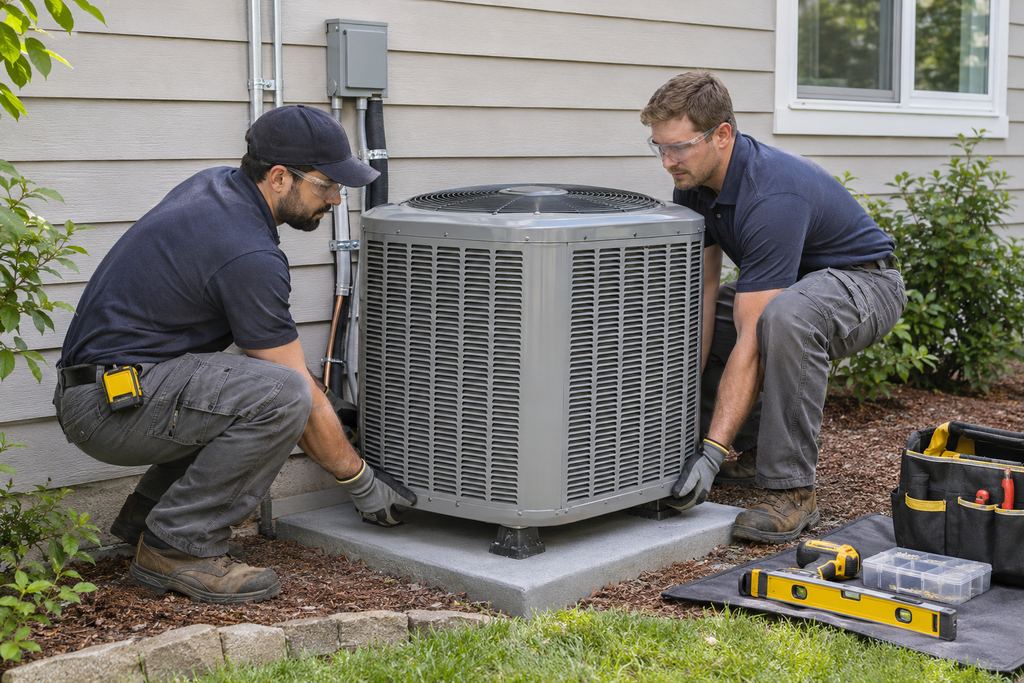
The outdoor unit goes on a level pad and the coil or air handler is installed indoors.
- Line set and vacuum
Refrigerant lines are replaced or flushed, leak tested and evacuated.
- Start-up
The system is charged to spec, airflow is checked and the thermostat is configured.
- Permit inspection
Where required, a local inspector reviews the work afterward.
How to compare replacement quotes
- Are model numbers listed for both units?
You need them to check the matched AHRI rating and warranty. - Was a load calculation done?
Ask to see the result, not just the tonnage. - What is included?
Line set, pad, thermostat, permit, removal and disposal should be spelled out. - What do the warranties cover?
Separate the manufacturer's parts warranty, which may need registration, from the installer's labor warranty. - Is the contractor licensed and insured?
Look up the license on your state or local board's site.
How a service request works
AC Service Near Me is a referral service. We don't send our own technicians. We connect you with independent local contractors.
- Tell us what you need
Enter your ZIP code and choose the service. Add a few details about the problem or project.
- Your request is routed
It goes to an independent HVAC contractor or partner network that serves your area and handles that type of work.
- A contractor contacts you
The contractor reaches out to confirm details and schedule a visit.
- You decide
The contractor diagnoses the system and quotes the work. Pricing, scheduling and warranty terms are between you and them.
Frequently asked questions
What does a replacement air conditioner cost on average?
It varies with size, efficiency, ductwork and local labor. Collect written quotes for the same scope, and see the replacement cost guide for published ranges.
How hard is it to replace an AC unit?
It is a professional job. It involves recovering refrigerant, brazing lines, pulling a vacuum, charging the system and electrical connections, and it usually needs a permit. A straightforward swap is often finished in a day.
Can I replace only the outdoor unit?
Sometimes, if the indoor coil is newer and compatible. Mismatched components often lose efficiency, and an R-22 coil cannot be paired with a current outdoor unit without changes. Ask the contractor to explain the match.
How long does a new AC last?
Many central systems last 12 to 15 years or more with yearly maintenance. Coastal salt air, heavy use and poor installation shorten that.
What happens to my old air conditioner?
The contractor recovers the refrigerant and usually hauls the old equipment away. Ask that removal and disposal be listed in the quote. See AC disposal for the rules.
Is this guidance for the UK?
No. This site covers US homes and US rules, such as DOE efficiency standards and EPA refrigerant requirements.
- Heating and cooling at home (ENERGY STAR)
- Section 608 Technician Certification (U.S. EPA)
- ENERGY STAR Rebate Finder (ENERGY STAR)
Last updated November 24, 2026. Editorial policy · Report an error
Related guides and services
Request replacement quotes
Share the system's age and the problem. A local contractor follows up to assess it and quote in writing.
AC Service Near Me is an independent referral service. Work is performed by independent, locally owned contractors. How we earn money
Tell us the age of the current system and what is wrong with it. A contractor serving your area follows up to look at it.
Please keep this page open.
- Your request is matched with an independent contractor or partner network that serves your ZIP code.
- The contractor contacts you to confirm details and schedule a visit.
- They diagnose the system and quote the work. You decide whether to go ahead.
Read how requests are handled.
We're still setting up the contractor network that receives online requests, so your details were not sent to anyone and were not stored. Please call to request service, or check back soon.
Call (888) 555-0199