Duct Leakage Testing
A duct leakage test pressurizes your duct system and measures how much air escapes. It tells you whether sealing or repair is worth paying for, and it is often required for new construction and system replacements under local energy codes. Request a test through this page and a local contractor can follow up.
- Measures leakage in cubic feet per minute
- Total leakage or leakage to outside
- Run before and after duct work
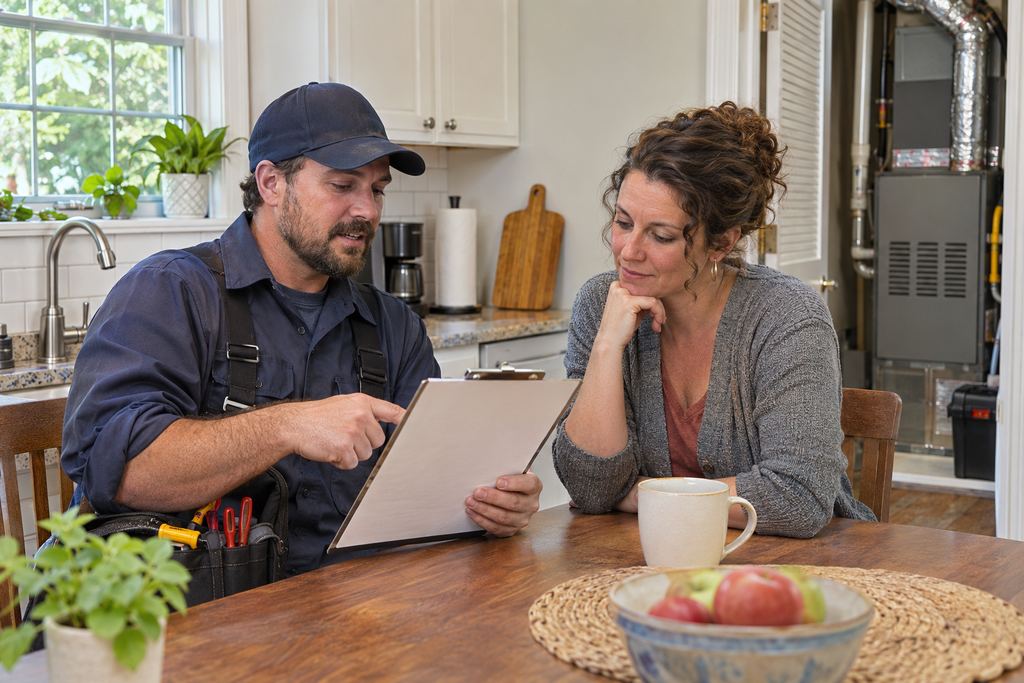
Tell us why you want the test: comfort, bills, code or a home sale. A contractor in your area follows up.
Please keep this page open.
- Your request is matched with an independent contractor or partner network that serves your ZIP code.
- The contractor contacts you to confirm details and schedule a visit.
- They diagnose the system and quote the work. You decide whether to go ahead.
Read how requests are handled.
We're still setting up the contractor network that receives online requests, so your details were not sent to anyone and were not stored. Please call to request service, or check back soon.
Call (888) 555-0199How a duct leakage test works
- Seal the registers
Supply and return grilles are covered with tape or film so the duct system is closed off.
- Connect the fan
A calibrated fan, often called a duct blaster, is attached at the air handler or a large return.
- Pressurize
The fan brings the ducts to a standard test pressure, commonly 25 pascals.
- Measure
The airflow needed to hold that pressure equals the leakage, reported in cubic feet per minute (CFM25).
- Optional: leakage to outside
Running a blower door on the house at the same time separates leaks to the outdoors from leaks inside the living space.
Reading the results
Results are usually expressed as CFM25, and for comparison they are often divided by the home's conditioned floor area. Total leakage counts every leak; leakage to outside counts only air escaping to attics, crawlspaces and outdoors, which is the part that wastes energy. Energy codes and efficiency programs set their own limits, so ask the tester which standard applies to your home and how your number compares.
A high result is a reason to look for the leaks, not proof of where they are. A good tester will point out the likely spots, such as the plenum connection, register boots and attic flex runs. From there, duct sealing or duct repair fixes them, and a retest confirms the result.
When a duct test is worth it
- New construction or a new system: Many energy codes based on the IECC require duct testing; your building department can confirm.
- Before paying for sealing: A baseline shows whether there is enough leakage to justify the work.
- After any duct work: The retest is the proof the job was done well.
- Comfort and dust complaints: Hot rooms and dusty registers often trace back to leaky ducts.
- Energy audits: Home energy raters and auditors often include duct testing.
Checking for duct leaks yourself vs. a real test
Safe checks you can do
No tools beyond a flashlight. Turn the system off at the thermostat before opening any filter or access door.
- Look at accessible ducts for gaps, disconnected sections and dried-out cloth tape
- With the system running, feel for air at joints you can reach safely
- Watch for dust streaks at seams and around register boots
Leave these to a licensed technician
These involve high voltage, refrigerant or sealed components. Refrigerant work requires EPA Section 608 certification.
- Calibrated duct pressurization testing
- Blower door testing for leakage to outside
- Sealing hidden or hard-to-reach leaks
- Code compliance documentation
Who performs duct testing
Some HVAC contractors own testing equipment; others work with home energy raters or auditors who do. For code compliance, ask who is accepted by your building department. For a new system, ask the installer whether testing is in the quote; see AC installation. For new ductwork, testing belongs in the scope of duct installation.
How a service request works
AC Service Near Me is a referral service. We don't send our own technicians. We connect you with independent local contractors.
- Tell us what you need
Enter your ZIP code and choose the service. Add a few details about the problem or project.
- Your request is routed
It goes to an independent HVAC contractor or partner network that serves your area and handles that type of work.
- A contractor contacts you
The contractor reaches out to confirm details and schedule a visit.
- You decide
The contractor diagnoses the system and quotes the work. Pricing, scheduling and warranty terms are between you and them.
Frequently asked questions
How do you tell if ductwork is leaking?
Warning signs include rooms that will not cool, dusty registers, a hot or dusty attic near the ducts and rising bills. Visible gaps and loose tape are clues. Only a pressurization test measures how much air is lost.
How much does a duct leakage test cost?
It depends on the provider, the size of the home and whether a blower door test is added. Ask whether the price includes a written report and a retest after any sealing.
What is the 2 foot rule for ductwork?
An informal installer guideline, usually about leaving a short straight section before a bend. It is not part of leakage testing or a code limit.
When do you test for duct leakage to the outdoors?
When the goal is energy savings or when a code or program sets a limit for leakage to outside. It requires a blower door on the house along with the duct fan.
- Seal and insulate (ENERGY STAR)
- RESNET (Residential Energy Services Network)
- Building America Solution Center (U.S. DOE / PNNL)
Last updated November 24, 2026. Editorial policy · Report an error
Related guides and services
Request a duct leakage test
Tell us why you want the test. A contractor or tester who serves your area follows up to schedule.
AC Service Near Me is an independent referral service. Work is performed by independent, locally owned contractors. How we earn money
Tell us why you want the test: comfort, bills, code or a home sale. A contractor in your area follows up.
Please keep this page open.
- Your request is matched with an independent contractor or partner network that serves your ZIP code.
- The contractor contacts you to confirm details and schedule a visit.
- They diagnose the system and quote the work. You decide whether to go ahead.
Read how requests are handled.
We're still setting up the contractor network that receives online requests, so your details were not sent to anyone and were not stored. Please call to request service, or check back soon.
Call (888) 555-0199