Air Conditioner Installation
A new air conditioner is only as good as its installation: correct sizing, a clean refrigerant circuit and matched ducts matter as much as the equipment. Request AC installation quotes through this page, and an independent contractor serving your area will follow up to look at the house.
- Central AC, heat pumps and ductless mini-splits
- Ask for a room-by-room load calculation
- Compare written quotes line by line
Tell us about the home and the system you have now, if any. A local installer follows up to schedule a site visit.
Please keep this page open.
- Your request is matched with an independent contractor or partner network that serves your ZIP code.
- The contractor contacts you to confirm details and schedule a visit.
- They diagnose the system and quote the work. You decide whether to go ahead.
Read how requests are handled.
We're still setting up the contractor network that receives online requests, so your details were not sent to anyone and were not stored. Please call to request service, or check back soon.
Call (888) 555-0199What professional air conditioning installation includes
A proper installation starts before any equipment arrives. The contractor measures the house and runs a cooling load calculation, typically using ACCA Manual J, to decide how much capacity the home actually needs. Rules of thumb based on square footage alone tend to oversize systems, and an oversized unit cools in short bursts, removes less humidity and wears out faster.
The next decisions are the system type, the efficiency level and whether the existing ductwork, electrical circuit and thermostat can stay. Ductwork deserves a real look: leaky or undersized ducts can undo the benefit of new equipment. If ducts need work, see duct replacement or new duct installation.
Common types of AC installation
How an AC installation usually goes
- Site visit and load calculation
The installer inspects the home, ducts and electrical service and sizes the system.
- Written proposal
Equipment model numbers, efficiency ratings, scope of work, permit, warranty terms and price.
- Permit
Most jurisdictions require a mechanical permit for a new or replacement central system. The contractor usually pulls it.
- Removal and prep
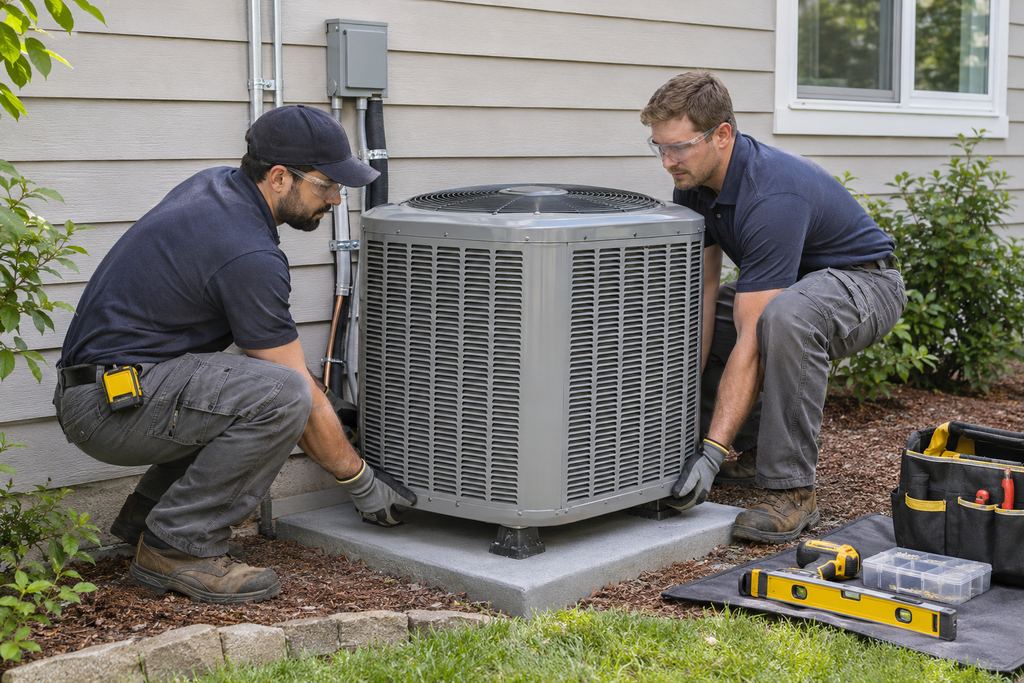
Old equipment is disconnected and refrigerant is recovered. A pad or wall bracket is set for the new outdoor unit.
- Set, connect and evacuate
The indoor coil and outdoor unit are set, the line set is brazed or flared, pressure tested and pulled into a deep vacuum.
- Charge and commission
Refrigerant is adjusted to the manufacturer's spec, airflow and temperatures are measured, and the thermostat is set up.
- Inspection and handoff
The local inspector signs off where required, and you get the paperwork and warranty registration details.
What moves the price of AC installation
We do not set prices. These are the items that make one quote higher than another.
Larger systems and higher SEER2 ratings cost more up front and less to run.
Variable-speed and multi-zone systems cost more than single-stage central air.
Reusing sound ducts saves money. Sealing, resizing or new runs add cost.
A new circuit, disconnect or panel upgrade can be needed, especially where there was no AC before.
Attic air handlers, rooftop placement and long line sets take more labor.
Permit fees, a new thermostat, a condensate pump or a surge protector may be line items.
Efficiency rules and refrigerants in new systems
Since January 1, 2023, new central air conditioners are rated in SEER2, and the Department of Energy sets regional minimums: 13.4 SEER2 for split systems in northern states and 14.3 SEER2 for most split systems under 45,000 Btu/h in the South and Southwest. Higher ratings are optional and pay back faster in hot climates with long cooling seasons.
New systems sold now use R-410A or the newer lower-GWP refrigerants such as R-454B or R-32, following the EPA's technology transition rules under the AIM Act. Ask which refrigerant the quoted equipment uses and whether the installer is trained for it. For incentives, check current federal, state and utility programs through the ENERGY STAR rebate finder; the federal 25C credit no longer applies to systems placed in service after 2025.
Can you install an AC yourself?
Safe checks you can do
No tools beyond a flashlight. Turn the system off at the thermostat before opening any filter or access door.
- Window and portable units, following the manual and the window's weight limits
- Choosing a location for the outdoor unit with the installer
- Clearing the work area and attic path before installation day
Leave these to a licensed technician
These involve high voltage, refrigerant or sealed components. Refrigerant work requires EPA Section 608 certification.
- Any work that opens or charges the refrigerant circuit (EPA Section 608)
- New circuits, disconnects and panel work
- Permits and inspections for central and ductless systems
- Sizing calculations and duct design
Questions to ask every installer
- Will you do a Manual J load calculation?
Sizing by square footage alone is a warning sign. - Are the indoor and outdoor units a matched pair?
Ask for the AHRI reference number that rates the combination. - What happens to my ducts?
Find out whether they will be tested, sealed or left as they are. - Who pulls the permit?
The contractor normally does. Get it in writing. - What warranty is included?
Separate the manufacturer's parts warranty, which often requires registration, from the installer's labor warranty. - Is your license current in this state or city?
Look it up on the licensing board website and ask for proof of insurance.
How a service request works
AC Service Near Me is a referral service. We don't send our own technicians. We connect you with independent local contractors.
- Tell us what you need
Enter your ZIP code and choose the service. Add a few details about the problem or project.
- Your request is routed
It goes to an independent HVAC contractor or partner network that serves your area and handles that type of work.
- A contractor contacts you
The contractor reaches out to confirm details and schedule a visit.
- You decide
The contractor diagnoses the system and quotes the work. Pricing, scheduling and warranty terms are between you and them.
Frequently asked questions
How much does it cost to have AC installed?
It depends on capacity, efficiency, system type, ductwork and electrical work, and prices vary by region. Get at least two or three written quotes for the same scope. Published ranges are collected in the AC installation cost guide.
Can I install central air myself?
Not legally in most cases. Connecting and charging the refrigerant circuit requires EPA Section 608 certification, and most jurisdictions require a permit and inspection for the electrical and mechanical work.
How long does an AC installation take?
A straightforward swap of a central system often takes a day. New ductwork, electrical upgrades or a multi-zone mini-split can stretch it to several days.
What is the $5,000 rule?
An informal guide for deciding between repair and replacement: system age times repair cost. If it tops $5,000, price a new system too.
What size air conditioner do I need?
That should come from a load calculation that accounts for insulation, windows, orientation and climate, not from square footage alone.
- Heating and cooling at home (ENERGY STAR)
- Section 608 Technician Certification (U.S. EPA)
- ENERGY STAR Rebate Finder (ENERGY STAR)
- Air Conditioning Contractors of America (ACCA)
Last updated November 24, 2026. Editorial policy · Report an error
Related guides and services
Request installation quotes
Describe the home and what you have now. A contractor who installs in your area follows up to arrange a site visit.
AC Service Near Me is an independent referral service. Work is performed by independent, locally owned contractors. How we earn money
Tell us about the home and the system you have now, if any. A local installer follows up to schedule a site visit.
Please keep this page open.
- Your request is matched with an independent contractor or partner network that serves your ZIP code.
- The contractor contacts you to confirm details and schedule a visit.
- They diagnose the system and quote the work. You decide whether to go ahead.
Read how requests are handled.
We're still setting up the contractor network that receives online requests, so your details were not sent to anyone and were not stored. Please call to request service, or check back soon.
Call (888) 555-0199