Packaged Air Conditioners and Package Units
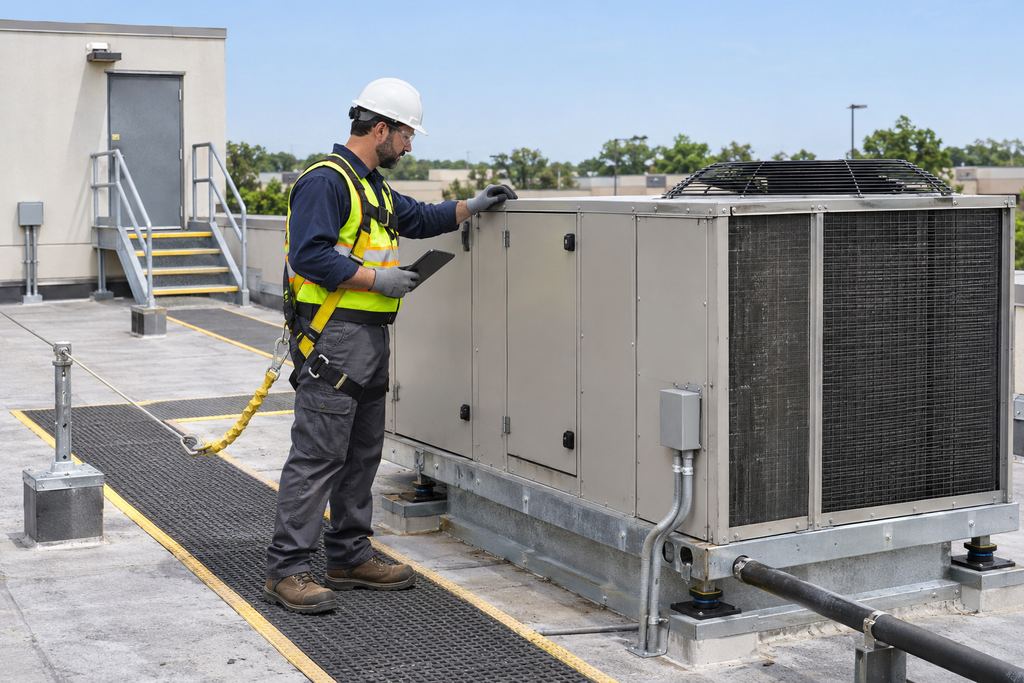
A packaged air conditioner puts the compressor, both coils and the blower in one cabinet that sits outside, on a slab beside the house or on the roof. Supply and return ducts connect to it through the wall or roof, and nothing but the ducts and thermostat is inside.
A package unit is a central, ducted system in a single outdoor box. It saves indoor space and suits homes without a basement, attic or closet for an air handler, as well as manufactured homes and small commercial buildings. The trade-offs are more exposure to weather, less choice of matched high-efficiency components and a cabinet that has to be replaced as a whole when it wears out.
Four kinds of package units
Package unit or split system
| Packaged | Split system | |
|---|---|---|
| Where the parts are | All outside in one cabinet | Condenser outside; coil and furnace or air handler inside |
| Indoor space used | None beyond ducts | Closet, attic, basement or garage |
| Refrigerant lines through the house | None; sealed at the factory | Line set between the two units |
| Equipment choice | Fewer models and efficiency tiers | Wide range of matched combinations |
| Weather exposure | Blower, controls and heat section all outdoors | Only the condenser outdoors |
| Replacement | Usually the whole cabinet | Outdoor and indoor parts can sometimes be replaced separately |
Where package units make sense
They are common on slab-built homes in hot regions where there is no basement and the attic is too hot or cramped for an air handler. Manufactured homes often use them, because the cabinet sits outside and connects to the duct system under the floor. On commercial buildings, the same idea scaled up is the rooftop unit.
If your home already has a package unit, replacing it with another one is usually the simplest path, since the ducts already meet the cabinet at a fixed location. Switching to a split system means finding indoor space for an air handler and running a line set.
What installation or replacement involves
- Load calculation: Same as any central system. The new unit should be sized for the house, not copied from the old nameplate.
- Pad or roof curb: A level, solid base. Roof units need a curb that matches the cabinet and seals against water.
- Duct connections: Transitions from the existing duct openings to the new cabinet, sealed and insulated.
- Utilities: Electrical circuit and disconnect; gas line and venting for gas packs; condensate drain.
- Rigging: Roof installs may need a crane, which adds cost and scheduling.
- Refrigerant recovery: The old unit's refrigerant must be recovered by an EPA Section 608 certified technician.
Efficiency and upkeep
Package units are rated in SEER2 for cooling and, for heat pumps, HSPF2 for heating. Federal minimums for single-package equipment are set separately from split systems, so confirm the rating on the AHRI certificate for the exact model quoted. Gas packs also carry an AFUE rating for the furnace section.
Because everything lives outdoors, keep the cabinet clear of plants and debris, change the filter at the return grille or inside the unit as the manual directs, and have a technician check the coils, drain, electrical parts and, on gas packs, the burners and venting each year. Book AC maintenance before the cooling season.
Frequently asked questions
What is an HVAC package unit?
It is a complete heating and cooling system in one outdoor cabinet, connected to the home's ducts. Depending on type it may include a gas furnace section, a heat pump or electric heat strips.
Are portable air conditioners more expensive than a package unit?
No. A portable air conditioner costs far less to buy, but it cools one room and uses more energy per unit of cooling. A package unit is a whole-house central system with professional installation.
What is the difference between commercial and residential AC units?
Commercial units are larger, usually run on three-phase power, often sit on roofs and include features such as economizers for outside air. Residential package units use single-phase power and smaller capacities.
How much should a package unit cost?
It depends on capacity, type (gas pack versus heat pump), efficiency, ground or roof location and duct work. Get written quotes from at least two contractors and compare the model numbers. The AC replacement cost guide lists the factors.
- Heating and cooling at home (ENERGY STAR)
- AHRI Directory of Certified Product Performance (AHRI)
- Section 608 Technician Certification (U.S. EPA)
Last updated November 24, 2026. Editorial policy · Report an error
Related guides and services
Request a package unit quote
Describe the current unit and how the home heats. We pass the request to an independent local contractor where one serves your ZIP code.
AC Service Near Me is an independent referral service. Work is performed by independent, locally owned contractors. How we earn money
Tell us whether the unit sits on the ground or the roof and how it heats. Availability varies by ZIP code.
Please keep this page open.
- Your request is matched with an independent contractor or partner network that serves your ZIP code.
- The contractor contacts you to confirm details and schedule a visit.
- They diagnose the system and quote the work. You decide whether to go ahead.
Read how requests are handled.
We're still setting up the contractor network that receives online requests, so your details were not sent to anyone and were not stored. Please call to request service, or check back soon.
Call (888) 555-0199