Split System Air Conditioners Explained
A split system air conditioner divides the work between two cabinets: an outdoor unit that holds the compressor and condenser coil, and an indoor unit that holds the evaporator coil and blower. Copper refrigerant lines and a control wire connect them. It is the most common central AC setup in US homes.
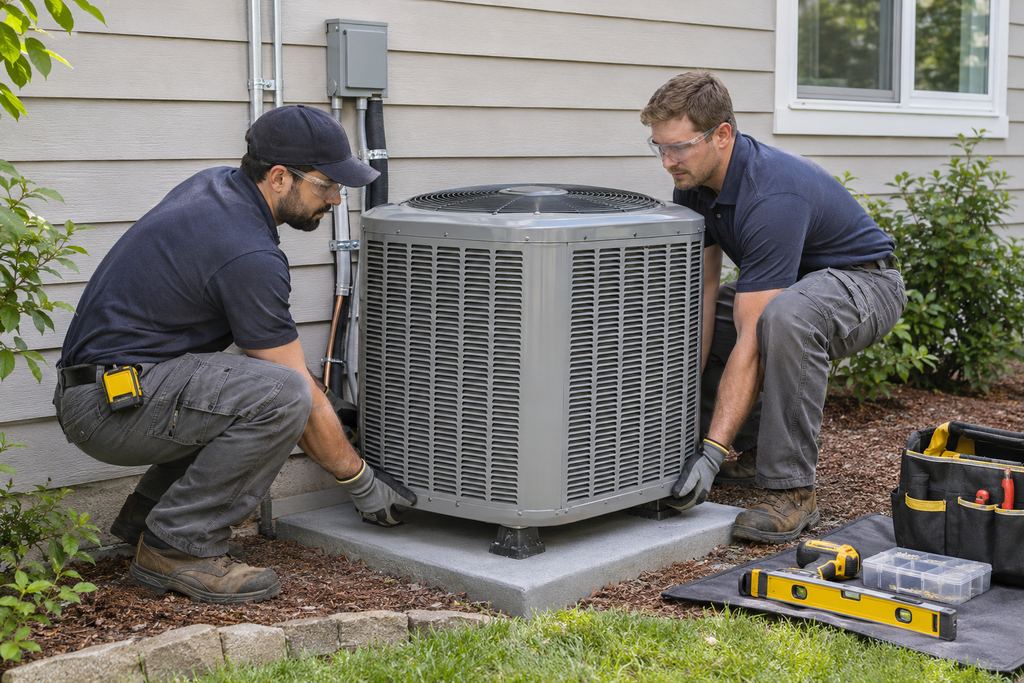
How the two halves of a split system connect
What each half does
Indoors, the blower pulls warm house air through a filter and across the cold evaporator coil. Refrigerant inside the coil absorbs the heat and moisture drips into a drain pan. The refrigerant, now a warm gas, travels out through the suction line to the outdoor unit, where the compressor squeezes it and the condenser fan blows the heat away. Cooled liquid refrigerant returns through the smaller line and the cycle repeats.
In a ducted split system, the indoor coil sits on top of a furnace or inside an air handler, and supply ducts spread the air through the house. In a ductless split, better known as a ductless mini-split, the coil and fan sit in a head mounted on the wall of the room it serves.
Types of split systems
Split system or packaged unit?
Both deliver central air. The difference is where the parts live.
| Split system | Packaged unit | |
|---|---|---|
| Cabinets | Two: outdoor and indoor | One, outdoors or on the roof |
| Indoor space needed | Closet, attic, basement or garage for the furnace or air handler | None beyond ducts |
| Typical homes | Most regions with basements, attics or closets | Slab homes, mobile homes, some Southwest and Southeast homes |
| Efficiency choices | Widest range, up to variable-speed models | Narrower range |
| Replacement | Outdoor and indoor sections should be matched | One unit swaps out |
Efficiency ratings and refrigerants
Since January 1, 2023, split central air conditioners are rated in SEER2, which uses a test closer to real duct conditions than the old SEER. The federal minimum for split AC is 13.4 SEER2 in the northern region and 14.3 SEER2 in the Southeast and Southwest for units under 45,000 Btu/h. Higher-tier systems with two-stage or variable-speed compressors rate well above that.
The refrigerant is changing too. R-22 production ended in 2020, and new split systems now use R-410A or newer A2L refrigerants such as R-454B or R-32 under the EPA technology transitions rule. Indoor and outdoor sections must be designed for the same refrigerant, which is one reason contractors often recommend replacing both halves together.
What drives the installed price
We do not set prices. These are the items that move a written quote up or down.
Tonnage from a load calculation, then single-stage, two-stage or variable-speed.
Replacing only the outdoor unit can leave a mismatched coil, a different refrigerant and lower efficiency.
Leaky or undersized ducts can waste a new system's efficiency. Ask whether duct repair is in scope.
New disconnect, breaker size changes, a new pad or wall bracket.
Most jurisdictions require a permit. Reusing an old line set is sometimes possible; ask why or why not.
Does the brand matter?
Most major manufacturers build split systems in similar efficiency tiers, and several brands share factories or parts. Installation quality, correct sizing and a matched indoor and outdoor section usually affect comfort and repair rates more than the badge. Compare quotes by model numbers, AHRI matched ratings, warranty registration terms and what labor coverage the contractor offers. The AC installation cost guide covers how to compare bids.
Frequently asked questions
What are the disadvantages of a split system?
It needs indoor space for the furnace or air handler and a path for refrigerant lines. Ducted versions lose some energy through ducts in attics or crawlspaces. Ductless versions put a visible head on the wall.
Is a mini-split a split system?
Yes. A mini-split is a split system without ducts. The term "split system" by itself usually means the ducted central kind.
Can I replace just the outdoor unit?
Sometimes, if the indoor coil is newer, uses the same refrigerant and is listed as a matched combination. Often it is not, so ask for the AHRI match for the exact pair being quoted.
Who can install a split system?
An HVAC contractor licensed where your state requires it, with technicians certified under EPA Section 608 for the refrigerant work. Start with split system AC installation.
- Energy Saver (U.S. Department of Energy)
- Section 608 Technician Certification (U.S. EPA)
- Hydrofluorocarbons (HFCs) (U.S. EPA)
- AHRI Directory of Certified Product Performance (AHRI)
Last updated November 24, 2026. Editorial policy · Report an error
Related guides and services
Request a split system quote
Share the home size and the equipment you have now. We pass it to an independent local contractor where one serves your ZIP code.
AC Service Near Me is an independent referral service. Work is performed by independent, locally owned contractors. How we earn money
Tell us the home size, whether you have ducts and what equipment you have now.
Please keep this page open.
- Your request is matched with an independent contractor or partner network that serves your ZIP code.
- The contractor contacts you to confirm details and schedule a visit.
- They diagnose the system and quote the work. You decide whether to go ahead.
Read how requests are handled.
We're still setting up the contractor network that receives online requests, so your details were not sent to anyone and were not stored. Please call to request service, or check back soon.
Call (888) 555-0199