Variable-Speed Air Conditioners vs. Single and Two-Stage
A variable speed air conditioner runs its compressor across a wide range of outputs instead of switching between full power and off. On most summer days it runs long and slow, which holds temperature closer to the setpoint and pulls more humidity out of the air.
It is worth it when you have a long cooling season, a humid climate, rooms that run hot or cold, and ducts in decent shape. It is less likely to pay back in a mild climate, a small home cooled a few weeks a year, or a house with leaky, undersized or uninsulated ducts. Two-stage systems are a middle option at a lower price.
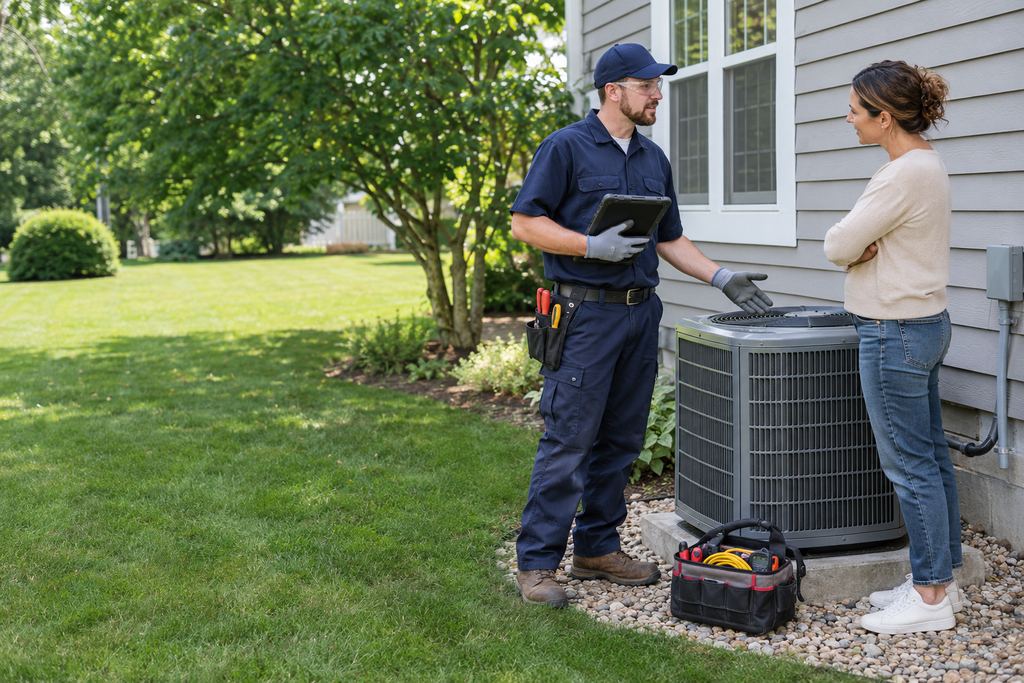
Three compressor types side by side
| Single-stage | Two-stage | Variable-speed | |
|---|---|---|---|
| How it runs | 100% or off | Low stage (often around two-thirds) or high | Modulates in small steps across a wide range |
| Temperature swings | Largest | Smaller | Smallest |
| Humidity removal | Fair; short cycles remove less | Better on low stage | Strongest, from long low-speed runs |
| Noise | Loud at every start | Quieter on low | Quietest at low speed |
| Efficiency tier | Near the federal minimum up to mid-range | Mid to upper range | Top of the range |
| Purchase price | Lowest | Middle | Highest |
| Controls | Any compatible thermostat | Two-stage thermostat | Often a communicating thermostat from the same maker |
What variable speed means in practice
In ducted equipment the term covers two parts. The compressor uses an inverter drive that changes its speed, the same technology described in the inverter air conditioner guide. The indoor blower uses a variable-speed motor that ramps airflow up and down to match. Some systems advertised as variable speed only have the variable blower, so check that the compressor itself modulates.
At low output the coils are large relative to the amount of refrigerant moving through them, which is where the efficiency gain comes from. That shows up in higher SEER2 ratings. The cooling you feel also changes: fewer blasts of cold air, more steady background cooling, and less of that cold but clammy feeling a short-cycling unit leaves behind.
Homes where variable speed tends to pay off
Questions to ask the contractor
- Does the compressor modulate, or only the blower?
Ask for the outdoor unit's model and its stated capacity range. - What load did you calculate?
Variable systems still need correct sizing. Ask to see the load calculation. - What thermostat does it need?
Many require the maker's communicating control to reach full performance. - Is the indoor coil and furnace or air handler matched?
Ask for the AHRI certificate for the exact combination. - How are repairs handled?
Inverter boards and sensors need trained diagnosis. Ask about parts availability and labor coverage.
Common problems and repairs
The usual failure points are electronics rather than mechanics: inverter boards, sensors, communication faults between the thermostat and the equipment, and fan motors. Most systems show a fault code at the outdoor unit or thermostat. Write it down before you call. For quote comparison and what drives a replacement price, see the AC replacement cost guide.
Frequently asked questions
Is variable speed better than two-stage?
It controls temperature and humidity more precisely and usually rates higher on efficiency. A two-stage system gets you much of the comfort gain for less money, and it is more forgiving of so-so ductwork.
Does a variable speed AC save money?
It uses less electricity per unit of cooling, mostly at part load. Whether the savings cover the higher price depends on your climate, hours of use, electricity rates and how long you stay in the home.
What is the $5,000 rule in HVAC?
A shortcut for repair-or-replace decisions: multiply the system's age by the repair quote. Over $5,000 suggests replacement is worth pricing. It ignores efficiency gains and refrigerant changes, so treat it as a starting point.
Do variable speed systems work with any furnace?
The outdoor unit and indoor coil must be compatible, and many variable-speed systems need a matching furnace or air handler with a variable-speed blower and the maker's controls. Ask before assuming your current furnace stays.
Are there incentives for high-efficiency systems?
Do not count on the federal 25C credit: it does not apply to equipment placed in service after December 31, 2025. Check current state and utility programs with the ENERGY STAR rebate finder.
- ENERGY STAR Rebate Finder (ENERGY STAR)
- Energy Saver (U.S. Department of Energy)
- AHRI Directory of Certified Product Performance (AHRI)
Last updated November 24, 2026. Editorial policy · Report an error
Related guides and services
Get variable-speed and two-stage quotes
Tell us the home and the system you have. We pass the request to an independent local contractor where one serves your ZIP code.
AC Service Near Me is an independent referral service. Work is performed by independent, locally owned contractors. How we earn money
Tell us the home size, your climate concerns and the system you have now.
Please keep this page open.
- Your request is matched with an independent contractor or partner network that serves your ZIP code.
- The contractor contacts you to confirm details and schedule a visit.
- They diagnose the system and quote the work. You decide whether to go ahead.
Read how requests are handled.
We're still setting up the contractor network that receives online requests, so your details were not sent to anyone and were not stored. Please call to request service, or check back soon.
Call (888) 555-0199