Mini Split Leaking Water: Why It Drips and How to Stop It
A ductless indoor unit pulls moisture from the air and sends it out through a small drain hose. When that water ends up on your wall or floor, something in the path is blocked, tilted or frozen.
A mini split leaking water inside is most often caused by a clogged drain pan or line, dirty filters that let the coil freeze and then drip as it melts, a kinked or poorly sloped drain hose, or a unit that is not level. Turn it off, clean the filters and check the hose outside. If it keeps leaking, a technician should clear the drain, check the slope or condensate pump, and test the refrigerant charge.
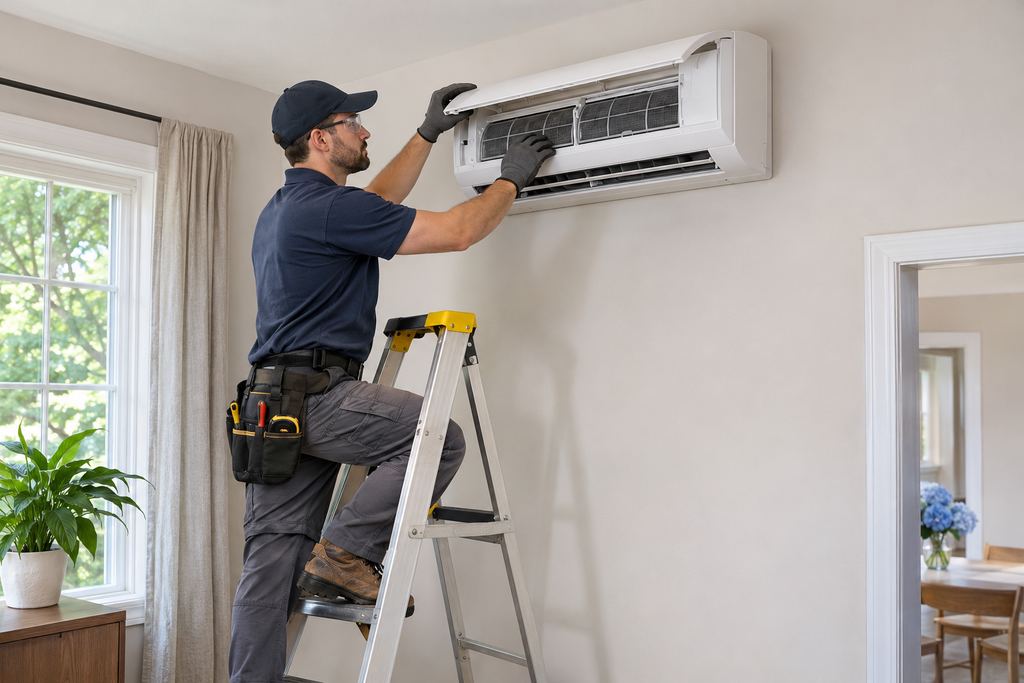
Where the water shows up and what it suggests
| What you see | Likely cause |
|---|---|
| Steady drip from the bottom of a wall unit | Clogged drain pan or drain line, often from dust and slime |
| Water after the unit has been off a while, or ice on the coil | Frozen coil from dirty filters or low refrigerant, now melting |
| Water running down the wall below the unit | Drain hose kinked, crushed, disconnected or sloped uphill |
| Dripping from one side of the unit only | Unit not level, so water pools at the wrong end of the pan |
| Water from a ceiling cassette | Failed condensate pump or a clogged pump inlet |
| Water under the outdoor unit | Usually normal: condensation, or melt during heating defrost |
What to do first
- Turn it off
Stop the unit with the remote and protect the floor and anything under it.
- Check for ice
Lift the front panel and look at the coil. If there is ice, leave the unit on fan mode until it melts.
- Clean the filters
Slide out the mesh filters, rinse them, and let them dry completely before reinstalling.
- Follow the drain hose outside
Find where the hose exits the wall. Make sure the end is not buried in mulch, blocked by insects or sitting in a puddle, and that it slopes downward.
- Try a short restart
Run cooling for an hour and look for drips. If water returns, book a service call.
Indoor units are usually wired close to where water drips. If water is running near an outlet, a light fixture or the unit's wiring, turn the mini split off at its breaker and do not touch wet electrical parts. Call a professional for anything inside the unit's housing.
What you can handle and what you cannot
Safe checks you can do
No tools beyond a flashlight. Turn the system off at the thermostat before opening any filter or access door.
- Rinsing and drying the filters.
- Thawing a frozen coil on fan mode.
- Clearing the outside end of the drain hose.
- Flushing the drain only if your manual describes how.
Leave these to a licensed technician
These involve high voltage, refrigerant or sealed components. Refrigerant work requires EPA Section 608 certification.
- Removing the front cover and drain pan to clean out blockages.
- Re-routing or replacing a drain hose with proper slope.
- Testing and replacing a condensate pump.
- Re-leveling a wall bracket.
- Checking refrigerant charge and repairing leaks under EPA Section 608.
How unit type changes the diagnosis
High wall units, the most common type, drain by gravity through a hose that runs out with the refrigerant lines, so slope and blockages are the main suspects. Ceiling cassettes and some ducted mini-split air handlers lift water with a condensate pump, which can fail or clog. Floor consoles sit low and often need a pump when the outside wall is below grade. Knowing which type you have helps the technician bring the right parts. Our ductless mini-split guide explains the configurations.
Habits that keep the drain clear
- Filters on schedule: Clean them as often as your manual says, and more often in peak season.
- Professional cleaning: A mini-split cleaning clears the coil, blower wheel and drain pan, where slime builds up.
- Hose exit kept clear: Keep plants, mulch and debris away from the end of the drain hose.
- Yearly check: A maintenance visit can catch a sagging hose or weak pump early.
How a service request works
- Tell us what you need
Enter your ZIP code and choose the service. Add a few details about the problem or project.
- Your request is routed
It goes to an independent HVAC contractor or partner network that serves your area and handles that type of work.
- A contractor contacts you
The contractor reaches out to confirm details and schedule a visit.
- You decide
The contractor diagnoses the system and quotes the work. Pricing, scheduling and warranty terms are between you and them.
Frequently asked questions
Why is my split AC dripping water inside the room?
The water is condensate that should leave through the drain hose. Inside drips usually mean the drain pan or hose is clogged or tilted, or the coil froze and is melting. Clean the filters and check the hose, then call if it continues.
Where do mini splits usually leak?
Water leaks usually start at the drain pan or the drain hose connection behind the indoor unit. Refrigerant leaks, which are a different problem, most often occur at the flare connections where the copper lines join each unit.
Can you put leak sealant in a mini split?
Many technicians and equipment makers advise against refrigerant sealants because they can clog small passages and valves. A proper repair finds and fixes the leak, then the system is evacuated and recharged by a certified technician.
How much does it cost to fix a mini-split leak?
A drain clog is usually a smaller job than a pump replacement or a refrigerant leak repair. Costs depend on the unit, access and the cause. See mini-split repair cost and ask for a written quote.
How do I clean a mini split drain line?
Only go as far as your owner's manual allows. Some manuals describe clearing the outside end of the hose or pouring a small amount of water into the drain pan to test flow. Reaching the pan itself usually means removing the front cover, and a clog deep in the hose may need a wet vacuum or a pump flush, which is a routine technician job.
Why did my mini split start leaking right after installation?
On a new install, the usual suspects are a drain hose that was not given enough downward slope, a kink where it passes through the wall, or a mounting bracket that is slightly out of level. These are workmanship issues, so contact the installer first and ask whether the work is covered.
Can I keep running a leaking mini split?
Not for long. Water can damage drywall and flooring and encourage mold. If the cause is a frozen coil, running cooling can also harm the compressor.
- Ductless heating and cooling (ENERGY STAR)
- Section 608 Technician Certification (U.S. EPA)
- Mold (U.S. EPA)
Last updated November 24, 2026. Editorial policy · Report an error
Related guides and services
Request help with a leaking mini split
Describe where the water appears and your unit type. An independent local contractor can clear the drain or find the cause.
AC Service Near Me is an independent referral service. Work is performed by independent, locally owned contractors. How we earn money
Tell us where the water appears and what type of indoor unit you have.
Please keep this page open.
- Your request is matched with an independent contractor or partner network that serves your ZIP code.
- The contractor contacts you to confirm details and schedule a visit.
- They diagnose the system and quote the work. You decide whether to go ahead.
Read how requests are handled.
We're still setting up the contractor network that receives online requests, so your details were not sent to anyone and were not stored. Please call to request service, or check back soon.
Call (888) 555-0199