AC Not Cooling: Common Causes and Repair Options
An AC not cooling is the most common reason people call for service, and the cause ranges from a dirty filter to a failing compressor. A few minutes of checks will tell you which side of that range you are on.
If your air conditioner is running but not cooling, check the filter, the thermostat settings and the outdoor unit first. A clogged filter, a dirty condenser coil or blocked airflow explains many cases. If the outdoor fan is not spinning, the copper line is iced, or the air is only slightly cool after those checks, the likely causes are a failed capacitor, a refrigerant leak or a compressor problem, and a technician needs to test the system. On extremely hot days, a system can also be working correctly and simply be unable to keep up.
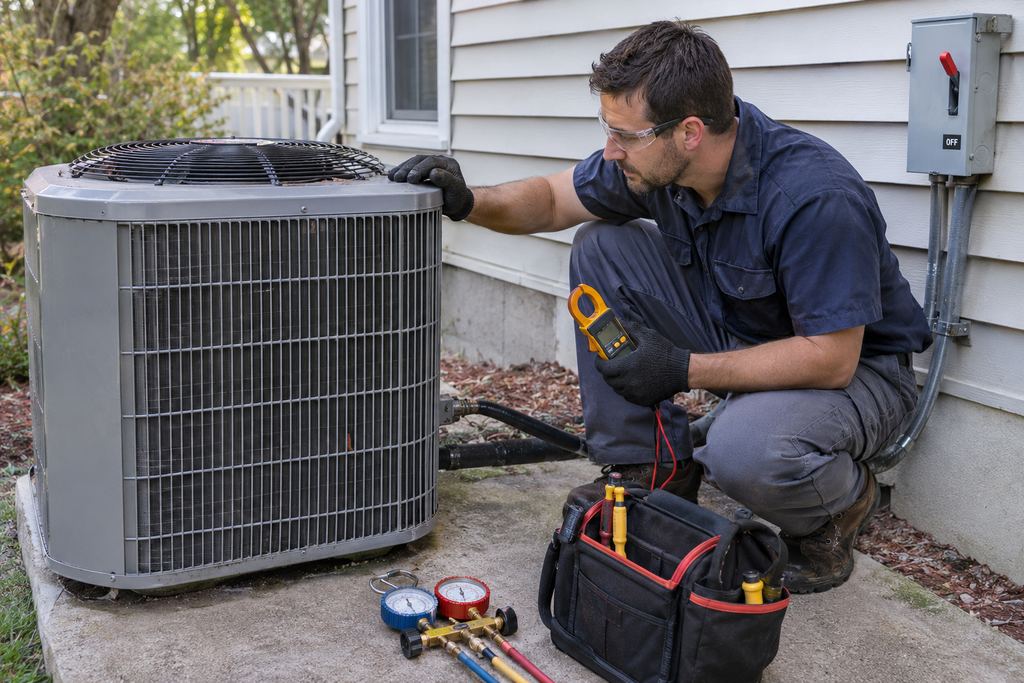
Which kind of not cooling do you have?
- No cool air at all: Air from the vents is room temperature. Usually the outdoor unit is not running. Read AC blowing warm air for that case.
- Running but not cooling enough: The air is cool but the house never reaches the setpoint. Think airflow, a dirty coil, low refrigerant or sizing.
- Fan running but not cooling: The blower moves air but the compressor does not start or keeps stopping. Electrical parts are the common suspects.
- Some rooms cool, others warm: Ducts, closed vents or a second floor that needs its own zone or return.
- Cooling fades through the day: Often ice building on the coil, which then blocks airflow.
Most likely causes
Do these checks first, then call
Safe checks you can do
No tools beyond a flashlight. Turn the system off at the thermostat before opening any filter or access door.
- Confirm the thermostat is on Cool, the fan is on Auto and the setpoint is below room temperature.
- Replace the filter. If it was very dirty, give the system an hour to recover.
- Make sure supply registers are open and return grilles are unblocked.
- Check that the outdoor unit is running and its fan is turning. Clear debris and plants away from it.
- Check the AC breaker and reset it once if tripped.
- If you find ice, set the thermostat to Off and the fan to On until it melts.
Leave these to a licensed technician
These involve high voltage, refrigerant or sealed components. Refrigerant work requires EPA Section 608 certification.
- Testing capacitors, contactors and the compressor.
- Finding and repairing a refrigerant leak, then charging the system. This requires EPA Section 608 certification.
- Cleaning the condenser coil thoroughly and the evaporator coil inside the air handler.
- Measuring airflow and duct leakage.
- Checking whether the system is sized correctly for the house.
How a split system moves heat from inside to outside
When the system is working but cannot keep up
Contractors size air conditioners for a design temperature, a typical hot day for your area rather than the most extreme one. During a heat wave, a correctly sized system may run nonstop and still leave the house a few degrees above the setpoint. That is not a fault, though a dirty coil or low charge makes it worse.
The opposite problem is common, too. An oversized unit cools the air near the thermostat quickly, shuts off, and leaves the house humid and unevenly cooled. A unit that is too small runs constantly. A proper load calculation, usually ACCA Manual J, is the way to know. If the system has never kept up since it was installed, sizing or ductwork is more likely than a broken part.
How the symptom differs by system type
| System | What to look at first |
|---|---|
| Central split AC | Outdoor fan and compressor running, filter, condenser coil, ice on the line set |
| Heat pump in cooling mode | The same checks, plus thermostat settings for heat pump mode; a stuck reversing valve can blow warm air |
| Ductless mini-split | Filters on the indoor head, error codes, outdoor unit clearance; see mini-split not cooling |
| Packaged unit on a slab or roof | Filter location, which may be in the unit itself, and condenser coil cleanliness |
Repair or replace?
Repairs to a newer system are usually worth it. Older systems with several failing parts are a different conversation.
Systems built for R-22 face expensive recharges since production ended in 2020.
A failed compressor is the repair most likely to make replacement worth pricing.
See AC diagnostic cost for how service-call fees work, and AC repair cost for common part repairs.
Frequently asked questions
Should I turn off my AC if it is not cooling?
If the outdoor unit hums without its fan turning, the breaker trips, or you see ice, yes. Running it that way can damage the compressor or flood the drain pan. If it is just slow on a very hot day, you can leave it running while you check the filter and outdoor unit.
What can I do if my AC is not cooling?
Check thermostat settings, replace the filter, clear the outdoor unit, open vents, and reset a tripped breaker once. If none of that helps, request a technician to test the electrical parts and refrigerant charge.
How do I know if my AC is low on freon?
Common signs are ice on the copper line or indoor coil, air that is cool but not cold, long run times and sometimes hissing. Freon is a brand name usually meaning R-22; most newer systems use R-410A or newer refrigerants. Only a certified technician can measure the charge and find the leak.
How long should I wait after resetting the thermostat?
Give it at least five minutes. Many systems delay the compressor restart by about three to five minutes after it stops, so the outdoor unit may stay quiet at first.
Why is my AC running but not cooling the upstairs?
Heat rises, attic ducts gain heat, and many homes have only one return. A technician can check whether the upstairs ducts leak or are undersized. Common fixes include duct sealing, an added return, or zoning.
Can a dirty filter really stop an AC from cooling?
Yes. A packed filter can cut airflow enough to freeze the coil, and then almost no cooling gets through.
- Heating and cooling maintenance checklist (ENERGY STAR)
- Section 608 Technician Certification (U.S. EPA)
- ENERGY STAR (U.S. EPA ENERGY STAR)
- Heat and Health (Centers for Disease Control and Prevention)
Last updated November 24, 2026. Editorial policy · Report an error
Related guides and services
Request AC repair
Share what you have already checked. A local contractor can follow up to schedule a diagnosis. Availability varies by ZIP code and season.
AC Service Near Me is an independent referral service. Work is performed by independent, locally owned contractors. How we earn money
Tell us the thermostat setting, the indoor temperature and what the outdoor unit is doing. A local independent contractor can follow up.
Please keep this page open.
- Your request is matched with an independent contractor or partner network that serves your ZIP code.
- The contractor contacts you to confirm details and schedule a visit.
- They diagnose the system and quote the work. You decide whether to go ahead.
Read how requests are handled.
We're still setting up the contractor network that receives online requests, so your details were not sent to anyone and were not stored. Please call to request service, or check back soon.
Call (888) 555-0199