AC Not Turning On: What to Check, in Order
An air conditioner that will not turn on has lost power, lost its signal to start, or been stopped by a safety switch. Checking those in order from the thermostat outward finds the simple causes quickly and tells you when to stop and call a technician.
Start at the thermostat: is it on Cool, below room temperature, and is the display working? Then check the AC breaker and the outdoor disconnect, the furnace or air handler power switch, and whether a float switch has shut the system off because of a clogged drain. If the indoor unit runs but the outside AC unit is not turning on, the likely causes are a failed capacitor or contactor, a blown fuse in the disconnect, or a broken low-voltage wire, all of which a technician should test.
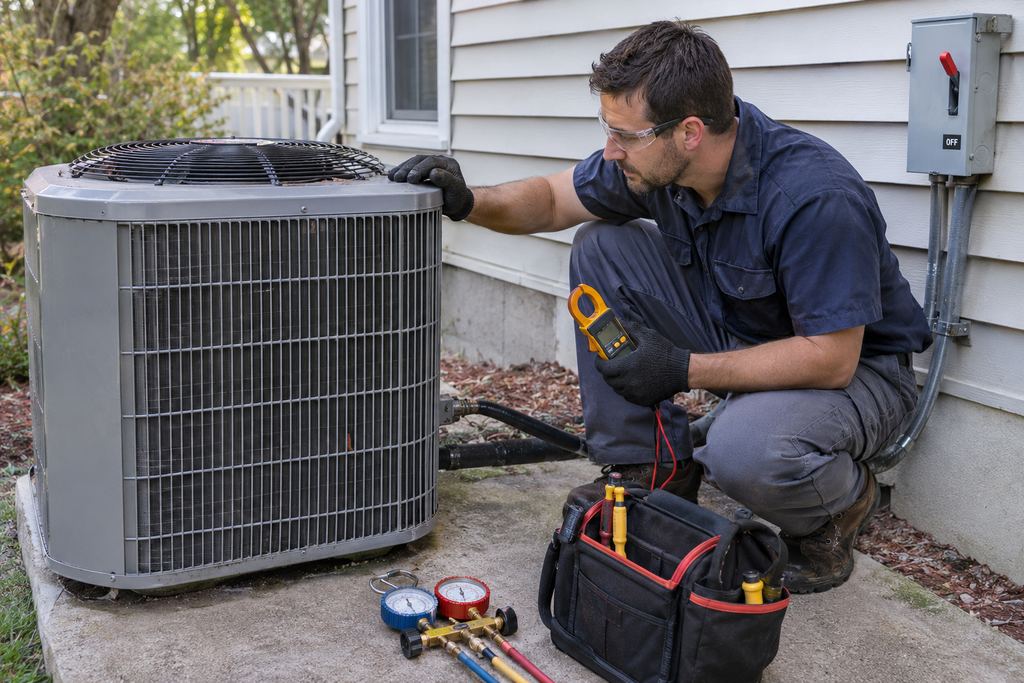
Work from the thermostat outward
- Thermostat display and mode
A blank screen often means dead batteries or a tripped furnace switch. Set the mode to Cool and the temperature at least three degrees below the room reading.
- Wait out the restart delay
Many systems will not restart the compressor for about three to five minutes after a stop. Give it five minutes before moving on.
- Indoor unit power switch
Furnaces and air handlers have a light-switch-style service switch near them, often mistaken for a light switch and turned off.
- Breakers
The AC usually has a double breaker for the outdoor unit and a separate one for the furnace or air handler. Reset a tripped one once.
- Outdoor disconnect
Look at the box on the wall near the condenser. If it has an outside lever, confirm it is set to On. If it uses a pull-out block behind a cover and you are unsure, leave it for the technician.
- Drain pan and float switch
Water in the pan or a full condensate pump can trigger a switch that keeps the AC off. Clear the water and the system may restart.
If a breaker trips a second time, leave it off. If you smell burning or hear buzzing from the panel, disconnect or outdoor unit, turn the system off at the thermostat and call a technician. Never open the electrical panel cover or the outdoor unit's service panel. For smoke or fire, leave and call 911.
Likely causes when nothing turns on
When neither the indoor blower nor the outdoor unit responds, the problem is usually upstream of both.
- Dead thermostat batteries or a thermostat that lost power.
- A tripped breaker or the furnace service switch turned off.
- A blown low-voltage fuse on the control board, often caused by a shorted wire.
- A failed transformer that powers the thermostat circuit.
- A float switch that has cut power because the drain is clogged.
A thermostat that clicks but does nothing else points toward wiring or the control board. A thermostat repair may be the fix if the thermostat itself has failed.
When the outside AC unit is not turning on
If air moves from the vents but the outdoor condenser is silent, the indoor side is getting power and the problem is outside.
- A failed capacitor, which the compressor and fan need to start. A hum with no movement is the classic sign. See capacitor replacement.
- A contactor that is burned, stuck open, or blocked by insects. See contactor replacement.
- A blown fuse in the outdoor disconnect, which is a job for a technician. See AC fuse replacement.
- A cut or chewed thermostat wire running to the condenser, common after landscaping work.
- A tripped high- or low-pressure switch from a dirty coil or refrigerant problem.
A breaker that trips every time the unit tries to start is a separate problem, usually a shorted compressor, fan motor or wire, and it needs a technician.
Where your checks stop and a technician starts
Safe checks you can do
No tools beyond a flashlight. Turn the system off at the thermostat before opening any filter or access door.
- Replace thermostat batteries and confirm settings.
- Turn on the furnace or air handler service switch.
- Reset a tripped breaker one time.
- Confirm an outside lever on the outdoor disconnect is set to On.
- Empty water from the drain pan or condensate pump reservoir.
- Clear debris from around the outdoor unit.
Leave these to a licensed technician
These involve high voltage, refrigerant or sealed components. Refrigerant work requires EPA Section 608 certification.
- Testing and replacing capacitors, contactors and fuses.
- Checking the transformer and control board fuse.
- Tracing and repairing damaged low-voltage wiring.
- Diagnosing pressure switch trips and refrigerant problems.
- Testing a compressor that will not start.
How a service request works
- Tell us what you need
Enter your ZIP code and choose the service. Add a few details about the problem or project.
- Your request is routed
It goes to an independent HVAC contractor or partner network that serves your area and handles that type of work.
- A contractor contacts you
The contractor reaches out to confirm details and schedule a visit.
- You decide
The contractor diagnoses the system and quotes the work. Pricing, scheduling and warranty terms are between you and them.
What the visit and repair may cost
Most no-start problems are found during the diagnostic part of the visit, and many are small parts. The AC diagnostic cost guide explains how service fees usually work, including whether they are credited toward the repair. Ask for the failed part and the price in writing before approving work.
Frequently asked questions
Does the 3 minute rule explain an AC that will not start?
After the compressor stops, many thermostats and outdoor controls hold it off for about three to five minutes to protect it. If you just changed settings or reset a breaker, wait that long before concluding the AC will not turn on.
Can a bad thermostat stop the AC from turning on?
Yes. A dead display, a failed relay inside the thermostat, or loose wiring means the system never gets the call to cool. Replacing batteries is the first test; if that does not help, a technician can check the wiring.
How long should an AC unit last?
Many central systems last somewhere around 10 to 15 years, depending on climate, maintenance and installation quality. An older system that will not turn on may still have a simple fix, so get a diagnosis before deciding to replace it.
How much does it cost to fix an AC that will not turn on?
It depends on what failed and local labor rates. Capacitors, contactors and fuses are usually smaller repairs; a compressor is not. See the AC repair cost guide and ask for a written quote.
Why did my AC stop turning on after a storm or outage?
Surges can trip breakers, blow fuses or damage a control board. Our guide to an AC not working after a power outage covers the reset steps.
- Heating and cooling maintenance checklist (ENERGY STAR)
- Electrical Safety Foundation International (ESFI)
- ENERGY STAR (U.S. EPA ENERGY STAR)
Last updated November 24, 2026. Editorial policy · Report an error
Related guides and services
Request help with an AC that will not start
Tell us what you checked and what happens when you try to turn it on. A local contractor can follow up. Availability varies by ZIP code and season.
AC Service Near Me is an independent referral service. Work is performed by independent, locally owned contractors. How we earn money
Tell us whether anything runs at all, inside or out. A local contractor can follow up to arrange a diagnosis.
Please keep this page open.
- Your request is matched with an independent contractor or partner network that serves your ZIP code.
- The contractor contacts you to confirm details and schedule a visit.
- They diagnose the system and quote the work. You decide whether to go ahead.
Read how requests are handled.
We're still setting up the contractor network that receives online requests, so your details were not sent to anyone and were not stored. Please call to request service, or check back soon.
Call (888) 555-0199