AC Not Working After a Power Outage: How to Reset It
When the lights come back but the air conditioner does not, the system is often just waiting out a delay, sitting on a tripped breaker, or showing a thermostat that lost its settings. Sometimes the surge when power returned damaged a part.
Turn the thermostat to Off, check the AC and furnace breakers, and reset any that tripped once. Wait about five minutes, then set the thermostat back to Cool. Smart thermostats may need their Wi-Fi or schedule restored. If the outdoor unit still does not run, or it hums without starting, the outage may have damaged a capacitor, contactor, fuse or control board, and a technician should test it.
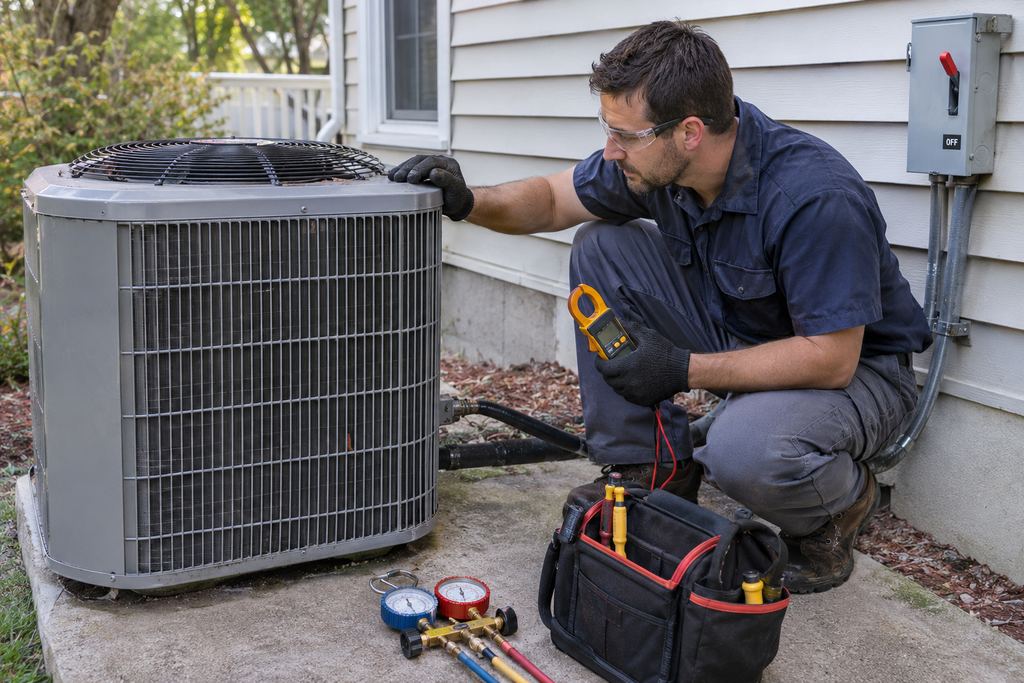
Reset sequence once power is back
- Set the thermostat to Off
This keeps the system from trying to start in the middle of power flickers, which is hard on the compressor.
- Wait until power is stable
Utilities often restore power in stages. If lights are still flickering, wait.
- Check the breakers
Look for a tripped breaker for the outdoor unit and another for the furnace or air handler. A tripped breaker sits in the middle or Off position. Push it fully off, then on, one time.
- Check the thermostat
Replace batteries if the screen is blank. Smart thermostats may need to reconnect to Wi-Fi, and some revert to default settings.
- Give it five minutes, then select Cool
Set the temperature a few degrees below the room. The compressor may not start right away because of a built-in delay.
- Watch both units
The indoor blower should start, then the outdoor fan and compressor. If the outdoor unit stays silent or only hums, stop and call a technician.
A breaker that trips again after one reset, a burning or electrical smell, buzzing from the outdoor unit, or a scorched smell at the thermostat or air handler means turn the system off and leave it off. Do not open the panel or the outdoor unit to look for damage. Smoke or flames: get out and call 911.
Why the AC may not come back
What you can reset and what needs a professional
Safe checks you can do
No tools beyond a flashlight. Turn the system off at the thermostat before opening any filter or access door.
- Turn the thermostat off during the outage and while power is unstable.
- Reset a tripped AC or furnace breaker once.
- Replace thermostat batteries and restore Wi-Fi and schedule settings.
- Check that the furnace or air handler service switch is on.
- Write down any error code on a smart thermostat or mini-split head.
Leave these to a licensed technician
These involve high voltage, refrigerant or sealed components. Refrigerant work requires EPA Section 608 certification.
- Testing the capacitor, contactor and control board.
- Replacing fuses inside the disconnect or on the board.
- Diagnosing a compressor that hums or trips the breaker.
- Clearing a control lockout and checking why it happened.
- Recommending surge protection for the HVAC circuit, with an electrician if needed.
How different systems behave after an outage
| Equipment | What to expect | What to check |
|---|---|---|
| Central AC with a basic thermostat | Restarts on its own after a short delay | Breakers and thermostat batteries |
| Smart or Wi-Fi thermostat | May reboot to default settings or lose its network | Mode, setpoint, schedule and app connection |
| Heat pump | Restarts like central AC after its delay | Breakers, thermostat set for heat pump |
| Ductless mini-split | Many models have auto-restart, others need the remote | Remote batteries, mode, error code on the indoor head |
| Window or portable unit | Often comes back off and needs its power button pressed | Outlet, any GFCI or reset button on the plug |
Reducing damage from the next outage
Turning the thermostat off when the power goes out, and leaving it off until the power is steady, is the simplest protection. Ask an electrician about whole-home surge protection or a surge device for the HVAC circuit, especially if outages are frequent where you live. A regular maintenance visit that tests the capacitor and checks connections can also catch weak parts before a surge finishes them off. If the AC still refuses to start after these steps, our guide to an AC not turning on goes further, and the AC diagnostic cost page explains service-call fees.
Frequently asked questions
Does an AC work when the power is out?
No. Central air, heat pumps and mini-splits all need grid power or a generator large enough to run them. Keep blinds closed and move to the coolest room. If the heat becomes dangerous, go to a cooling center or another cool place.
Why won't the AC start right after the power comes back?
Many systems hold the compressor off for three to five minutes after power returns or after a stop. Wait at least that long before deciding something is wrong.
Why does my AC stop working and then start again?
That pattern can mean a safety control or overload is tripping and resetting, or a weak part is struggling to start. After an outage, a surge-damaged capacitor is a common reason. Have it tested.
Should I turn my AC off if it is not cooling after an outage?
Yes, if the outdoor unit is not running or is humming. Running the blower with a stalled compressor does not cool the house, and repeated start attempts can cause more damage.
Will home insurance cover AC damage from a power surge?
Some policies cover surge damage and some do not. Ask the technician to note the cause in writing and check your policy before filing a claim.
- Power Outages (Ready.gov (FEMA))
- Electrical Safety Foundation International (ESFI)
- Heat and Health (Centers for Disease Control and Prevention)
Last updated November 24, 2026. Editorial policy · Report an error
Related guides and services
Request help after an outage
Tell us what you reset and what the system does now. A local contractor can follow up to arrange a visit. Availability varies by ZIP code and season.
AC Service Near Me is an independent referral service. Work is performed by independent, locally owned contractors. How we earn money
Tell us what happened when the power came back and what the AC does now. A local contractor can follow up.
Please keep this page open.
- Your request is matched with an independent contractor or partner network that serves your ZIP code.
- The contractor contacts you to confirm details and schedule a visit.
- They diagnose the system and quote the work. You decide whether to go ahead.
Read how requests are handled.
We're still setting up the contractor network that receives online requests, so your details were not sent to anyone and were not stored. Please call to request service, or check back soon.
Call (888) 555-0199