Rooftop Air Conditioner Maintenance
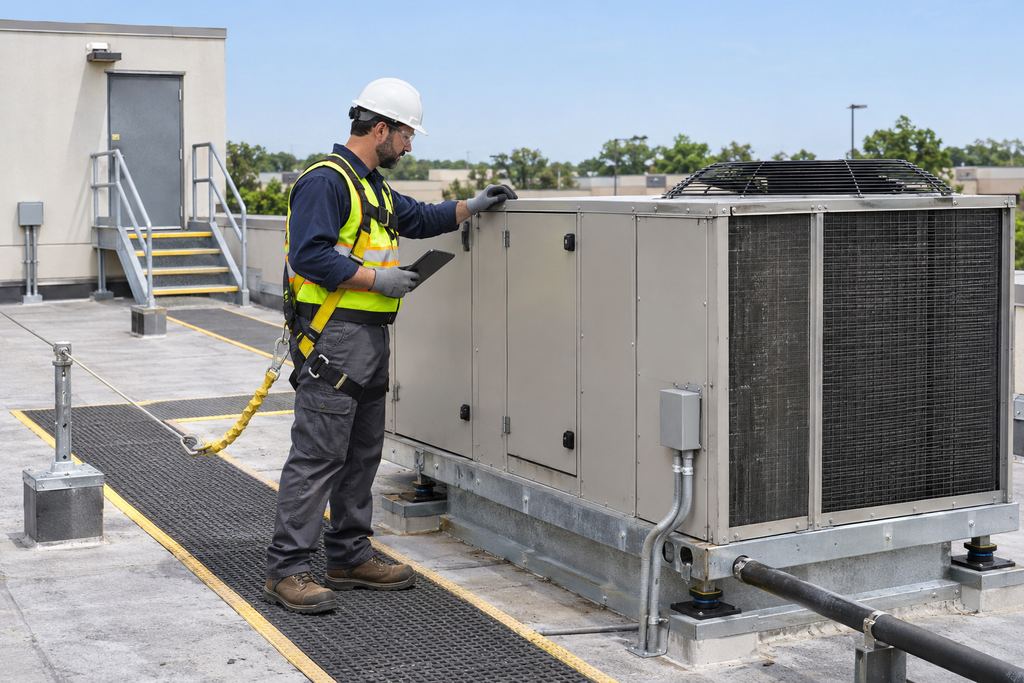
Rooftop air conditioner maintenance covers filters, belts, coils, condensate drains, economizer dampers, electrical parts and, on gas units, the heat section. Most commercial buildings schedule it at least twice a year, before cooling and heating seasons, with filter changes more often. The work happens on a roof, so it belongs with a trained commercial HVAC technician using proper fall protection.
- Spring and fall service plans
- Single units or multi-site portfolios
- Written reports per unit
List the number of units, approximate tonnage and when they were last serviced.
Please keep this page open.
- Your request is matched with an independent contractor or partner network that serves your ZIP code.
- The contractor contacts you to confirm details and schedule a visit.
- They diagnose the system and quote the work. You decide whether to go ahead.
Read how requests are handled.
We're still setting up the contractor network that receives online requests, so your details were not sent to anyone and were not stored. Please call to request service, or check back soon.
Call (888) 555-0199Typical rooftop unit maintenance tasks
| Task | What the technician does | Usual frequency |
|---|---|---|
| Filters | Replace and check the rack for bypass gaps | Every 1 to 3 months, depending on use |
| Belts and pulleys | Check tension, wear and alignment; replace cracked belts | Each visit |
| Condenser coil | Clean debris and dirt; straighten fins | At least yearly, before cooling season |
| Evaporator coil and drain pan | Inspect, clean, clear the drain and trap | Each visit |
| Economizer | Test damper movement, linkage and sensors | Each visit |
| Electrical | Inspect contactors, wiring, disconnect; measure motor amps | Each visit |
| Refrigerant circuit | Compare operating pressures and temperatures with specs | Cooling season visit |
| Gas heat section | Inspect burners, heat exchanger, flue and safeties | Before heating season |
| Cabinet and curb | Check panels, gaskets, roof curb seal and rust | Each visit |
Why rooftop units need a plan
Rooftop units sit in full sun, wind and weather, and nobody sees them day to day. A loose belt, a clogged drain or an economizer stuck open can run for months before anyone notices higher bills or a warm store. Restaurants and sites near trees or highways clog filters and coils faster than offices. The rooftop AC unit guide explains the main sections of the cabinet.
The industry reference for commercial maintenance is ANSI/ASHRAE/ACCA Standard 180, which lists inspection tasks and intervals by component. A contractor who follows it, or a similar written checklist, should leave a report per unit noting what was found and what was replaced.
Signs a unit needs attention before the next visit
- Warm spaces or long run times: Dirty coils, a failing compressor or low airflow.
- Water stains on ceiling tiles: A clogged drain pan or a failing curb seal.
- Squealing or slapping: A worn or loose belt.
- High humidity indoors: An economizer stuck open, or a unit that cycles too short.
- Gas smell or burning smell: Shut the unit down and call for service right away. If you smell gas inside, leave the building and call the gas utility or 911 from outside.
Facility staff versus technician
Safe checks you can do
No tools beyond a flashlight. Turn the system off at the thermostat before opening any filter or access door.
- Keep a log of units, filter sizes and service dates
- Report ceiling leaks, odors and comfort complaints by area
- Keep the roof access path and area around units clear
- Change filters only if trained and the roof access is safe and approved
Leave these to a licensed technician
These involve high voltage, refrigerant or sealed components. Refrigerant work requires EPA Section 608 certification.
- Coil cleaning and drain work on the roof
- Electrical testing and part replacement
- Refrigerant checks and repairs (EPA Section 608)
- Gas heat section inspection and combustion checks
- Economizer and controls calibration
Choosing a service agreement
Ask what each visit includes, whether filters and belts are part of the price, how the contractor reports findings, and how repair approvals work. Multi-site owners should ask whether reports can be shared in one format across locations. If a unit fails between visits, commercial AC repair covers diagnostics, and units near the end of their life are covered under rooftop AC installation.
How a service request works
AC Service Near Me is a referral service. We don't send our own technicians. We connect you with independent local contractors.
- Tell us what you need
Enter your ZIP code and choose the service. Add a few details about the problem or project.
- Your request is routed
It goes to an independent HVAC contractor or partner network that serves your area and handles that type of work.
- A contractor contacts you
The contractor reaches out to confirm details and schedule a visit.
- You decide
The contractor diagnoses the system and quotes the work. Pricing, scheduling and warranty terms are between you and them.
Frequently asked questions
How often should a rooftop AC unit be serviced?
At least twice a year for most buildings, once before cooling season and once before heating season, with filters changed every one to three months. Kitchens and dusty sites may need more frequent visits.
How do you maintain an outdoor or rooftop AC unit?
Keep the coil clean, the drain clear, belts tight, filters fresh and electrical connections sound. On a roof this should be done by a technician who has fall protection and roof access approval.
What does an economizer do?
It opens dampers to bring in cool outdoor air when conditions allow, reducing compressor run time. A stuck or miscalibrated economizer can waste energy or let humid air in, so it is checked at every visit.
Does rooftop maintenance lower energy use?
Clean coils, correct belt tension and a working economizer all reduce how hard the unit works. ENERGY STAR lists regular maintenance as a basic step for efficient cooling.
What is the 3 minute rule, and does it matter for rooftop units?
It refers to waiting a few minutes before restarting a compressor so pressures equalize. Rooftop unit controls typically build in a delay, so staff should not cycle units on and off repeatedly from the thermostat.
- Maintenance Checklist (ENERGY STAR)
- Air Conditioning Contractors of America (ACCA)
- Section 608 of the Clean Air Act (U.S. EPA)
Last updated November 24, 2026. Editorial policy · Report an error
Related guides and services
Set up rooftop unit maintenance
Share the unit count and service history. An independent commercial HVAC contractor can propose a visit schedule and scope.
AC Service Near Me is an independent referral service. Work is performed by independent, locally owned contractors. How we earn money
List the number of units, approximate tonnage and when they were last serviced.
Please keep this page open.
- Your request is matched with an independent contractor or partner network that serves your ZIP code.
- The contractor contacts you to confirm details and schedule a visit.
- They diagnose the system and quote the work. You decide whether to go ahead.
Read how requests are handled.
We're still setting up the contractor network that receives online requests, so your details were not sent to anyone and were not stored. Please call to request service, or check back soon.
Call (888) 555-0199