Rooftop AC Units for Buildings and Homes
A rooftop AC unit, often called an RTU, is a packaged air conditioner that sits on the roof and sends cooled air down into the building through ducts. It is the standard setup on strip malls, restaurants, warehouses and offices, and it shows up on flat-roof homes in parts of the Southwest.
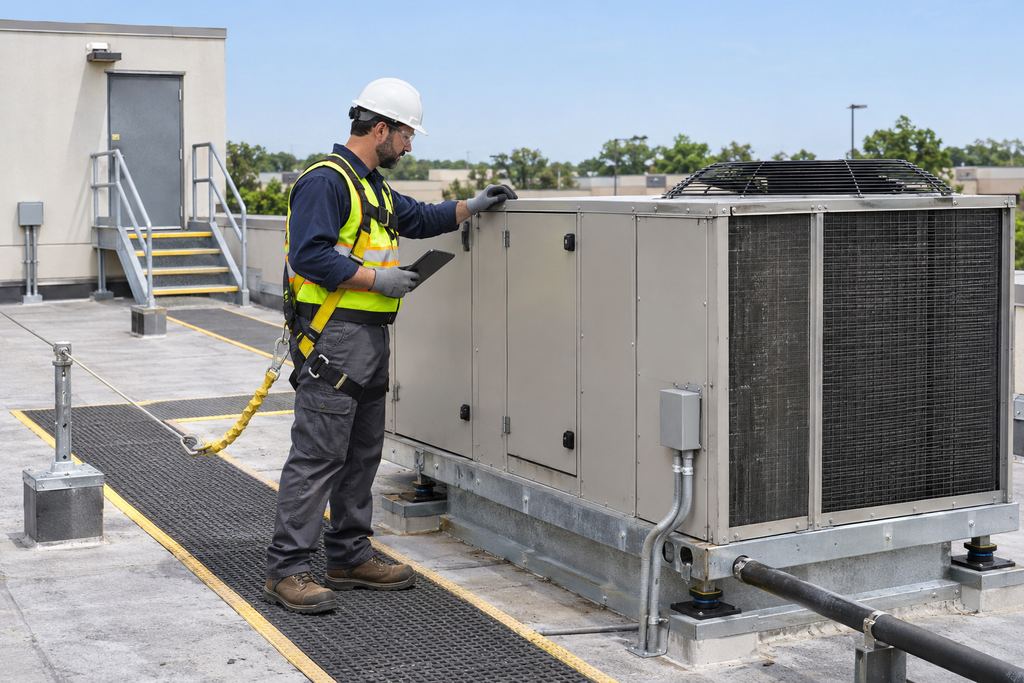
A rooftop unit holds the compressor, both coils, the blower and often a gas or electric heat section in one weatherproof cabinet. It mounts on a roof curb over openings for supply and return ducts. Size it with a load calculation, not by copying the old tonnage. Because the unit sits on a roof, access, fall protection and crane lifts affect every installation and many repairs.
What sits inside a rooftop unit
An RTU is a packaged air conditioner built to live outdoors. The condenser section with its fans and compressor rejects heat to the air on the roof. The evaporator coil and blower sit in the air handling section, connected straight to the ducts below through the curb. Many commercial units add a gas furnace section or electric heat, and an economizer: a set of dampers that brings in cool outdoor air instead of running the compressor when the weather allows.
Units range from a few tons on a small shop to very large machines on big-box stores. A building may have one unit or a dozen, each serving a zone, which means a single failure usually leaves part of the building comfortable.
Common rooftop configurations
How rooftop sizing is done
- Run a load calculation
Contractors use ACCA Manual N for commercial spaces and Manual J for homes. Inputs include insulation, glass, occupancy, lighting, equipment and required ventilation air.
- Check the existing unit, not just its size
The old unit may have been oversized, or the space may have changed. A restaurant that added fryers or an office that became a gym needs a fresh look.
- Confirm the curb
A unit with the same footprint can drop onto the existing curb. A different footprint needs an adapter curb or a new curb, plus roofing work.
- Plan structure and lifting
Heavier units may need a structural check of the roof. Most installs use a crane, which needs permits for street use in many cities. Rooftop AC installation walks through the job.
Why rooftop units are common on homes in Arizona and the Southwest
Many homes in the desert Southwest are built on slabs with low-slope roofs and no basement. Putting a packaged unit on the roof keeps the yard clear, shortens duct runs into the attic and follows the older habit of roof-mounted evaporative coolers. The cost is harsh sun exposure, harder service access and roof penetrations that need careful flashing. Homeowners who replace one often weigh a ground-mounted split system instead, which a contractor can price both ways.
Rooftop unit maintenance that prevents most calls
Commercial units are usually serviced on a schedule, often quarterly for filters and seasonally for coils and heat.
- Filters: Changed on a set schedule. Restaurants and dusty sites need shorter intervals.
- Belts and bearings: Older belt-drive blowers need belt tension checks and replacement.
- Condenser coil: Roof dirt, cottonwood and grease from kitchen exhaust coat coils quickly.
- Condensate drain and trap: Rooftop traps dry out or clog. A blocked drain can leak through the curb into the ceiling.
- Economizer: Stuck dampers waste energy or let in too much hot air. Test the actuator and controls.
- Curb and panels: Check seals and access panels so rain and wind stay out. The rooftop AC maintenance page lists what a full visit covers.
Building staff checks and contractor work
Safe checks you can do
No tools beyond a flashlight. Turn the system off at the thermostat before opening any filter or access door.
- Confirm the thermostat or building controls are calling for cooling
- Check that the unit's breaker in the building has not tripped, and reset it once
- Report water stains below the curb
- Keep a log of unit numbers, tonnage and model plates
Leave these to a licensed technician
These involve high voltage, refrigerant or sealed components. Refrigerant work requires EPA Section 608 certification.
- Any roof access without proper fall protection
- Electrical, refrigerant and compressor work (refrigerant handling requires EPA Section 608 certification)
- Gas heat sections and flue problems
- Curb, crane and structural work for replacement
The three-minute rule and short cycling
After a compressor stops, the refrigerant pressures need a few minutes to even out before it restarts. That is the three-minute rule. Most modern controls build in an anti-short-cycle delay. If a unit starts, stops and starts again in a few minutes, the cause might be an oversized unit, a bad thermostat location or a failing control, and it shortens compressor life. See AC short cycling for causes.
Frequently asked questions
Does a split AC have an outdoor unit?
Yes. A split system has an outdoor condenser and an indoor coil and blower, joined by refrigerant lines. A rooftop unit puts both halves in one cabinet.
What is the $5,000 rule for rooftop units?
It is a quick test: unit age times repair cost. A total over $5,000 suggests replacement deserves a look. For rooftop units also factor crane costs, curb condition and whether the replacement uses a newer refrigerant.
How long do rooftop units last?
Life depends heavily on climate, salt air, maintenance and run hours. Ask the contractor to inspect the heat exchanger, coils and compressor and give a written opinion before you decide on a major repair.
Can a homeowner service a rooftop unit?
Changing filters through an indoor return grille is fine. Climbing onto the roof to open the cabinet is not a homeowner task because of fall risk and live electrical parts.
- ACCA technical manuals (Manual J, Manual N) (Air Conditioning Contractors of America)
- Section 608 Technician Certification (U.S. EPA)
- ENERGY STAR (ENERGY STAR)
Last updated November 24, 2026. Editorial policy · Report an error
Related guides and services
Request rooftop unit service
List the units, the building and the symptom. We route the request to an independent local commercial contractor where one serves your area.
AC Service Near Me is an independent referral service. Work is performed by independent, locally owned contractors. How we earn money
Tell us the building type, number of units and what is happening. Availability varies by ZIP code.
Please keep this page open.
- Your request is matched with an independent contractor or partner network that serves your ZIP code.
- The contractor contacts you to confirm details and schedule a visit.
- They diagnose the system and quote the work. You decide whether to go ahead.
Read how requests are handled.
We're still setting up the contractor network that receives online requests, so your details were not sent to anyone and were not stored. Please call to request service, or check back soon.
Call (888) 555-0199