Ductless Mini Split Systems: What to Know Before You Buy
A ductless mini split cools, and in heat pump models heats, individual rooms without ductwork. An outdoor unit connects to one or more indoor units through a small hole in the wall, and each indoor unit has its own setpoint.
A ductless mini split is a split-system heat pump or air conditioner whose indoor units blow air straight into the room instead of into ducts. It is a strong fit for homes without ducts, additions, garages and rooms the central system cannot keep comfortable. It costs more per room than a window unit and needs a contractor for the refrigerant and electrical work, but it is quieter, more efficient and does not block a window.
How a ductless system works
The outdoor unit holds the compressor, a coil and a fan. A line set made of two insulated copper tubes, a control cable and a condensate drain runs through a hole about three inches across to the indoor unit. Inside, a fan pulls room air across the indoor coil. In cooling mode the coil absorbs heat and moisture; in heating mode on a heat pump the refrigerant flow reverses and the indoor coil releases heat.
Nearly all current mini-splits use inverter-driven compressors that speed up and slow down instead of switching fully on and off. That is the main reason they hold a steady temperature and run quietly. Our inverter air conditioner guide explains the technology.
Outdoor unit, line set and indoor head
Indoor unit styles
Every style connects to the same kind of outdoor unit. The choice is about the room.
Advantages and drawbacks
| Advantages | Drawbacks |
|---|---|
| No ductwork, so no duct leakage. DOE notes duct losses can exceed 30 percent of space-conditioning energy when ducts run through unconditioned space. | Higher cost per room than window or portable units, and often higher than extending existing ducts to one room. |
| Each room has its own temperature control. | Each indoor unit is visible on the wall or ceiling, and some owners dislike the look. |
| Quiet indoors because the compressor is outside. | Filters in every head need regular cleaning, or capacity and air quality drop. |
| Heat pump models heat as well as cool, and many cold-climate models work well below freezing. | A head cools the room it is in. Closed-off rooms without their own head stay warm. |
| Small wall opening and no window blocked. | Refrigerant and electrical work need a qualified installer, and poor installs are a common source of leaks. |
Sizing a mini-split
Indoor units are sold in fixed capacities, commonly 6,000, 9,000, 12,000, 18,000 and 24,000 BTU per hour. For a rough idea, the ENERGY STAR sizing chart for room air conditioners lists 9,000 BTU for a room of 350 to 400 square feet and 12,000 BTU for 450 to 550 square feet, with about 10 percent more for a very sunny room and 10 percent less for a heavily shaded one. That chart was written for room units, not for whole-room heat pumps that also have to heat.
For an actual purchase, ask the installer to run a room-by-room load calculation (ACCA Manual J). An oversized head short cycles and leaves the room clammy; an undersized one cannot keep up on the hottest or coldest days. If you want the system to heat, the load calculation should cover your winter design temperature too.
What installation involves
These items set the scope and the price of a quote. The mini-split installation cost guide explains how they add up.
One head on one outdoor unit, or several heads on a multi-zone outdoor unit or several single-zone units.
Distance and height between indoor and outdoor units, and whether lines run in a cover outside or through walls and attic.
A dedicated circuit and an outdoor disconnect. Older panels may need room for a new breaker.
Gravity drain to the outside where possible, or a condensate pump when the head sits below or far from a drain point.
Pressure test, vacuum and charge check. This is EPA Section 608 work.
Maintenance: owner tasks and technician tasks
Safe checks you can do
No tools beyond a flashlight. Turn the system off at the thermostat before opening any filter or access door.
- Wash the indoor filters as the manual describes, often every few weeks in heavy use
- Keep the outdoor unit clear of leaves, snow and plants
- Wipe dust from the indoor grille and louvers with the unit off
- Watch for water dripping from a head or ice on the lines and switch the unit off if you see it
Leave these to a licensed technician
These involve high voltage, refrigerant or sealed components. Refrigerant work requires EPA Section 608 certification.
- Deep cleaning the indoor coil and blower wheel
- Checking the drain pan, line and any condensate pump
- Checking refrigerant pressures and flare connections for leaks
- Cleaning the outdoor coil and testing electrical parts
Owning one: repairs and service
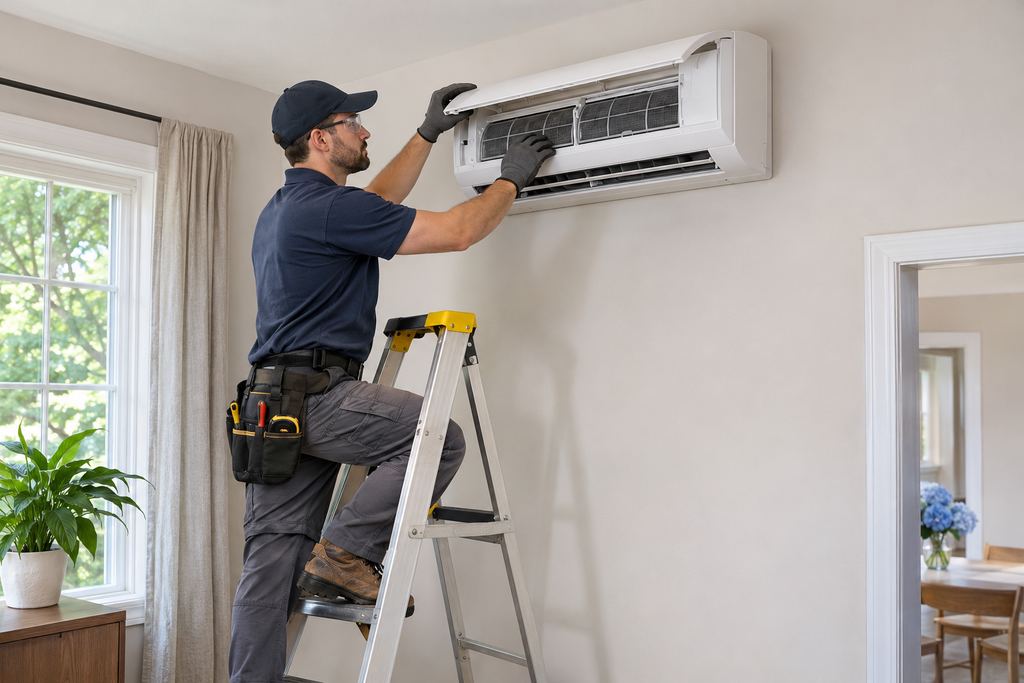
Most mini-split service calls come down to dirty filters and coils, clogged drains and small refrigerant leaks at flare joints. If a head stops cooling, start with mini split not cooling; for water on the wall, see mini split leaking water. Yearly mini-split maintenance by a technician keeps the inside of the head clean, which owners cannot reach. Ready to get quotes? The mini-split installation page explains how to request one.
Frequently asked questions
Is a ductless mini split worth it?
It usually is when the house has no ducts, when you are adding a room, or when one area never gets comfortable on the central system. It is harder to justify for a single room you cool a few weeks a year, where a window air conditioner or a portable unit costs far less.
How much does it cost to install a ductless mini split?
Price depends on the number of zones, the indoor style, line set length, electrical work and efficiency tier. A single wall head is the simplest job; a multi-room system with cassettes costs much more. Ask for an itemized written quote.
Why is my electric bill high with a mini split?
Common reasons are using it to heat in very cold weather, setpoints that change often, clogged filters or coils, heads that are too large and short cycle, or cooling rooms with the doors open to the rest of the house. A technician can check charge and airflow if the bill jumped suddenly.
What are the disadvantages of a mini split?
Higher upfront cost per room, visible indoor units, filters to clean in every head and the need for a skilled installer. Rooms without a head get little benefit.
Can I install a ductless mini split myself?
Some kits are sold with pre-charged quick-connect lines for owner installation. Standard systems need a vacuum pump, torque tools and refrigerant handling under EPA Section 608, plus electrical work that may need a permit. Check the manufacturer's warranty terms before choosing a DIY route.
- Ductless heating and cooling (ENERGY STAR)
- Room Air Conditioners (ENERGY STAR)
- Air Conditioning Contractors of America (ACCA)
- Section 608 Technician Certification (U.S. EPA)
- ENERGY STAR Rebate Finder (ENERGY STAR)
Last updated November 24, 2026. Editorial policy · Report an error
Related guides and services
Request mini-split installation
Tell us how many rooms and what kind of walls and ceilings they have. We pass the request to an independent local contractor where one serves your ZIP code.
AC Service Near Me is an independent referral service. Work is performed by independent, locally owned contractors. How we earn money
List the rooms you want to cool or heat and whether the house has ducts. Availability varies by ZIP code.
Please keep this page open.
- Your request is matched with an independent contractor or partner network that serves your ZIP code.
- The contractor contacts you to confirm details and schedule a visit.
- They diagnose the system and quote the work. You decide whether to go ahead.
Read how requests are handled.
We're still setting up the contractor network that receives online requests, so your details were not sent to anyone and were not stored. Please call to request service, or check back soon.
Call (888) 555-0199