Single-Zone Mini-Splits: One Room, One Outdoor Unit
A single zone mini split connects one outdoor unit to one indoor unit with a small refrigerant line set. It heats or cools one room or open area without ducts, and it is the simplest and usually least expensive way to add ductless comfort to a garage conversion, addition, bonus room or small apartment.
Yes, you can install a mini-split for just one room, and a single-zone system is built for exactly that. Each outdoor unit is matched to its indoor head, so capacity, controls and efficiency ratings belong to that pair. Choose single-zone when you have one problem space or want each area to run independently; choose multi-zone when several rooms must share one outdoor unit.
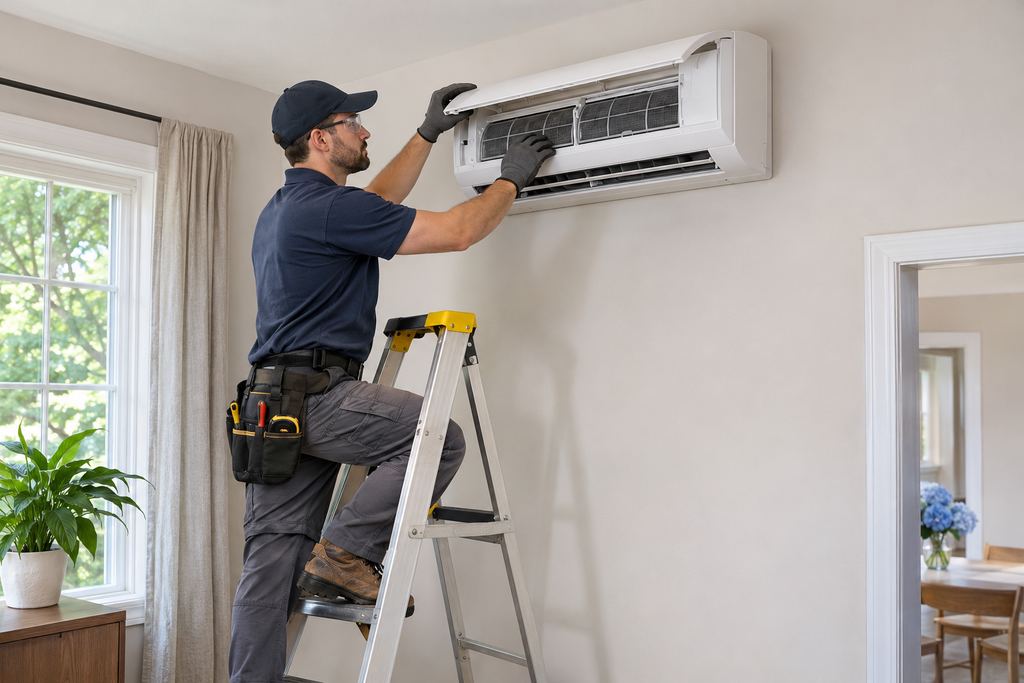
One outdoor unit, one indoor head
Single-zone vs. multi-zone at a glance
| Question | Single-zone | Multi-zone |
|---|---|---|
| Indoor units per outdoor unit | One | Two or more, up to the model's limit |
| If the outdoor unit fails | One room loses comfort | Every connected room does |
| Efficiency ratings | Rated as a matched pair | Rated as a combination; real results vary with how many heads run |
| Wall penetrations and line runs | One short run | One run per head back to the outdoor unit |
| Good fit | One room, addition, garage, sunroom | Several rooms in a house without ducts |
Are HVAC and a mini-split the same thing?
A mini-split is one kind of HVAC equipment. It works like a central heat pump, with a compressor outdoors and a coil and fan indoors, but it skips the duct system. The indoor head blows conditioned air straight into the room. Most current models use an inverter compressor that changes speed to match the load, which is why they hold temperature steadily and rate well on efficiency. ENERGY STAR describes the setup as one or more indoor heads connected to an outdoor unit, with no ductwork needed.
Indoor units come in several styles. Wall-mounted heads are the most common. Floor consoles suit rooms with sloped ceilings or low walls, and ceiling cassettes hide most of the unit above the ceiling.
How to size a single-zone system
Undersized units run flat out on the worst days. Oversized ones cycle and leave the room clammy.
As a first check, the ENERGY STAR room AC chart suggests 6,000 Btu/h for 150 to 250 square feet, 9,000 for 350 to 400, and 12,000 for 450 to 550. Single-zone units are commonly sold in steps such as 9,000, 12,000, 18,000 and 24,000 Btu/h.
Sun, high ceilings, large windows, poor insulation and a kitchen all push the load up. A shaded, well-insulated room needs less.
If the mini-split will be the main heat source, size for winter too and check the unit's heating output at your design low temperature on the spec sheet.
ENERGY STAR recommends a contractor verify sizing with a Manual J calculation. For one room this is quick and worth requesting.
What a professional installation involves
- Placement
The head goes high on a wall with clear airflow; the outdoor unit needs open space, a level pad or wall bracket and a spot away from roof runoff.
- Wall penetration
A hole of a few inches carries the refrigerant lines, control wire and condensate drain. The drain needs a steady downward slope or a condensate pump.
- Electrical
Most single-zone units need a dedicated circuit and an outdoor disconnect. Some small models run on 115 volts; many need 230.
- Refrigerant work
The installer pressure tests the lines, pulls a vacuum and releases or adjusts the charge. That work requires EPA Section 608 certification.
- Startup
Check the drain, airflow and both modes, and register the equipment for warranty as the manufacturer requires.
Owner upkeep
- Rinse the filters: Pull the mesh filters behind the front panel and rinse them on the schedule in the manual.
- Keep the outdoor unit clear: Two feet of open space, no plants, no snow piled against it.
- Watch the drain: Water dripping from the head usually means a clogged or poorly sloped drain. See mini-split leaking water.
- Book a deep clean: Blower wheels collect grime that filters miss. A mini-split cleaning visit handles it.
Frequently asked questions
How much does a single zone mini split cost?
Price depends on capacity, efficiency tier, line length, wall type, electrical work and local labor rates. Get written quotes that list equipment model numbers and the electrical scope. The mini-split installation cost guide breaks down the factors.
How long does a single-zone mini-split last?
There is no official figure. Commonly cited estimates run from about 10 to 20 years. Coastal salt air, skipped cleanings and long hours shorten it.
Can a single-zone unit cool two rooms?
Only if the rooms are open to each other. Air from one head does not travel well through doorways or around corners, so closed rooms need their own head or a multi-zone system.
Is a single-zone mini-split better than a window unit?
It is quieter because the compressor is outside, it leaves the window free, and most models also heat. It costs more and needs professional installation. A window air conditioner is cheaper and removable.
- Ductless Heating & Cooling (ENERGY STAR)
- Room Air Conditioners (sizing chart) (ENERGY STAR)
- Section 608 Technician Certification (U.S. EPA)
Last updated November 24, 2026. Editorial policy · Report an error
Related guides and services
Get a single-zone mini-split quote
Describe the room and where the outdoor unit could sit. We send the request to an independent local installer where one serves your ZIP code.
AC Service Near Me is an independent referral service. Work is performed by independent, locally owned contractors. How we earn money
Tell us the room size, where the outdoor unit could go and whether you need heat too.
Please keep this page open.
- Your request is matched with an independent contractor or partner network that serves your ZIP code.
- The contractor contacts you to confirm details and schedule a visit.
- They diagnose the system and quote the work. You decide whether to go ahead.
Read how requests are handled.
We're still setting up the contractor network that receives online requests, so your details were not sent to anyone and were not stored. Please call to request service, or check back soon.
Call (888) 555-0199