Multi Zone Mini Split Systems: Sizing, Pros and Cons
A multi zone mini split connects two or more indoor units to a single outdoor unit. Each room gets its own head and setpoint, and the house needs only one condenser on the outside wall.
Multi-zone outdoor units are built to serve a set number of heads, commonly two to five, and sometimes more on larger models. Each indoor unit is sized for its own room, and the total connected capacity must stay inside the range the manufacturer allows for that outdoor unit. The trade-off is that one outdoor failure takes every zone down, and small heads running alone can be less efficient than a dedicated single-zone system.
How one outdoor unit feeds several rooms
Each indoor head has its own pair of refrigerant lines and control cable running back to a separate port on the outdoor unit, or to a branch box that splits one main line into several. The outdoor unit's inverter compressor speeds up or slows down based on how many heads are calling and how hard. Electronic expansion valves meter refrigerant to each zone.
All heads on a standard multi-zone system run in the same mode at the same time. If one room calls for heat while another wants cooling, the system gives priority to one mode. Simultaneous heating and cooling is a feature of heat-recovery VRF systems, which are mostly used in commercial buildings.
Split system basics that apply to every zone
Multi-zone or several single-zone units?
| Question | One multi-zone system | Separate single-zone systems |
|---|---|---|
| Outdoor units on the house | One | One per room |
| If the outdoor unit fails | Every room loses cooling or heat | Only that room is affected |
| Efficiency when one small room runs alone | Can drop if the head is far below the outdoor unit's minimum output | Usually better, since each system matches its room |
| Mixed indoor styles | Wall, cassette, floor and ducted heads can often share one outdoor unit | Any style per room |
| Line set runs | All lines converge at one location | Shorter runs to several locations |
| Equipment cost | Often lower than buying the same number of separate systems | Often higher, with more outdoor units to buy |
Indoor units you can mix
Compatibility is model-specific. Check the manufacturer's combination tables.
Sizing each zone and the outdoor unit
Sizing happens twice. First, each head is matched to its room's load, ideally from a room-by-room ACCA Manual J calculation. Heads come in fixed steps, commonly 6,000, 9,000, 12,000 and 18,000 BTU per hour, so a 9,000 BTU head on a room that needs 5,000 will cycle on and off. Second, the outdoor unit is chosen so the combined indoor capacity falls inside the connection range the manufacturer publishes for it.
Rooms are rarely all at peak load at the same moment, so manufacturers allow connected indoor capacity to exceed the outdoor rating by a set amount. That helps cost, but when every room calls hard on a hot afternoon, each head gets less than its nameplate. A good installer will explain the combination and the expected output in your design conditions.
What moves the price
Cassettes and ducted units cost more to buy and install than wall heads.
Long runs through attics or finished walls take more labor than short runs on an outside wall.
One larger circuit for the outdoor unit, plus wiring between units.
Interior heads far from an outside wall may need condensate pumps.
Higher SEER2 and low-temperature heating capacity raise the equipment price.
When one zone misbehaves
Safe checks you can do
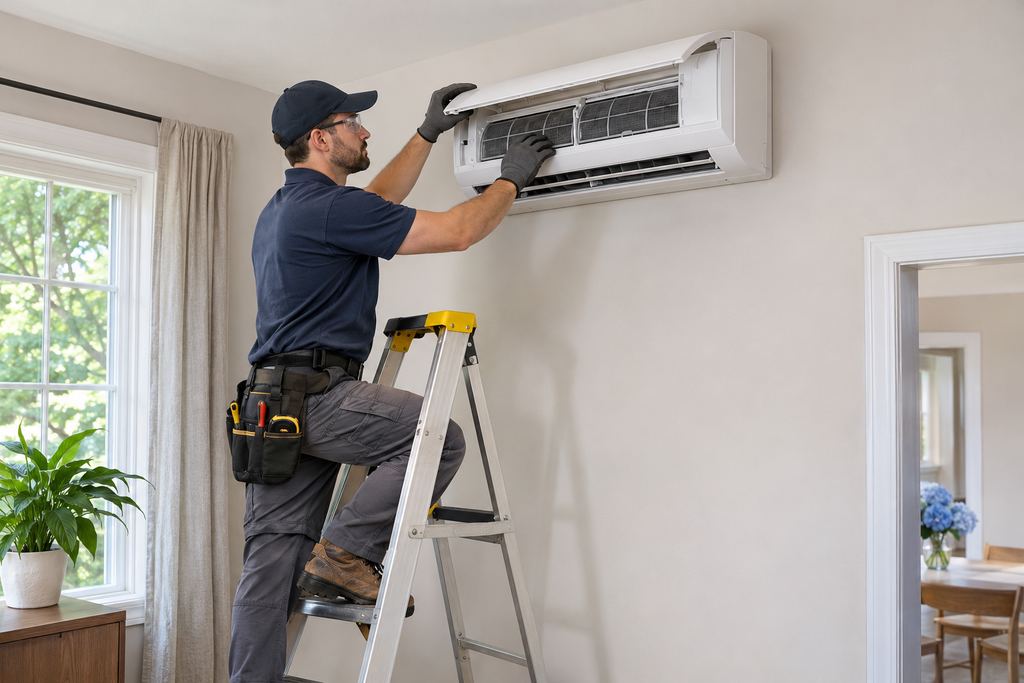
No tools beyond a flashlight. Turn the system off at the thermostat before opening any filter or access door.
- Check that every remote is set to the same mode, since mixed requests can make one zone seem dead
- Clean the filter in the head that is struggling
- Make sure nothing blocks the head's intake or louvers
- Note any error code shown on the head or outdoor unit
Leave these to a licensed technician
These involve high voltage, refrigerant or sealed components. Refrigerant work requires EPA Section 608 certification.
- Testing expansion valves and sensors for that zone
- Checking for leaks at that zone's flare connections
- Diagnosing communication faults between the head and outdoor unit
- Clearing a blocked drain or failed condensate pump
Next steps
Think about how the rooms are used. Bedrooms that run all night and a home office that runs all day suit their own heads; a guest room used a few weeks a year may not justify one. Start with the rooms that most need help, then ask contractors to price both a multi-zone layout and separate systems. The mini-split installation cost guide explains quote line items, and the mini-split installation page explains how to request a site visit. If you only need one room, read the single-zone mini split guide.
Frequently asked questions
Can a mini split have multiple zones?
Yes. A multi-zone outdoor unit has several ports or a branch box, each serving its own indoor head with its own thermostat or remote.
What is the $5,000 rule for AC?
It is an informal rule of thumb, not a standard: multiply the system's age in years by the repair quote, and if the result is above 5,000, replacement is worth pricing. It ignores efficiency, refrigerant type and condition, so treat it as a prompt to get a second opinion rather than a decision.
How much does a multi zone mini split system cost?
Cost depends on the number and type of heads, line set lengths, electrical work and efficiency tier. Ask for itemized quotes for both a multi-zone and a single-zone layout so you can compare.
Which multi zone mini split is the one to buy?
There is no single answer. Choose a line that a local contractor installs and services regularly, with an AHRI-listed rating for your exact combination and a warranty you can register. Installation quality affects performance as much as the brand.
- Ductless heating and cooling (ENERGY STAR)
- AHRI Directory of Certified Product Performance (AHRI)
- Air Conditioning Contractors of America (ACCA)
- ENERGY STAR Rebate Finder (ENERGY STAR)
Last updated November 24, 2026. Editorial policy · Report an error
Related guides and services
Request a multi-room mini-split quote
List the rooms you want to cover and where an outdoor unit could sit. We pass the request to an independent local contractor.
AC Service Near Me is an independent referral service. Work is performed by independent, locally owned contractors. How we earn money
List the rooms and their rough sizes. A contractor will confirm the layout on site.
Please keep this page open.
- Your request is matched with an independent contractor or partner network that serves your ZIP code.
- The contractor contacts you to confirm details and schedule a visit.
- They diagnose the system and quote the work. You decide whether to go ahead.
Read how requests are handled.
We're still setting up the contractor network that receives online requests, so your details were not sent to anyone and were not stored. Please call to request service, or check back soon.
Call (888) 555-0199