Inverter Air Conditioners: How They Work and When They Pay Off
In an inverter air conditioner, a variable-frequency drive controls how fast the compressor motor turns. Instead of running flat out and shutting off, the system slows down as the room approaches the setpoint and keeps running at low speed.
A conventional AC compressor has two states: full speed or off. An inverter converts incoming power so the compressor can run across a range of speeds, matching output to the load. That gives steadier temperatures, quieter operation and lower energy use at part load, which is most of the cooling season. Inverter units cost more up front, and their electronics need a technician for diagnosis.
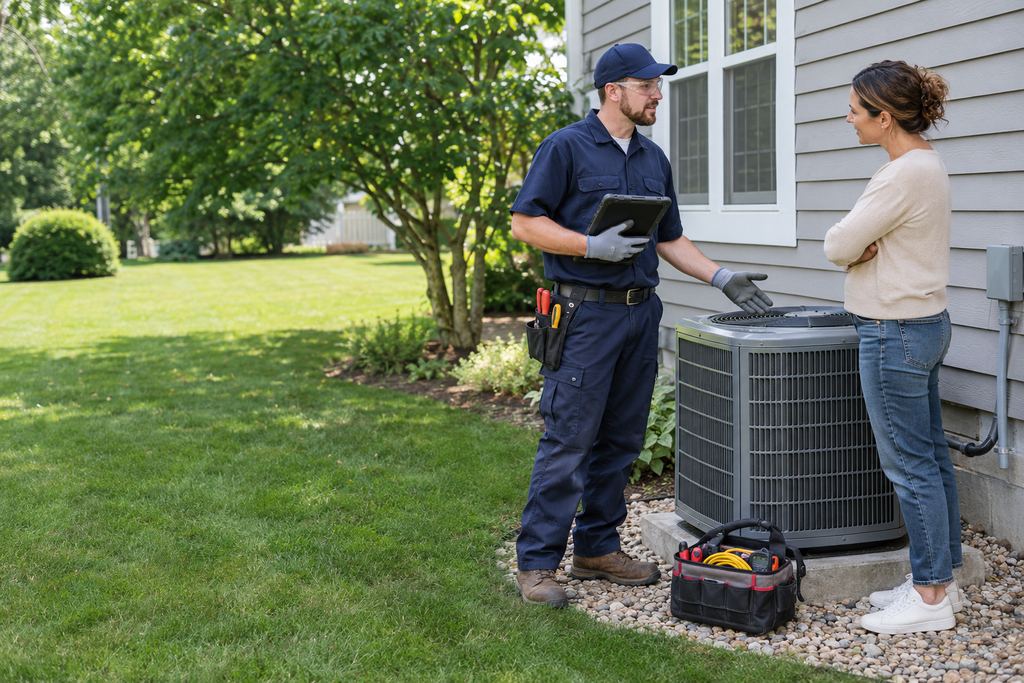
What the inverter actually does
Household power arrives as alternating current at a fixed 60 hertz. In a fixed-speed unit, that fixed frequency spins the compressor at one speed. An inverter board first converts the supply to direct current, then builds a new output at whatever frequency the controller asks for. Higher frequency spins the compressor faster for more cooling; lower frequency slows it down.
The control logic reads room and coil temperatures and adjusts many times a minute. On a mild afternoon the compressor may run at a fraction of its top speed for hours. On the hottest day it ramps up toward full capacity, and some models can briefly exceed their nominal rating.
Inverter versus fixed-speed
| Inverter | Fixed-speed | |
|---|---|---|
| Compressor behavior | Varies speed continuously | Full speed or off |
| Room temperature | Holds close to the setpoint | Swings a few degrees between cycles |
| Starts per hour | Few; runs long at low speed | Many in mild weather |
| Noise | Quieter at low speed | Noticeable at each start |
| Up-front price | Higher | Lower |
| Repairs | Control boards and sensors need diagnosis by a technician | Simpler parts, often cheaper to fix |
Where you find inverter compressors
How much energy it saves
Savings come from running at part load, where the coils are oversized relative to the refrigerant flow and the system moves heat more efficiently. That shows up in the seasonal ratings: SEER2 for ducted and mini-split systems, and CEER (combined energy efficiency ratio) for window and portable units on the yellow EnergyGuide label. Compare those ratings between models of the same type and capacity rather than relying on a percentage printed on the box.
How much you save depends on climate, hours of use and electricity rates. Long cooling seasons with many mild days favor an inverter most, which is one reason ductless mini-splits do well in shoulder seasons. In a room cooled a few evenings a year, the extra purchase price can take a long time to pay back.
Signs an inverter unit needs a technician
Cleaning filters is an owner job. Anything inside the cabinet is not, because inverter boards can hold a charge after power is off.
- Blinking lights or an error code: Write down the code and look it up in the owner's manual before calling. It tells the technician where to start.
- Runs but barely cools: Could be dirty filters or coils, a refrigerant leak or a failing sensor. Start with the filter.
- Outdoor unit will not start: Board, sensor or power issues. Check the breaker once, then call.
- New buzzing or whining: Inverter boards and fan motors can make electrical noise when failing.
Repairs and replacement
A failed inverter board or compressor on an older unit can be expensive. Ask for a written diagnosis and a quote, and weigh it against the unit's age. For mini-splits, see ductless AC repair; for central systems, the AC repair cost guide lists the common parts and what drives their price.
Frequently asked questions
What is an inverter in an air conditioner?
It is the electronic drive that changes the compressor's speed by changing the frequency of the power sent to its motor. It lets the system run slowly when little cooling is needed instead of cycling on and off.
Which type of inverter AC uses the least electricity?
No single type wins in every home. Within one category, compare SEER2 for mini-splits and central systems or CEER for window and portable units, at the capacity your room needs. ENERGY STAR certified models meet a higher efficiency bar than the federal minimum.
Is an inverter AC cheaper?
It costs more to buy and usually less to run. Whether the total is lower depends on how many hours a year you use it and what you pay for electricity.
How many hours can an AC run on a power inverter and battery?
That is a different kind of inverter, the one in a solar or backup battery system. Divide the battery's usable watt-hours by the AC's running watts, then allow for conversion losses. A unit drawing 800 watts on a 4,000 watt-hour battery runs well under five hours. Check that the inverter can handle the AC's starting surge, and that the setup meets the manufacturer's and local electrical requirements.
Do inverter air conditioners last longer?
Fewer hard starts reduce wear on the compressor, but the added electronics are another part that can fail. Regular filter and coil cleaning, plus a yearly technician visit such as mini-split maintenance, has a bigger effect on lifespan than the drive type.
- Room Air Conditioners (ENERGY STAR)
- Ductless heating and cooling (ENERGY STAR)
- Heating and cooling at home (ENERGY STAR)
Last updated November 24, 2026. Editorial policy · Report an error
Related guides and services
Talk to a contractor about inverter equipment
Tell us the space and what you use now. We pass the request to an independent local contractor where one serves your ZIP code.
AC Service Near Me is an independent referral service. Work is performed by independent, locally owned contractors. How we earn money
Tell us the space you want to cool and the system you have now.
Please keep this page open.
- Your request is matched with an independent contractor or partner network that serves your ZIP code.
- The contractor contacts you to confirm details and schedule a visit.
- They diagnose the system and quote the work. You decide whether to go ahead.
Read how requests are handled.
We're still setting up the contractor network that receives online requests, so your details were not sent to anyone and were not stored. Please call to request service, or check back soon.
Call (888) 555-0199