Central Air Conditioning: A Homeowner's Guide
Central air conditioning cools the whole house from one system and delivers the air through a network of supply and return ducts. Most homes in the US with central air have a split system: a condenser outside and a coil and blower inside.
Central AC removes heat and moisture from indoor air at an evaporator coil, then pumps that heat outdoors through refrigerant lines to a condenser. A blower pushes the cooled air through ducts to every room. The right size comes from a room-by-room load calculation, not square footage alone, and installation is contractor work that includes electrical, refrigerant and duct checks.
How central air works
An air conditioner does not make cold. It moves heat. Inside, warm return air passes over the evaporator coil, where liquid refrigerant boils off and absorbs heat. Water vapor condenses on the cold coil and drains away, which is why central air also lowers humidity. The refrigerant, now a gas, travels to the outdoor unit. The compressor squeezes it to a high pressure and temperature, and the condenser fan blows outdoor air across the coil so the heat leaves the house.
The indoor coil sits on top of a furnace or inside an air handler. That same blower serves the heating system in most homes, so central AC and a forced-air furnace share filters, ducts and the thermostat.
Parts of a split central air system
Types of central systems
All four deliver air through ducts. They differ in where the parts live and how the home is heated.
Central air compared with other options
| Central AC | Ductless mini-split | Window or portable | |
|---|---|---|---|
| Rooms served | Whole house | One room per indoor head | One room |
| Needs ducts | Yes | No | No |
| Room-by-room control | Only with a zoning system | Yes, each head has its own setpoint | Yes |
| Installation | Contractor | Contractor | Usually the owner |
| Typical fit | Homes with good existing ducts | No ducts, additions, problem rooms | Renters, single rooms, temporary cooling |
Sizing: why square footage is only a starting point
Two houses with the same floor area can need very different equipment. Insulation, window area and direction, air leakage, ceiling height, shade and local climate all change the cooling load. The industry method is an ACCA Manual J load calculation, which works room by room and produces a BTU figure the contractor then uses to choose equipment (Manual S) and check the ducts (Manual D).
Residential central systems are sold in half-ton steps, where one ton equals 12,000 BTU per hour. An oversized system cools the air fast and shuts off before it removes much moisture, which leaves the house cool but clammy and wears the compressor with short cycles. An undersized one runs nonstop on the hottest days. Ask every bidder whether they ran a load calculation and to show you the result.
What drives the price of a new system
No fair number exists without seeing the house. These are the line items that move a quote.
Tonnage from the load calculation, SEER2 tier and single-stage versus two-stage or variable-speed compressors.
Leaky, undersized or uninsulated ducts may need sealing, repair or replacement. A home with no ducts adds the largest cost.
A new circuit, disconnect or panel capacity upgrade if the home has never had central air.
Whether the existing furnace blower can be matched to the new coil or should be replaced at the same time.
New systems use R-410A or a newer A2L refrigerant such as R-454B or R-32. Old line sets may need replacing or flushing.
Local permits, crane or attic access, and removal of the old equipment.
What a typical installation includes
- Home survey
The contractor measures rooms and windows, checks insulation, inspects ducts and the electrical panel, and runs the load calculation.
- Written proposal
Model numbers for the outdoor unit, coil and furnace or air handler, the AHRI match, scope of duct work, permit and warranty registration.
- Removal and setup
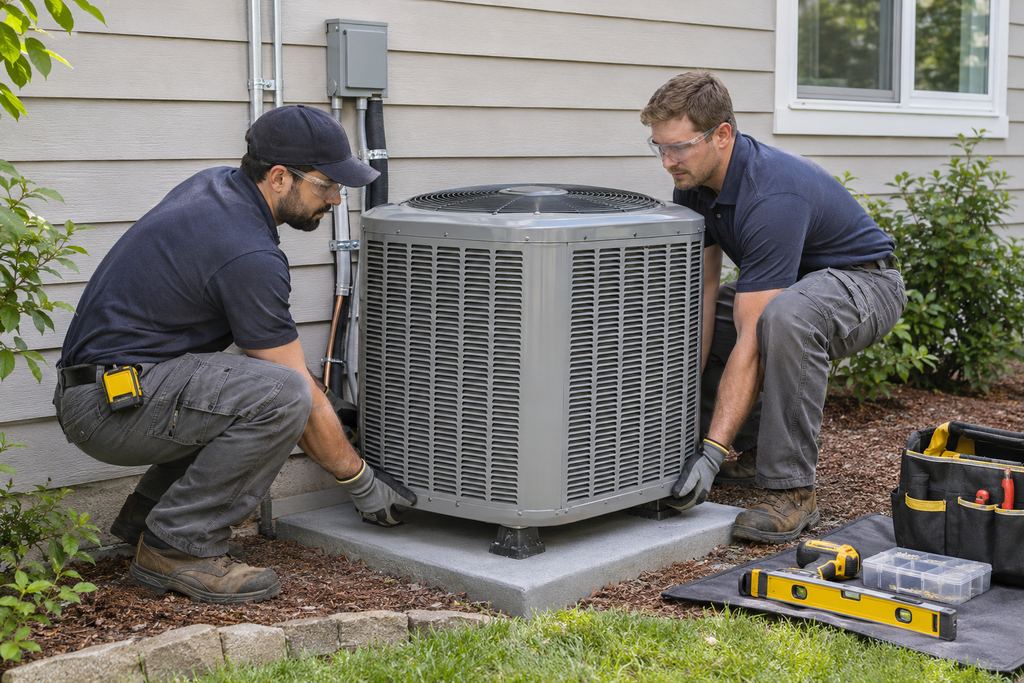
Refrigerant from the old system is recovered, the new condenser is set on a level pad, and the coil is installed on the furnace or air handler.
- Line set and electrical
Lines are brazed or connected, pressure tested and evacuated with a vacuum pump before refrigerant is released. The circuit and disconnect are connected.
- Startup and checks
Charge, airflow and temperature split are measured, the thermostat is set up, and the drain is tested. Ask for the startup readings in writing.
Keeping it running
Safe checks you can do
No tools beyond a flashlight. Turn the system off at the thermostat before opening any filter or access door.
- Replace or clean the air filter on the schedule for your filter type
- Keep plants, leaves and grass clippings at least a couple of feet from the outdoor unit
- Keep supply and return grilles clear of furniture and rugs
- Flush the condensate line only if the owner's manual describes how
Leave these to a licensed technician
These involve high voltage, refrigerant or sealed components. Refrigerant work requires EPA Section 608 certification.
- Cleaning the indoor and outdoor coils
- Checking refrigerant pressures and looking for leaks (EPA Section 608 work)
- Testing capacitors, contactor and electrical connections
- Measuring airflow and static pressure in the ducts
Where to go next
If you are pricing a project, the central AC installation cost guide breaks down the factors above. Homes with an aging system can start with central AC replacement, and a system that already works but runs poorly may only need seasonal maintenance.
Frequently asked questions
How much should I expect to pay for new central air?
It depends on tonnage, efficiency tier, the state of the ducts and electrical work. A replacement on good existing ducts costs far less than a first-time install in a house without them. Get at least two written quotes built on a load calculation, and see the AC replacement cost guide for the factors.
What is the difference between air conditioning and central air?
Air conditioning is any equipment that cools and dehumidifies air. Central air is one type that conditions the whole house from a single system through ducts, as opposed to window, portable or ductless units that cool one space each.
What size central AC does a 2,000 square foot house need?
There is no reliable answer from floor area alone. Climate, insulation, windows and air leakage can move the result by a ton or more. Ask the contractor for a Manual J load calculation before accepting a size.
Is central AC better than a split AC?
The question mixes two terms. Most central air systems are split systems, with one unit outside and one inside. The real choice is usually between ducted central air and a ductless mini-split. Ducted wins when the house already has sound ducts; ductless wins when there are none or only a few rooms need cooling.
Can I add central air to a house without ducts?
Yes, but installing ducts means opening walls, ceilings or attic space and adds cost. A ducted mini-split for part of the house or several ductless heads are common alternatives.
- Heating and cooling at home (ENERGY STAR)
- ENERGY STAR Rebate Finder (ENERGY STAR)
- Air Conditioning Contractors of America (ACCA)
- Section 608 Technician Certification (U.S. EPA)
- AHRI Directory of Certified Product Performance (AHRI)
Last updated November 24, 2026. Editorial policy · Report an error
Related guides and services
Talk to a local contractor about central air
Describe the house, the current heating system and whether ducts are in place. We pass the request to an independent local contractor.
AC Service Near Me is an independent referral service. Work is performed by independent, locally owned contractors. How we earn money
Tell us whether the home already has ducts and what heats it now. Availability varies by ZIP code and season.
Please keep this page open.
- Your request is matched with an independent contractor or partner network that serves your ZIP code.
- The contractor contacts you to confirm details and schedule a visit.
- They diagnose the system and quote the work. You decide whether to go ahead.
Read how requests are handled.
We're still setting up the contractor network that receives online requests, so your details were not sent to anyone and were not stored. Please call to request service, or check back soon.
Call (888) 555-0199