Central Air Conditioner Installation Cost: What Drives the Quote
Central air conditioner installation cost comes down to how much equipment you need, how efficient it is and how much of the house has to change to accept it. A swap onto sound ducts and an existing circuit is the smallest job. Adding central air to a house with no ducts is the largest.
We do not publish a price, because installed cost depends on local labor rates, the equipment line and what your house already has. The biggest swing factors are whether ducts exist and are usable, the system size from a load calculation, and the SEER2 tier you choose. Ask at least two or three contractors for itemized written quotes on the same scope.
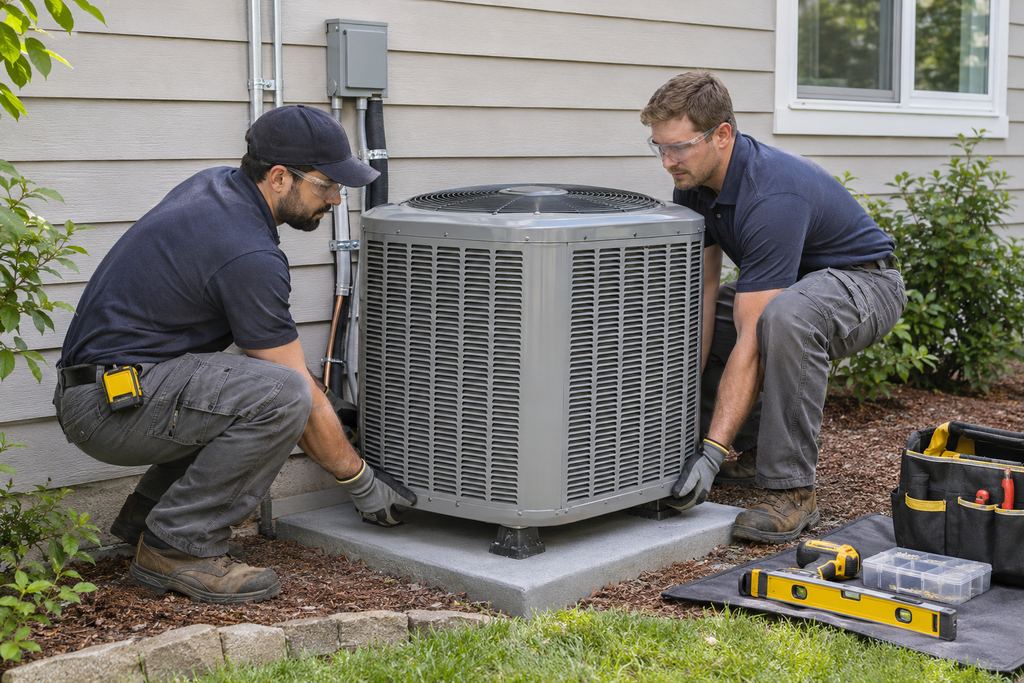
The six line items that move the total
Every central AC quote is built from the same parts. These are the ones that change the most from house to house.
Residential systems usually run from about 1.5 to 5 tons. Each step up costs more for the condenser and the matching coil, so oversizing wastes money twice: once at purchase and again in short cycling.
Single-stage units at the federal minimum cost least. Two-stage and variable-speed (inverter) units cost more and hold humidity and temperature more evenly.
Reusing tight, correctly sized ducts keeps the price down. New trunk lines, added returns or a full duct system can rival the equipment cost.
The condenser needs its own circuit and an outdoor disconnect. Older homes sometimes need a panel upgrade to carry it.
Split central AC pairs with a furnace or air handler. If the furnace blower is weak or the cabinet will not fit the new coil, the scope grows.
Mechanical permits, a new condenser pad, line set work and haul-away of old equipment are often separate lines on the quote.
What you are paying for in a split central air system
How the starting point changes the job
Relative scope only. We do not set prices, and the same scenario can be quoted very differently in two regions.
| Your house today | What gets installed | Where the cost goes |
|---|---|---|
| Old central AC, good ducts | New condenser, matched indoor coil, line set check | Mostly equipment; labor is a day or so |
| Furnace and ducts, no AC | Condenser, coil on the furnace, new line set, circuit | Electrical run and coil fit on the furnace |
| Boiler or baseboard heat, no ducts | Air handler, full duct system, condenser | Ductwork and attic or closet space |
| Ducts in poor shape | System plus duct sealing, repair or replacement | Duct labor, sometimes more than the unit |
| Replacing a heat pump with AC | Condenser, coil, possibly a furnace for heat | Heating source becomes part of the decision |
Sizing: why 1,500 square feet is not a price
Square footage is the first number people search with, but it does not set the system size. A load calculation under ACCA Manual J uses insulation, window area and direction, air leakage, ceiling height and your local design temperature. A 1,500 square foot ranch in Phoenix and one in Minneapolis can land a full ton apart.
A quote that sizes by a rule of thumb, such as one ton per so many square feet, tends to oversize. The bigger unit costs more, cycles on and off quickly and leaves the house damp. Ask each bidder to show the calculated cooling load in Btu per hour, then compare tonnage across quotes before you compare totals.
Efficiency rules, refrigerant and incentives
Since January 1, 2023, central air conditioners are rated in SEER2. The Department of Energy minimum for split AC is 13.4 SEER2 in northern states and 14.3 SEER2 in the South and Southwest for systems under 45,000 Btu per hour. Units above the minimum cost more to buy and less to run; the payback is fastest where the cooling season is long.
New equipment is moving from R-410A to A2L refrigerants such as R-454B and R-32 under the EPA technology transitions rule. That can mean a new indoor coil and a check of the line set even when the old system looks reusable. The federal 25C tax credit no longer applies to systems placed in service after 2025, so check current state and utility offers with the ENERGY STAR rebate finder before you sign.
What a complete installation quote should include
- Model numbers for the condenser and coil: Lets you confirm the matched SEER2 rating in the AHRI directory.
- Load calculation result: The cooling load and the tonnage chosen to meet it.
- Line set plan: Reuse after flushing and pressure testing, or new copper.
- Electrical scope: Circuit, breaker, disconnect and any panel work.
- Duct work: Sealing, added returns or replacement, described in plain words.
- Thermostat, permit and haul-away: Whether each is included or extra.
- Warranty terms: Manufacturer coverage, registration steps and any labor coverage from the contractor.
How to get comparable quotes
- Gather your basics
Approximate square footage, the age of the current system, the heat source and any rooms that never cool well.
- Request site visits
A contractor should look at the attic or basement, ducts and electrical panel before quoting.
- Ask for the same scope
Give each bidder the same efficiency target so the totals can be compared fairly.
- Compare line by line
Check tonnage, model numbers, duct work and what is excluded before price.
Related pages
For what happens on install day, read central air conditioner installation. If you already have central air and it is failing, the central AC replacement cost guide covers removal and the repair or replace decision. Homes without ducts often compare against ductless mini-split installation. Broader price factors for every system type sit in the AC installation cost guide, and the central AC section lists every service page.
Frequently asked questions
How much does central air cost to install in a 1,500 square foot house?
It depends on the load calculation, whether ducts exist and the efficiency tier, more than the floor area. Many 1,500 square foot homes need between 2 and 3 tons, but climate and insulation decide. Get written quotes that state the tonnage and the calculated load.
What is the 20 rule for air conditioning?
It is a rule of thumb that a central AC on a very hot day can hold the house roughly 20 degrees below the outdoor temperature. It is not a design standard, but if your system cannot get near that, the size, refrigerant charge or ducts may need a look.
What time of year is cheapest to install central air?
No month is always cheapest, but spring and fall usually give you more scheduling choice and time to compare bids. Some manufacturers and utilities run seasonal promotions; ask each contractor what applies.
What is the $5,000 rule in HVAC?
Multiply the age of your current system by a quoted repair cost. If the result is above 5,000, many contractors suggest pricing a replacement. It ignores efficiency and condition, so treat it as a prompt, not a verdict.
Is it cheaper to install central air if I already have a furnace?
Usually, yes. The furnace blower and ducts are already in place, so the job is mostly the condenser, a coil on the furnace, a line set and a circuit. The furnace must be able to move enough air for the new coil.
- Manual J Residential Load Calculation (ACCA)
- Appliance and Equipment Standards Program (U.S. Department of Energy)
- Technology Transitions Program (U.S. EPA)
- ENERGY STAR Rebate Finder (ENERGY STAR)
- AHRI (Air-Conditioning, Heating, and Refrigeration Institute)
Last updated November 24, 2026. Editorial policy · Report an error
Related guides and services
Compare central air installation quotes
Tell us about the house and what heats it now. Independent local contractors can visit and provide written, itemized quotes.
AC Service Near Me is an independent referral service. Work is performed by independent, locally owned contractors. How we earn money
Share the home size, what heats the house now and whether ducts exist. An independent local contractor can quote the job.
Please keep this page open.
- Your request is matched with an independent contractor or partner network that serves your ZIP code.
- The contractor contacts you to confirm details and schedule a visit.
- They diagnose the system and quote the work. You decide whether to go ahead.
Read how requests are handled.
We're still setting up the contractor network that receives online requests, so your details were not sent to anyone and were not stored. Please call to request service, or check back soon.
Call (888) 555-0199