Why Your AC Keeps Shutting Off and How to Narrow It Down
An AC that keeps shutting off is either being stopped by a safety device, losing power, or getting a wrong signal from the thermostat. Which one it is depends on how long it runs and whether it comes back on by itself.
If the AC shuts off after a few minutes and restarts soon after, it is short cycling, often from an oversized unit, a thermostat problem or low refrigerant. If it shuts off and stays off, look for a tripped breaker, a float switch triggered by a clogged drain, or an outdoor unit that overheated because its coil is dirty. Replace the filter and clear the outdoor unit first. If the breaker trips more than once, leave it off and call a technician.
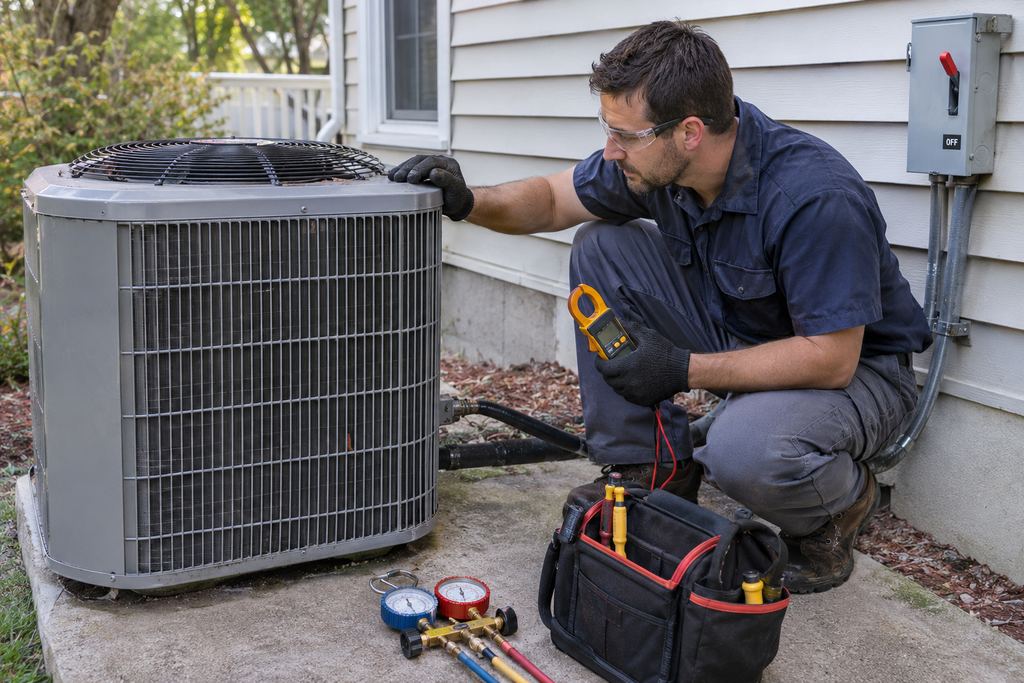
First, which pattern do you have?
| Pattern | What it suggests | Where to read more |
|---|---|---|
| Runs a few minutes, stops, restarts within minutes | Short cycling: oversized unit, thermostat placement, low refrigerant, frozen coil | AC short cycling |
| Runs, stops, and the breaker is tripped | Electrical fault, failing compressor or fan motor, weak capacitor | AC tripping breaker |
| Stops and the thermostat goes blank | Dead batteries, a float switch cutting power, or a blown control fuse | Sections below |
| Outdoor unit stops on hot afternoons, restarts later | Overheating: dirty condenser coil, failing fan motor, high-pressure safety trip | Sections below |
Likely causes
Reset a tripped AC breaker once. If it trips again, leave it off and call a technician. Repeated resets can overheat wiring and damage the compressor. A burning smell or buzzing from the panel or outdoor unit means turn the system off and keep it off.
Homeowner checks and technician work
Safe checks you can do
No tools beyond a flashlight. Turn the system off at the thermostat before opening any filter or access door.
- Replace thermostat batteries and confirm the thermostat is not in sun or next to a lamp, oven or supply vent.
- Change the air filter.
- Clear leaves, grass and anything stored within a couple of feet of the outdoor unit.
- Look for water in the drain pan and flush the drain line only as your manual describes.
- Reset a tripped breaker one time.
- Check for ice on the indoor coil or the copper line; if you find it, run the fan only to thaw it.
Leave these to a licensed technician
These involve high voltage, refrigerant or sealed components. Refrigerant work requires EPA Section 608 certification.
- Cleaning the condenser coil and checking the fan motor.
- Testing capacitors, contactors and the compressor's amp draw.
- Checking refrigerant pressures and the high- and low-pressure switches.
- Clearing a deep drain clog and testing the float switch.
- Moving or rewiring the thermostat.
- Running a load calculation if the unit seems oversized.
When the real problem is sizing
An air conditioner that is too large for the house reaches the thermostat setting quickly and shuts off before it has run long enough to pull moisture out of the air. You get short bursts of cold air, a clammy feel and more wear on the compressor from frequent starts. This often happens after a replacement where the new unit was matched to the old one's size instead of to the home.
Contractors size systems with a load calculation, commonly ACCA Manual J, that accounts for insulation, windows, orientation and duct location. If your system is oversized, options include adjusting blower settings, adding dehumidification, or planning a correctly sized unit at the next AC replacement.
Keeping it from happening again
Most shut-off problems trace back to heat that cannot escape or water that cannot drain. An annual service visit that cleans the condenser coil, clears the drain line, and tests electrical parts handles both. Check the AC repair cost guide for the factors that affect pricing if a part has already failed.
Frequently asked questions
Why does my AC turn on and off repeatedly?
Frequent on and off cycles usually come from an oversized system, a thermostat getting false readings, low refrigerant, or a frozen coil. Start with the filter and thermostat, then have a technician check charge and sizing.
How long should an AC run before it shuts off?
It depends on the weather, the house and the equipment. In mild weather, single-stage systems commonly run somewhere around 10 to 20 minutes per cycle, and in extreme heat they may run much longer. Variable-speed systems are designed to run for long stretches at low output.
Does the AC's restart delay mean it is shutting off by mistake?
No. Many systems keep the compressor off for about three to five minutes after it stops so pressures can even out. A short pause before restarting is normal.
Can an AC that keeps shutting off make allergies worse?
Short cycles remove less moisture, and higher indoor humidity favors dust mites and mold. A clean filter and a system that runs full cycles help keep humidity down.
Can a dirty filter make the AC shut off?
Yes. A clogged filter can freeze the coil or overheat the system, and safety controls then stop it. Replacing the filter is the first thing to try.
- Heating and cooling maintenance checklist (ENERGY STAR)
- ENERGY STAR (U.S. EPA ENERGY STAR)
- Mold (U.S. EPA)
Last updated November 24, 2026. Editorial policy · Report an error
Related guides and services
Request help with an AC that keeps stopping
Tell us how long it runs and what happens when it stops. A local contractor can follow up to arrange a visit. Availability varies by ZIP code and season.
AC Service Near Me is an independent referral service. Work is performed by independent, locally owned contractors. How we earn money
Note roughly how long it runs and whether it restarts. A local contractor can follow up to schedule a diagnosis.
Please keep this page open.
- Your request is matched with an independent contractor or partner network that serves your ZIP code.
- The contractor contacts you to confirm details and schedule a visit.
- They diagnose the system and quote the work. You decide whether to go ahead.
Read how requests are handled.
We're still setting up the contractor network that receives online requests, so your details were not sent to anyone and were not stored. Please call to request service, or check back soon.
Call (888) 555-0199