AC Blower Motor Replacement Cost Explained
AC blower motor replacement cost depends mostly on which kind of motor your air handler or furnace uses, how hard it is to reach, and whether the part is still under the manufacturer's warranty. A basic single-speed motor is usually the low end; a variable-speed ECM motor or its control module sits higher.
Expect the bill to combine a diagnostic visit, the motor, often a new run capacitor, and one to a few hours of labor. Constant-torque and variable-speed ECM motors cost noticeably more than older PSC motors. Prices vary by region and season, so the reliable number is a written quote from a technician who has tested the motor in your system.
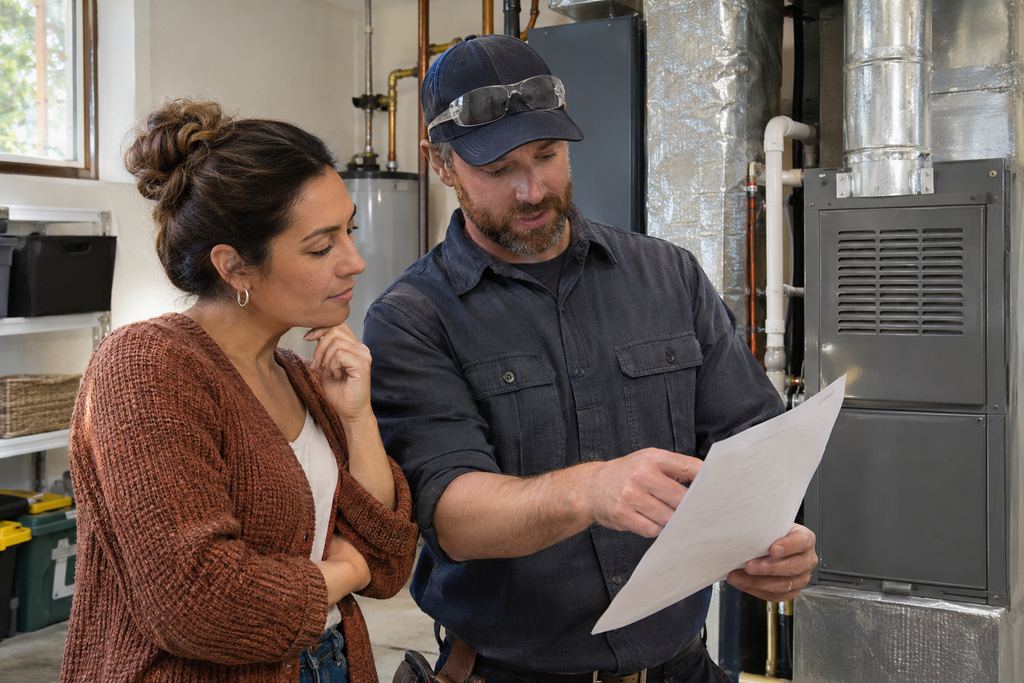
What the blower motor does and why price varies so much
The blower motor sits indoors, inside the air handler, furnace cabinet or fan coil, and pushes air across the evaporator coil and through your ducts. When it stops, the outdoor unit may keep running while almost no air comes out of the vents, and the indoor coil can start to ice over.
Two homes with the same symptom can get very different quotes. One may need a simple motor that a technician swaps in about an hour. Another may have a programmed variable-speed motor buried behind a coil in a tight attic. The part, the access and the warranty paperwork change the total far more than the brand name on the cabinet.
Cost factors to check on any quote
Permanent split capacitor (PSC) motors are older, simpler and cheaper. Electronically commutated motors (ECM), both constant-torque and fully variable-speed, cost more and sometimes need to be programmed for your system.
On many ECM motors the electronic module on the back fails before the motor itself. Some can be replaced separately, which may lower the cost. Ask the technician which part tested bad.
A basement furnace is easier to work on than a horizontal air handler in a hot attic or a closet with the coil stacked on top. Tight access adds labor time.
The replacement has to match the original's horsepower, voltage, rotation and mounting. Universal motors exist, but an exact or factory-approved part is often preferred.
If the equipment is registered and still in its parts warranty, the motor itself may be covered while you still pay labor and the service call. Find your registration before the visit.
After-hours or peak-season visits can carry higher rates, and some ECM motors have to be ordered. Ask how long the part will take before you approve.
Line items you may see on a blower motor quote
Use this to compare written quotes. It lists what each charge should cover, not a price.
| Line item | What it should cover | What raises it |
|---|---|---|
| Diagnostic or service call | Testing the motor, capacitor, control board and wiring to confirm the cause | After-hours visits, long travel distance |
| Blower motor | The replacement motor matched to your unit | ECM or variable-speed design, factory-only part |
| Run capacitor (PSC only) | A new capacitor sized to the new motor | Rarely significant on its own |
| Labor | Removing the blower assembly, swapping the motor, reinstalling and testing | Attic or crawlspace access, seized blower wheel |
| Blower wheel cleaning or replacement | Cleaning a dirty wheel or replacing a cracked or unbalanced one | Heavy buildup, damaged wheel |
| Programming (some ECM motors) | Loading the correct airflow settings for your equipment | Needs a manufacturer tool or specific part number |
Signs the blower motor may be failing
These point to the indoor fan, though a technician still has to confirm the cause.
- Weak or no airflow: The outdoor unit runs, but little air comes from the registers.
- Humming without spinning: Often a failed capacitor on a PSC motor, which is a cheaper repair than a new motor.
- Squealing, grinding or rattling indoors: Worn bearings or a loose or damaged blower wheel.
- Fan starts and stops on its own: Can be the motor overheating, a failing ECM module, or a control board fault.
- Burning or hot electrical smell: Turn the system off and call a professional. See AC burning smell.
What you can check before paying for a visit
Safe checks you can do
No tools beyond a flashlight. Turn the system off at the thermostat before opening any filter or access door.
- Confirm the thermostat is set to Cool and the fan setting is Auto or On
- Replace a clogged air filter; a choked filter strains the motor
- Check that the furnace or air handler service switch is on and the door panel is fully closed
- Look for a tripped breaker and reset it once; if it trips again, leave it off
Leave these to a licensed technician
These involve high voltage, refrigerant or sealed components. Refrigerant work requires EPA Section 608 certification.
- Testing motor windings, amp draw and the capacitor
- Diagnosing an ECM module or control board
- Removing and replacing the blower assembly
- Checking airflow and static pressure after the repair
Repair the motor or replace the system?
A blower motor is a mid-priced repair. On a system that is otherwise healthy it is usually worth doing, especially when the motor is under warranty. The calculation changes when the equipment is old, already needs other major work, or uses R-22 refrigerant, which has not been produced since 2020.
Some technicians mention a rough rule of thumb: multiply the system's age by the repair cost, and if the result is above about 5,000, consider replacement. Treat it as a conversation starter, not a rule. A better test is to ask what else the technician found during the visit. If the compressor is also weak, compare the totals with our guides to compressor replacement cost and AC replacement cost.
Questions to ask before you approve the work
- Which part failed the test?
Motor, module, capacitor or control board. Ask to see the reading or the old part. - Is it an exact match or a universal motor?
Either can work, but you should know which and why. - Is my unit still under parts warranty?
Bring the model and serial number, or the registration email. - What else did you notice?
A dirty blower wheel, a weak run capacitor or a clogged coil can shorten the new motor's life.
Frequently asked questions
How long does a blower motor replacement take?
When the right motor is on the truck, many replacements are finished in one visit of a couple of hours. Tight attic access, a seized blower wheel or an ECM motor that has to be ordered can stretch it to a second visit.
How much should an AC blower motor cost?
There is no single fair price because motor type, access and local labor rates differ. A PSC motor job is usually well below a variable-speed ECM job. Get one or two written quotes that list the part, labor and any programming separately.
Is this the same as a car AC blower motor?
No. This page covers the indoor blower in a home furnace or air handler. A car blower motor is a different, much smaller part handled by an auto repair shop.
What is usually the most expensive repair on a home AC or furnace?
On the cooling side it is usually the compressor; on a gas furnace, the heat exchanger. A blower motor normally falls in the middle of the range, well below either.
Can a bad capacitor look like a bad blower motor?
Yes. On PSC motors a weak capacitor often causes humming, slow starts or no start. Capacitors hold a charge even with the power off, so leave testing and replacement to a technician.
- Energy Saver: Air Conditioning and Maintenance (U.S. Department of Energy)
- ENERGY STAR Heating and Cooling Guidance (ENERGY STAR (U.S. EPA))
- Section 608 of the Clean Air Act: Stationary Refrigeration and Air Conditioning (U.S. EPA)
Last updated November 24, 2026. Editorial policy · Report an error
Related guides and services
Get a written blower motor quote
Share your ZIP code and what the system is doing. A local contractor who serves your area can test the motor and price the repair.
AC Service Near Me is an independent referral service. Work is performed by independent, locally owned contractors. How we earn money
A local contractor tests the motor and gives a written price before any work.
Please keep this page open.
- Your request is matched with an independent contractor or partner network that serves your ZIP code.
- The contractor contacts you to confirm details and schedule a visit.
- They diagnose the system and quote the work. You decide whether to go ahead.
Read how requests are handled.
We're still setting up the contractor network that receives online requests, so your details were not sent to anyone and were not stored. Please call to request service, or check back soon.
Call (888) 555-0199