AC Refrigerant Recharge for Home Systems
An AC refrigerant recharge restores the charge in a system that has lost some, and on a home air conditioner that only happens through a leak or an undercharged install. A proper recharge starts with finding the leak and ends with the charge set to the manufacturer's specification. Adding refrigerant to a home system requires EPA Section 608 certification.
- Leak check first, then charge to spec
- Charged by weight or by superheat and subcooling
- Never a homeowner job on a central AC or mini-split
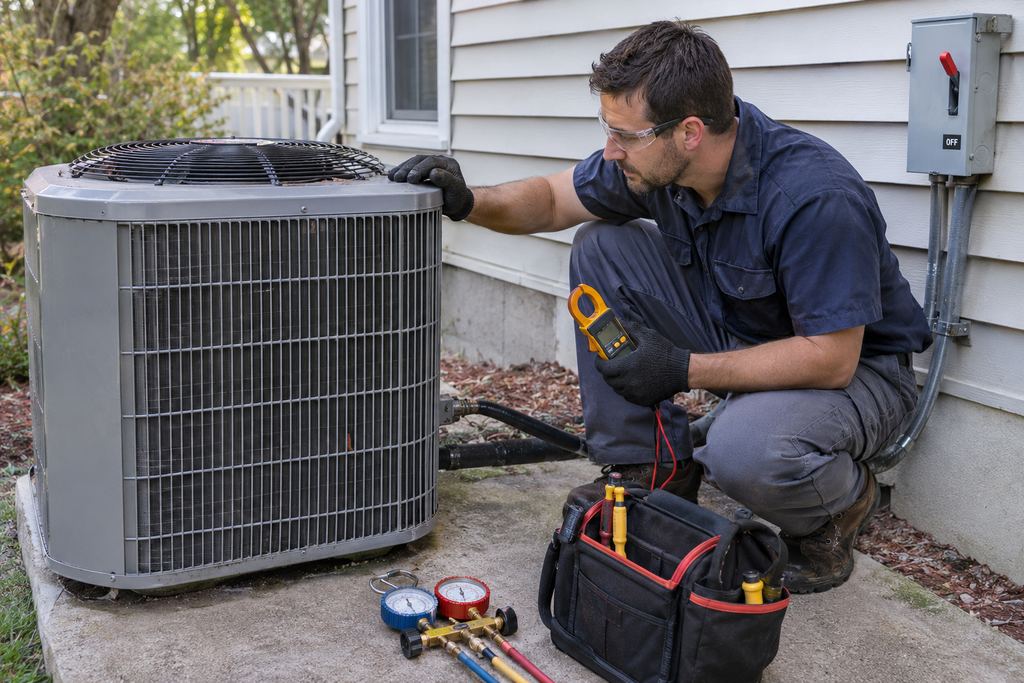
Tell us what the AC is doing. A local contractor checks the charge and looks for a leak before quoting.
Please keep this page open.
- Your request is matched with an independent contractor or partner network that serves your ZIP code.
- The contractor contacts you to confirm details and schedule a visit.
- They diagnose the system and quote the work. You decide whether to go ahead.
Read how requests are handled.
We're still setting up the contractor network that receives online requests, so your details were not sent to anyone and were not stored. Please call to request service, or check back soon.
Call (888) 555-0199Why a home AC runs low
Refrigerant circulates in a sealed loop between the indoor coil and the outdoor unit, absorbing heat inside and releasing it outside. It is not consumed. When the charge is low, the cause is a leak somewhere in the loop or a system that was not charged correctly when it was installed or last serviced.
The usual leak points are valve cores at the service ports, flare fittings, brazed joints, and pinholes in the indoor or outdoor coil. That is why a recharge without a leak search is a temporary fix. Our refrigerant leak repair page describes how leaks are found and fixed.
Signs the charge may be low
- Cool, not cold, supply air: Rooms never quite reach the setpoint on hot days.
- Ice on the larger copper line: Or on the indoor coil. Turn the system to fan-only to thaw it.
- Long cycles: The system runs far longer than it used to.
- Hissing: At the indoor coil, outdoor unit or lines.
What a correct recharge involves
- Check airflow first
A dirty filter or coil can mimic low charge, so the technician rules those out.
- Measure the charge
Gauges or digital probes read pressures and line temperatures, compared with the maker's chart.
- Look for the leak
With a detector, bubbles, dye or a nitrogen test, and repair it.
- Evacuate if the system was opened
A deep vacuum removes air and moisture before new refrigerant goes in.
- Charge by the manufacturer's method
By weight, or by superheat on fixed-orifice systems and subcooling on systems with an expansion valve.
- Record what was added
The invoice should show refrigerant type and pounds.
Refrigerant types in home systems
| Refrigerant | Notes for a recharge |
|---|---|
| R-22 | Production ended in 2020. Service uses recovered or reclaimed supply, so recharges are costly and may push you toward replacement. |
| R-410A | Common in systems installed from roughly 2010 through 2024. Not interchangeable with R-22. |
| R-454B, R-32 | Lower-GWP A2L refrigerants used in many new systems since 2025. Mildly flammable; technicians use A2L-rated tools and procedures. |
Homeowner checks and technician work
Safe checks you can do
No tools beyond a flashlight. Turn the system off at the thermostat before opening any filter or access door.
- Replace the filter and make sure supply and return grilles are open
- Keep shrubs, leaves and stored items away from the outdoor unit
- Read the refrigerant type from the data plate
- Switch to fan-only if you see ice
Leave these to a licensed technician
These involve high voltage, refrigerant or sealed components. Refrigerant work requires EPA Section 608 certification.
- Measuring and adjusting the charge
- Finding and repairing leaks
- Recovering, evacuating and recharging
- Checking the compressor if the system ran low for a long time
What a recharge costs depends on
Prices vary. The refrigerant recharge cost guide explains how invoices are built.
R-22 costs the most.
Billed per pound.
Usually the larger part of the job.
Trip fee and labor time.
Questions to ask the technician
- What readings showed the system was low?
Ask to see superheat or subcooling numbers. - Did you find the leak?
If not, ask what the next step is. - Which refrigerant and how many pounds?
It belongs on the invoice. - Do you hold EPA Section 608 certification?
Federal rules require it for anyone handling refrigerant on these systems.
How a service request works
AC Service Near Me is a referral service. We don't send our own technicians. We connect you with independent local contractors.
- Tell us what you need
Enter your ZIP code and choose the service. Add a few details about the problem or project.
- Your request is routed
It goes to an independent HVAC contractor or partner network that serves your area and handles that type of work.
- A contractor contacts you
The contractor reaches out to confirm details and schedule a visit.
- You decide
The contractor diagnoses the system and quotes the work. Pricing, scheduling and warranty terms are between you and them.
Frequently asked questions
How do I recharge my home AC refrigerant?
You do not. Adding refrigerant to a home system requires EPA Section 608 certification, gauges and recovery equipment. A technician should find the leak, repair it and charge the system.
Will an auto parts store refill my Freon?
Auto parts stores sell kits for car AC, which is a different system. They do not service home air conditioners.
What is the 3 minute rule for AC?
Wait about three minutes after the AC shuts off before restarting it so the compressor does not start against high pressure. Many thermostats add this delay automatically.
Which AC brand lasts the longest?
We cannot point to a reliable ranking. Correct sizing, a proper refrigerant charge, clean airflow and regular maintenance matter more to lifespan than the brand name.
How often does a home AC need a recharge?
Never, if it has no leaks. A system that needs refrigerant every year has a leak that should be found.
Can I recharge a central AC myself with a kit?
No. Kits are made for cars, home systems use different refrigerants and pressures, and adding refrigerant without certification is not allowed. Central AC questions are covered on our central AC service page.
- Section 608 of the Clean Air Act: Stationary Refrigeration and Air Conditioning (U.S. EPA)
- Protecting Our Climate by Reducing Use of HFCs (U.S. EPA)
- Energy Saver (U.S. Department of Energy)
- Heating and cooling maintenance checklist (ENERGY STAR)
Last updated November 24, 2026. Editorial policy · Report an error
Related guides and services
Request refrigerant service
Enter your ZIP code and describe the symptoms. A local contractor follows up to check the charge and find the leak.
AC Service Near Me is an independent referral service. Work is performed by independent, locally owned contractors. How we earn money
Tell us what the AC is doing. A local contractor checks the charge and looks for a leak before quoting.
Please keep this page open.
- Your request is matched with an independent contractor or partner network that serves your ZIP code.
- The contractor contacts you to confirm details and schedule a visit.
- They diagnose the system and quote the work. You decide whether to go ahead.
Read how requests are handled.
We're still setting up the contractor network that receives online requests, so your details were not sent to anyone and were not stored. Please call to request service, or check back soon.
Call (888) 555-0199