AC Thermostat Wiring Explained
AC thermostat wiring is a 24-volt control circuit: the R wire brings power from the transformer, and the thermostat sends it back down Y to start cooling, G to run the blower and W to call for heat. Match wires by the letter on the old terminal, not by color. When the wiring does not line up, an independent local HVAC contractor can sort it out.
- Terminal-by-terminal reference
- C-wire options for smart thermostats
- Clear signs to stop and call a pro
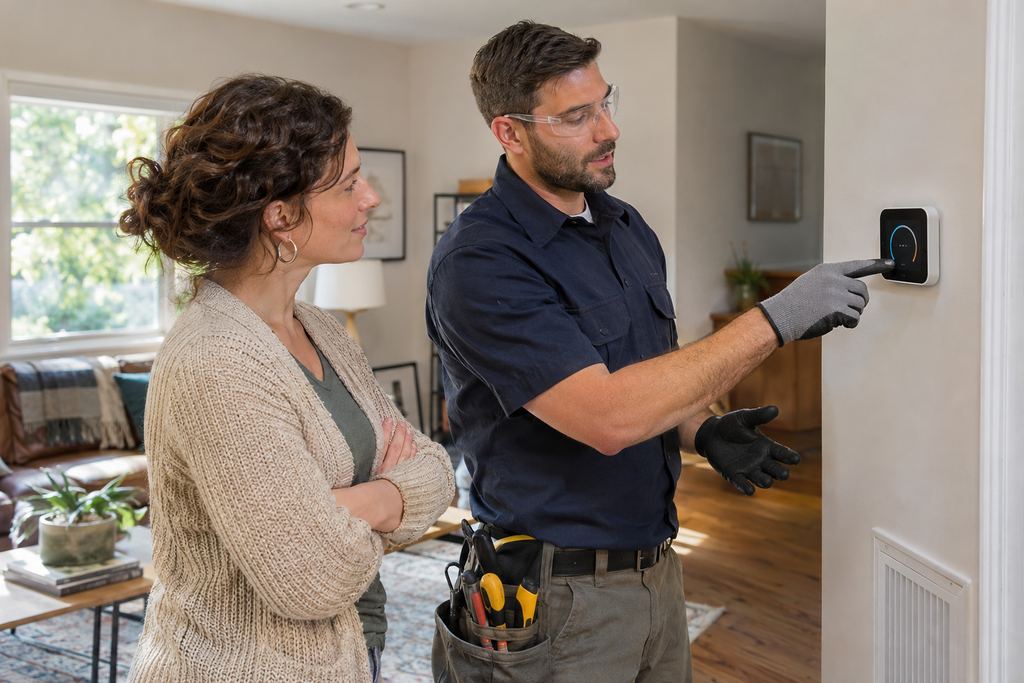
List the terminals your current thermostat uses and your system type. A local HVAC technician can wire or troubleshoot it.
Please keep this page open.
- Your request is matched with an independent contractor or partner network that serves your ZIP code.
- The contractor contacts you to confirm details and schedule a visit.
- They diagnose the system and quote the work. You decide whether to go ahead.
Read how requests are handled.
We're still setting up the contractor network that receives online requests, so your details were not sent to anyone and were not stored. Please call to request service, or check back soon.
Call (888) 555-0199What each terminal does
| Terminal | Common color | Function |
|---|---|---|
| R / Rh / Rc | Red | 24-volt power. Rh feeds heating, Rc feeds cooling; one transformer systems jumper them together |
| C | Blue or black | Common return; gives a smart thermostat constant power |
| Y / Y1 | Yellow | Calls the compressor for cooling (and heating on a heat pump) |
| Y2 | Light blue or other | Second compressor stage |
| G | Green | Runs the indoor blower fan |
| W / W1 | White | Calls for heat from a furnace or boiler |
| W2 / AUX / E | Brown or other | Second heat stage, or auxiliary and emergency heat on a heat pump |
| O/B | Orange or dark blue | Heat pump reversing valve; O energizes in cooling, B in heating, depending on the brand |
Does the red wire go to R or Rc?
If your old thermostat had one red wire and a small jumper between Rh and Rc, put the red wire on either one and keep the jumper in place, or use the single R terminal if the new thermostat has one. If it had two red-side wires, one on Rh and one on Rc, your system has separate heating and cooling transformers and the wires must stay on their own terminals with no jumper.
For heat, the wire is usually white on W. On a heat pump, heat comes from the compressor through Y with the reversing valve switched by O/B, and W2 or AUX brings on the backup heat.
Read the existing wiring before touching anything
- Turn off power
Shut off the HVAC system at its breaker or furnace service switch. A shorted R wire can blow the control board fuse.
- Remove the face only
Leave wires attached and photograph the terminals with the letters visible.
- Note unused wires
A folded-back wire in the bundle may be a spare you can use as a C wire, if it is connected at the furnace.
- Compare with the new thermostat
Every wire in use must have a matching terminal. If one does not, stop.
- Check the equipment end if needed
Tracing wires at the furnace or air handler board means opening the equipment cabinet; that is technician work.
No C wire? Your options
Signs of a wiring problem
- Thermostat dead after a swap: Often a blown low-voltage fuse from a brief short.
- Fan runs constantly: G wire touching R, or a wrong terminal.
- Heat pump heats when you ask for cooling: O/B setting is reversed.
- Smart thermostat reboots or drops Wi-Fi: Not enough power; usually a C-wire issue.
- Short cycling or chattering: Loose connection or power-stealing conflict.
Wiring you can handle vs. call a pro
Safe checks you can do
No tools beyond a flashlight. Turn the system off at the thermostat before opening any filter or access door.
- Moving labeled wires one for one to a compatible new thermostat
- Keeping or removing the Rh/Rc jumper as the manual directs
- Setting the O/B option in the thermostat menu
Leave these to a licensed technician
These involve high voltage, refrigerant or sealed components. Refrigerant work requires EPA Section 608 certification.
- Any connection at the furnace, air handler or outdoor unit
- Adding a C wire or adapter at the control board
- Replacing a blown fuse or transformer
- Two-transformer, zoned or communicating systems
- Line-voltage thermostats on 120 or 240 volts
Brand and system compatibility
Most single and two-stage systems from any brand work with any compatible low-voltage thermostat. The exception is communicating equipment, such as Carrier Infinity and Bryant Evolution lines, which use their own control protocol. For a Bryant or any other system, check the equipment manual or the thermostat maker's compatibility checker. We are independent and not affiliated with any equipment brand.
A smart thermostat is a Wi-Fi model with app control and scheduling that can adapt to your routine; most need the C wire described above. For choosing a model, see thermostat replacement. If the thermostat has quit and you are not sure why, the thermostat troubleshooting and installation page walks through symptoms, and thermostat repair covers what a technician fixes. Adding a whole-home dehumidifier usually needs extra wiring at the thermostat or air handler too.
How a service request works
AC Service Near Me is a referral service. We don't send our own technicians. We connect you with independent local contractors.
- Tell us what you need
Enter your ZIP code and choose the service. Add a few details about the problem or project.
- Your request is routed
It goes to an independent HVAC contractor or partner network that serves your area and handles that type of work.
- A contractor contacts you
The contractor reaches out to confirm details and schedule a visit.
- You decide
The contractor diagnoses the system and quotes the work. Pricing, scheduling and warranty terms are between you and them.
Frequently asked questions
Which wire is for heat on a thermostat?
On a furnace or boiler, usually the white wire on W or W1. On a heat pump, primary heat comes through Y with the O/B wire setting the reversing valve, and W2 or AUX runs backup heat.
Does the red wire go to R or Rc?
With one red wire and a jumper between Rh and Rc, either works as long as the jumper stays. With two separate R wires, keep each on its own terminal and remove the jumper.
What thermostat is compatible with a Bryant system?
Standard Bryant single and two-stage systems work with many low-voltage thermostats. Bryant Evolution communicating systems need a compatible communicating control. Check your equipment manual.
What is a smart thermostat?
A Wi-Fi thermostat you can control from a phone, with schedules and sometimes occupancy sensing. Most need constant power from a C wire.
Can thermostat wiring shock me?
Standard HVAC thermostat wiring is 24 volts, which is low risk, but shorts can damage the control board. Line-voltage thermostats on baseboard heat are 120 or 240 volts and dangerous; leave those to a pro.
- Smart thermostats (ENERGY STAR)
- Bryant (Bryant Heating and Cooling Systems)
Last updated November 24, 2026. Editorial policy · Report an error
Related guides and services
Wiring not matching up?
Send the terminal list from your current thermostat and your system type. An independent local HVAC technician can wire or troubleshoot it.
AC Service Near Me is an independent referral service. Work is performed by independent, locally owned contractors. How we earn money
List the terminals your current thermostat uses and your system type. A local HVAC technician can wire or troubleshoot it.
Please keep this page open.
- Your request is matched with an independent contractor or partner network that serves your ZIP code.
- The contractor contacts you to confirm details and schedule a visit.
- They diagnose the system and quote the work. You decide whether to go ahead.
Read how requests are handled.
We're still setting up the contractor network that receives online requests, so your details were not sent to anyone and were not stored. Please call to request service, or check back soon.
Call (888) 555-0199