AC Repair in Atlanta
If your Atlanta air conditioner is running but the house feels warm and sticky, or it will not start at all, send us your ZIP code and the symptom. We pass AC repair requests to independent HVAC contractors who work in the metro area; how soon one can come depends on your location and the season.
- Problems that show up most in Atlanta homes
- Quick checks you can safely do first
- How to confirm a Georgia conditioned air license
Your ZIP code, the symptom, and where the equipment sits (attic, basement, crawl space or closet) help the contractor plan the visit.
Please keep this page open.
- Your request is matched with an independent contractor or partner network that serves your ZIP code.
- The contractor contacts you to confirm details and schedule a visit.
- They diagnose the system and quote the work. You decide whether to go ahead.
Read how requests are handled.
We're still setting up the contractor network that receives online requests, so your details were not sent to anyone and were not stored. Please call to request service, or check back soon.
Call (888) 555-0199Why Atlanta air conditioners work so hard
Atlanta summers combine heat with heavy, humid air. July afternoons usually reach about 90 degrees, but the bigger load is moisture: an AC in Atlanta spends much of its effort pulling water out of the air, and the season runs from late spring well into October. A system that cools but no longer dehumidifies leaves rooms clammy at 75 degrees, which is often the first sign something is off.
Spring adds its own problem. The yellow pine and oak pollen that coats cars across the metro each March and April also loads up return filters and the fins of outdoor units. A filter that looked fine in February can choke airflow by May.
Repairs Atlanta homeowners ask about most
Check these before you book
Safe checks you can do
No tools beyond a flashlight. Turn the system off at the thermostat before opening any filter or access door.
- Thermostat set to Cool and below room temperature; replace weak batteries
- Return filter: replace it if it is gray or coated with yellow pollen
- AC breaker: reset it once if tripped; if it trips again, leave it off
- Outdoor unit: clear leaves, pine straw and grass clippings from around it
- Ice on the copper line: set the system to fan only and let it thaw
Leave these to a licensed technician
These involve high voltage, refrigerant or sealed components. Refrigerant work requires EPA Section 608 certification.
- Burning smell, smoke or a breaker that keeps tripping
- Hissing or bubbling near the coils, which can mean a refrigerant leak
- Water overflowing a pan or a shut-off float switch
- Any work inside the electrical panel or outdoor unit's control box
What an Atlanta AC repair visit usually covers
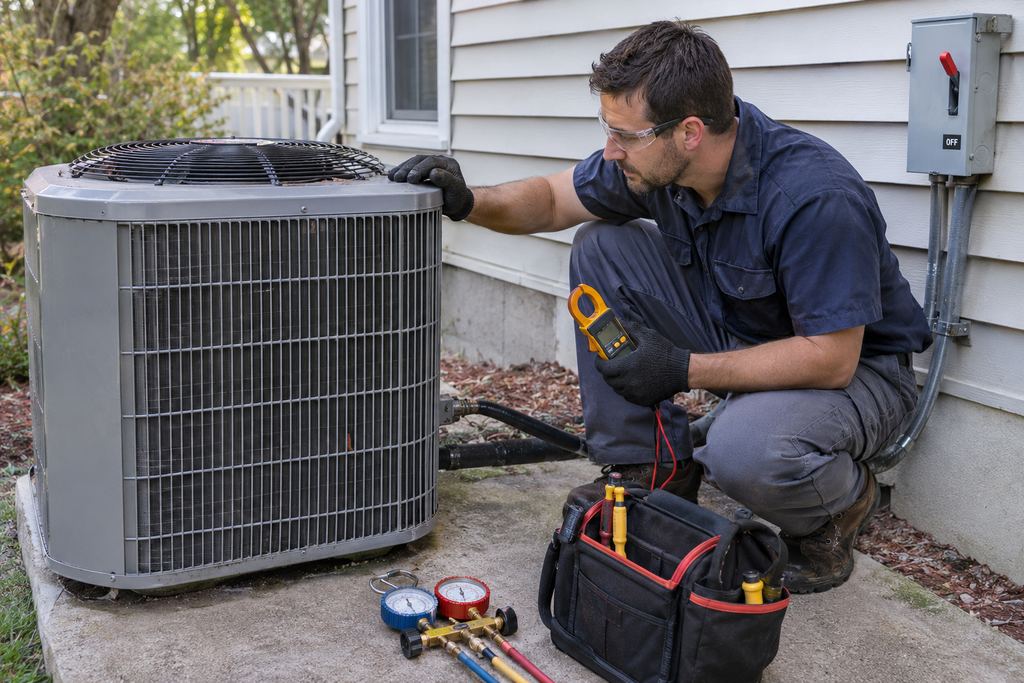
- Diagnosis: Measuring temperatures, pressures and electrical readings to find the failed part.
- Electrical parts: Capacitors, contactors, fan motors and wiring at the outdoor unit.
- Refrigerant leaks: Finding and repairing leaks; only EPA Section 608 certified techs may handle refrigerant.
- Drain and pan: Clearing the condensate line and checking the float switch on attic and crawl space units.
- Airflow: Blower, coil and duct checks when one floor stays warm.
- Heat pump issues: Many metro homes heat with a heat pump, so the same unit may need a check before winter.
Equipment in Atlanta homes, and where it hides
Older intown houses, such as early 1900s bungalows, often got central air decades after they were built, so ducts were added through the crawl space or a tight attic. Those runs can be leaky or uninsulated, and in a humid crawl space they can sweat. Suburban homes from the 1980s through the 2000s more often have two systems: one in the attic for the upstairs and one in the basement for the main floor. Gas furnaces and heat pumps are both common, so tell the contractor which one you have.
Equipment location changes the job. A technician reaching an attic air handler in August needs more time than one working in a basement, and that can show up in the labor charge. If the unit is old or uses R-22, which is no longer produced, a repair quote may come with a replacement option. Our page on AC installation in Atlanta covers what a new system involves.
Vetting an Atlanta HVAC company
- Is your conditioned air license active?
Georgia licenses conditioned air contractors through the State Construction Industry Licensing Board, Division of Conditioned Air Contractors. You can look up a license through the Georgia Secretary of State at sos.ga.gov. - What is the diagnostic fee, and does it apply to the repair?
Ask before the visit, not after. - Will I get the repair price in writing first?
A written quote lets you compare if the number is large. - Do you carry liability insurance?
Ask for proof, especially for attic or roof work.
How a service request works
AC Service Near Me is a referral service. We don't send our own technicians. We connect you with independent local contractors.
- Tell us what you need
Enter your ZIP code and choose the service. Add a few details about the problem or project.
- Your request is routed
It goes to an independent HVAC contractor or partner network that serves your area and handles that type of work.
- A contractor contacts you
The contractor reaches out to confirm details and schedule a visit.
- You decide
The contractor diagnoses the system and quotes the work. Pricing, scheduling and warranty terms are between you and them.
Other AC services in Atlanta
Frequently asked questions
How do I know if my Atlanta AC needs repair or just a new filter?
Replace the filter first, wait an hour and check again. If the house still will not drop below the setting, the air from the vents is not clearly cooler than room air, or you see ice or water, book a repair visit.
Why is my house humid even though the AC is running?
In Atlanta, this is often an oversized system that cools quickly and shuts off before it removes moisture, a fan setting left on On instead of Auto, or a dirty coil. A technician can check which applies.
Do Atlanta HVAC companies repair heat pumps and furnaces too?
Most residential HVAC contractors in the metro work on both, since homes here use the same system or ductwork for heating and cooling. Mention your heating type when you send the request.
How much does AC repair cost in Atlanta?
It depends on the part, the system type and how hard the equipment is to reach. We do not set prices. Ask for the diagnostic fee up front and the repair price in writing; our AC repair cost guide explains the main factors.
How can I check an HVAC contractor's license in Georgia?
Use the license lookup on the Georgia Secretary of State site at sos.ga.gov and search under the Division of Conditioned Air Contractors. Check that the name matches the company and the license is active.
- Professional Licensing Boards Division (Georgia Secretary of State)
- Section 608 Technician Certification (U.S. EPA)
- Mold (U.S. EPA)
- Phaseout of Class II Ozone-Depleting Substances (U.S. EPA)
Last updated November 24, 2026. Editorial policy · Report an error
Related guides and services
Get your Atlanta AC looked at
Send your ZIP code and what the system is doing. An independent local contractor can follow up based on availability in your part of the metro.
AC Service Near Me is an independent referral service. Work is performed by independent, locally owned contractors. How we earn money
Your ZIP code, the symptom, and where the equipment sits (attic, basement, crawl space or closet) help the contractor plan the visit.
Please keep this page open.
- Your request is matched with an independent contractor or partner network that serves your ZIP code.
- The contractor contacts you to confirm details and schedule a visit.
- They diagnose the system and quote the work. You decide whether to go ahead.
Read how requests are handled.
We're still setting up the contractor network that receives online requests, so your details were not sent to anyone and were not stored. Please call to request service, or check back soon.
Call (888) 555-0199