Ductless Mini-Split Installation in Austin
A ductless mini-split is often the simplest way to cool an Austin space the central system cannot reach: a garage apartment, a converted porch, a home office over the garage or an older bungalow with no ductwork. Tell us the rooms you want to cool and your ZIP code, and we pass the request to an independent local installer where one is available.
- Single-zone and multi-zone systems
- Sizing for Central Texas heat and humid mornings
- Permits, electrical work and quote comparison
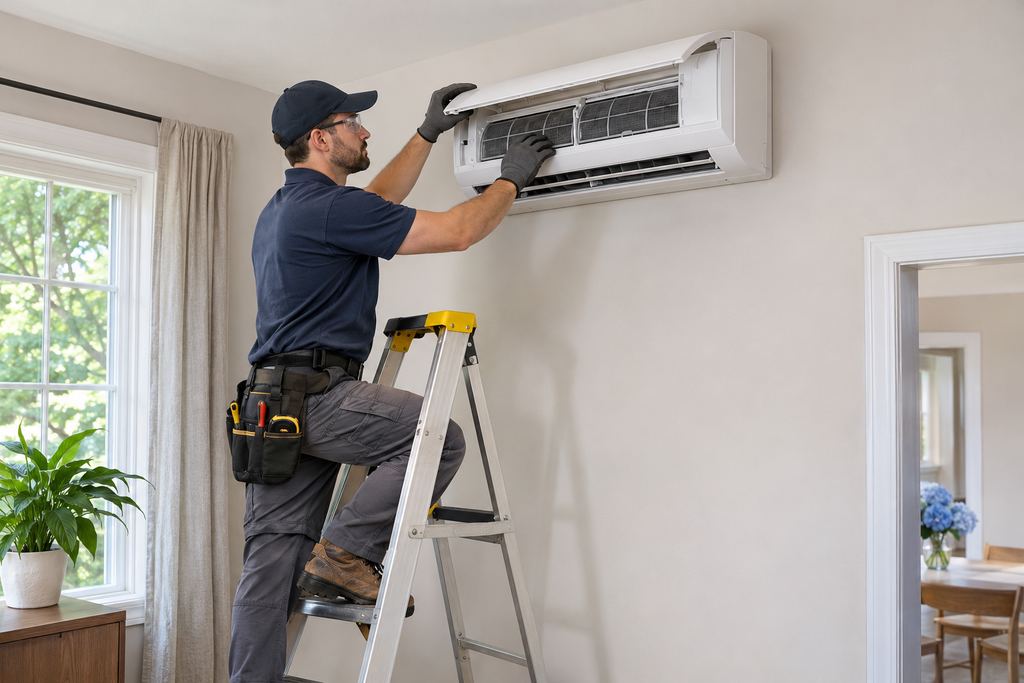
Room count, rough sizes and the location of the outdoor unit help the installer.
Please keep this page open.
- Your request is matched with an independent contractor or partner network that serves your ZIP code.
- The contractor contacts you to confirm details and schedule a visit.
- They diagnose the system and quote the work. You decide whether to go ahead.
Read how requests are handled.
We're still setting up the contractor network that receives online requests, so your details were not sent to anyone and were not stored. Please call to request service, or check back soon.
Call (888) 555-0199Where mini-splits fit in Austin homes
Sizing and choosing equipment
Mini-splits are sized room by room. An installer should look at each room's floor area, windows, ceiling height and sun exposure rather than picking a capacity from a chart. A garage conversion with a metal door and little insulation needs far more cooling per square foot than an interior bedroom. Oversized heads cool fast and shut down before they pull moisture out of the air, which is noticeable on humid Austin mornings. Most current systems have a dry mode that helps.
Inverter-driven mini-splits heat as well as cool. Central Texas winters are usually mild, but a hard freeze like the one in February 2021 is a reason to ask how the model you are quoted performs at low outdoor temperatures. Cold-climate models hold more of their heating capacity in that weather. For more background on the equipment, see our ductless mini-split guide.
Single-zone or multi-zone?
| Single-zone | Multi-zone | |
|---|---|---|
| Setup | One outdoor unit, one indoor head | One outdoor unit, two or more heads |
| Typical Austin use | ADU, garage room, office | Whole bungalow, several bedrooms |
| If the outdoor unit fails | One room loses cooling | Every connected room loses cooling |
| Efficiency | Usually highest per room | Can drop when only one head is running |
What the installation includes
- Site assessment: Head locations, line set route and a level pad or wall bracket for the outdoor unit.
- Wall penetration: A small hole for the refrigerant lines, drain and control wire, sealed against heat and pests.
- Refrigerant lines: Flared or brazed connections, pressure tested and evacuated with a vacuum pump.
- Condensate drain: Routed by gravity or to a small pump. Poor drainage is the main source of later leaks.
- Electrical circuit: Usually a dedicated 240-volt circuit and an outdoor disconnect.
- Startup and walkthrough: Checking operation in each mode and showing you how to clean the filters.
What changes the price
We do not quote prices. National factors are on our mini-split installation cost page. Ask for at least two written quotes with model numbers.
Each extra head adds equipment, line set and labor.
Larger capacity, higher SEER2 and cold-climate models cost more.
Long runs, two-story routes and decorative line covers add time.
A new circuit, panel space or a service upgrade in an older house.
Permits and licensing
Inside the city limits, a mini-split installation generally needs a mechanical permit from the City of Austin, and the new circuit may need an electrical permit as well. Texas requires a licensed air conditioning and refrigeration contractor for most HVAC installation, licensed by TDLR, and the person connecting refrigerant lines needs EPA Section 608 certification. Search the contractor at tdlr.texas.gov before you sign. Pre-charged DIY kits exist, but a botched flare connection leaks refrigerant and voids many warranties.
Keeping a mini-split running
Safe checks you can do
No tools beyond a flashlight. Turn the system off at the thermostat before opening any filter or access door.
- Rinse the washable indoor filters every few weeks in summer
- Keep the outdoor unit clear of leaves and mulch
- Watch for water dripping from the indoor head
Leave these to a licensed technician
These involve high voltage, refrigerant or sealed components. Refrigerant work requires EPA Section 608 certification.
- Deep cleaning of the indoor coil and blower wheel
- Refrigerant and electrical checks
- Drain line and pump service
How a service request works
AC Service Near Me is a referral service. We don't send our own technicians. We connect you with independent local contractors.
- Tell us what you need
Enter your ZIP code and choose the service. Add a few details about the problem or project.
- Your request is routed
It goes to an independent HVAC contractor or partner network that serves your area and handles that type of work.
- A contractor contacts you
The contractor reaches out to confirm details and schedule a visit.
- You decide
The contractor diagnoses the system and quotes the work. Pricing, scheduling and warranty terms are between you and them.
Frequently asked questions
What is a fair price for a mini-split installation?
It depends on the number of zones, capacity, efficiency, line set length and electrical work. A single head in a garage room and a four-zone bungalow are very different jobs. Compare written quotes that list the same equipment and scope.
Is Daikin as good as Mitsubishi for a mini-split?
Both are major mini-split manufacturers with broad product lines, and either can perform well when sized and installed correctly. Compare the specific models quoted for capacity, low-temperature heating and the installer's experience with that brand. We are not affiliated with either.
Can a mini-split plug into a regular outlet?
A few small units are made for a standard 120-volt circuit, but most mini-splits need a dedicated 240-volt circuit hardwired through an outdoor disconnect. The installer or an electrician confirms what your panel can support.
What are the downsides of a mini-split?
The indoor heads are visible on the wall, filters need frequent cleaning, multi-zone systems share one outdoor unit, and each head needs a reliable condensate drain. Upfront cost per room is often higher than extending existing ducts.
Do mini-splits work well in Austin summers?
Yes, when sized for the room. Inverter compressors run steadily through hot afternoons, and dry mode helps on humid days.
- Ductless Heating and Cooling (ENERGY STAR)
- Texas Department of Licensing and Regulation (TDLR)
- Section 608 Technician Certification (U.S. EPA)
- City of Austin (City of Austin)
Last updated November 24, 2026. Editorial policy · Report an error
Related guides and services
Plan a mini-split installation in Austin
Tell us which rooms you want to cool and your ZIP code. An independent installer serving your area can contact you to look at the space and write a quote.
AC Service Near Me is an independent referral service. Work is performed by independent, locally owned contractors. How we earn money
Room count, rough sizes and the location of the outdoor unit help the installer.
Please keep this page open.
- Your request is matched with an independent contractor or partner network that serves your ZIP code.
- The contractor contacts you to confirm details and schedule a visit.
- They diagnose the system and quote the work. You decide whether to go ahead.
Read how requests are handled.
We're still setting up the contractor network that receives online requests, so your details were not sent to anyone and were not stored. Please call to request service, or check back soon.
Call (888) 555-0199