Wall-Mounted Air Conditioners: Which Kind Fits Your Room
A wall mounted air conditioner can mean three different products: the indoor head of a ductless mini-split, a through-the-wall unit set in a sleeve, or an all-in-one unit that hangs on the inside of an exterior wall with two vent holes. They differ in noise, efficiency, heating ability and how much work the installation takes.
Wall-mounted ACs are a good choice for single rooms, additions and homes without ducts. A ductless mini-split is the quietest and most efficient, but needs an outdoor unit and a professional installer. A through-the-wall unit costs less and needs only a sleeve and an outlet. All-in-one units avoid an outdoor unit entirely, at the cost of more indoor noise and lower capacity. Every type still has to send heat outside.
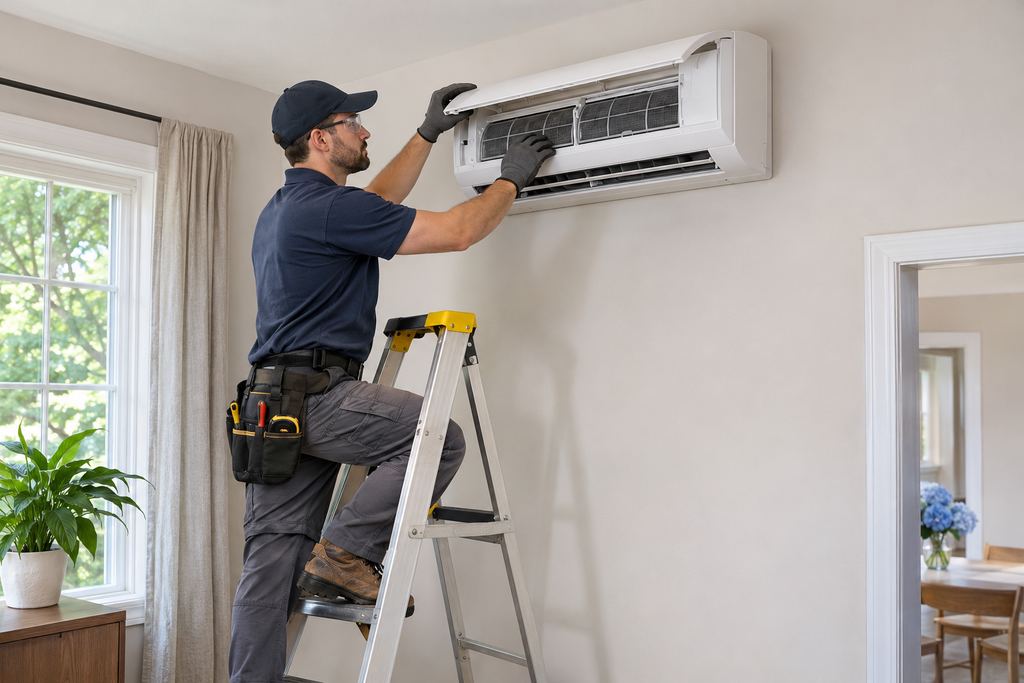
Three kinds of wall-mounted AC
How the options compare
| Mini-split head | Through-the-wall | All-in-one | |
|---|---|---|---|
| Indoor noise | Low, compressor outside | Moderate | Moderate to high |
| Efficiency | Highest, inverter models | Moderate | Lower for the same output |
| Heat | Heat pump on most models | Some models | Some models |
| Wall work | Small hole for lines and drain | Sleeve-sized opening | Two vent holes |
| Outdoor equipment | Yes | Rear grille only | Vent caps only |
| Installer | HVAC contractor | Owner for a swap; contractor for a new opening | Contractor or handy owner, per the manual |
Do wall AC units need to be vented?
Yes. An air conditioner does not destroy heat, it moves it. Whatever the type, the heat taken out of the room has to leave the building somewhere. A mini-split carries it outside through refrigerant lines. A through-the-wall unit pushes it out the rear grille. An all-in-one unit blows outdoor air across its condenser through one wall hole and exhausts it through the other. Products sold as wall-mounted coolers with no vent at all are usually evaporative coolers or fans, which add moisture and do not work like an air conditioner.
Sizing a wall-mounted unit
The ENERGY STAR room chart gives a reasonable first estimate before a contractor's load calculation.
7,000 Btu/h for 250 to 300 square feet, 9,000 for 350 to 400, 12,000 for 450 to 550 and 18,000 for 700 to 1,000, with an 8-foot ceiling.
Increase capacity about 10 percent for a very sunny room and reduce about 10 percent for a heavily shaded one.
Add 600 Btu/h per regular occupant past two, and 4,000 Btu/h for a kitchen.
If the unit will heat the room, check its heating output at cold temperatures. ENERGY STAR recommends a Manual J calculation for ductless systems.
What affects the installed cost
Prices vary widely by region and job. These are the parts of a written quote to compare.
Mini-splits cost the most up front; through-the-wall and all-in-one units less.
Wood frame, brick, block and concrete take different tools and time. A load-bearing wall needs a header for a sleeve.
A new dedicated circuit, a 230-volt line or an outdoor disconnect adds cost.
Mini-splits need a sloped drain or a pump. Wall units drain through the sleeve.
Many cities require a permit for refrigerant and electrical work. Condo boards and landlords may need to sign off on exterior changes.
What owners can handle and what needs a pro
Safe checks you can do
No tools beyond a flashlight. Turn the system off at the thermostat before opening any filter or access door.
- Clean or rinse filters as the manual describes
- Keep outdoor units and grilles clear of plants and debris
- Check the thermostat or remote mode and batteries
- Reset a tripped breaker one time
- Swap a through-the-wall unit into an existing, matching sleeve
Leave these to a licensed technician
These involve high voltage, refrigerant or sealed components. Refrigerant work requires EPA Section 608 certification.
- Mini-split line set, vacuum and charge work (EPA Section 608 certification required)
- Cutting a new sleeve opening or vent holes in masonry
- New circuits or 230-volt wiring
- Water leaking into the wall or ceiling
- Error codes, repeated trips or burning smells
How a service request works
- Tell us what you need
Enter your ZIP code and choose the service. Add a few details about the problem or project.
- Your request is routed
It goes to an independent HVAC contractor or partner network that serves your area and handles that type of work.
- A contractor contacts you
The contractor reaches out to confirm details and schedule a visit.
- You decide
The contractor diagnoses the system and quotes the work. Pricing, scheduling and warranty terms are between you and them.
Repair or replace an older wall unit
Some contractors use a rough $5,000 rule: the unit's age times the repair quote. If the product passes $5,000, start pricing replacement. For a wall-sleeve unit the decision is usually easier, since a new chassis often costs less than a sealed-system repair. For mini-splits, compare the quote with the age of the system and the parts available. See mini-split repair for what a service visit covers.
Frequently asked questions
Are wall mounted AC units any good?
They are a strong choice for single rooms and homes without ducts. Ductless mini-splits in particular are quiet and efficient. They are less suited to cooling a whole multi-room house from one unit.
Can I get a wall mounted air conditioner without an outdoor unit?
Yes. Through-the-wall units and all-in-one wall units have no separate outdoor cabinet, though both still vent outside. Expect more indoor noise than a mini-split.
Do wall air conditioners also heat?
Many do. Most mini-splits are heat pumps, and some through-the-wall and all-in-one models include heat pump or electric heat. Check the heating output on the spec sheet.
Can a wall-mounted AC plug into a regular outlet?
Smaller through-the-wall and some all-in-one units run on 115 volts and plug in. Larger units and most mini-splits need a dedicated circuit, and many need 230 volts.
How much does it cost to put in a wall AC unit?
It depends on the type, the wall and the electrical work. Get two or three written quotes that list the equipment model and all labor. The mini-split installation cost guide explains the main factors.
- Room Air Conditioners (sizing chart) (ENERGY STAR)
- Ductless Heating & Cooling (ENERGY STAR)
- Section 608 Technician Certification (U.S. EPA)
Last updated November 24, 2026. Editorial policy · Report an error
Related guides and services
Get help choosing a wall AC
Describe the room and the wall. We pass the request to an independent local contractor where one serves your ZIP code.
AC Service Near Me is an independent referral service. Work is performed by independent, locally owned contractors. How we earn money
Tell us the room size, the wall type and whether you want heating too.
Please keep this page open.
- Your request is matched with an independent contractor or partner network that serves your ZIP code.
- The contractor contacts you to confirm details and schedule a visit.
- They diagnose the system and quote the work. You decide whether to go ahead.
Read how requests are handled.
We're still setting up the contractor network that receives online requests, so your details were not sent to anyone and were not stored. Please call to request service, or check back soon.
Call (888) 555-0199