HVAC Installation for Homes and Businesses
HVAC installation means putting in a heating and cooling system sized to your building: a furnace and AC, a heat pump, a ductless system or, for commercial space, a rooftop unit. A good install starts with a load calculation and ends with a tested, permitted system. Request it here and we pass it to independent local HVAC contractors.
- Residential and light commercial systems
- Load-based sizing, not guesswork
- Questions that separate good bids from weak ones
Tell us the building type, square footage, current system and what you want installed.
Please keep this page open.
- Your request is matched with an independent contractor or partner network that serves your ZIP code.
- The contractor contacts you to confirm details and schedule a visit.
- They diagnose the system and quote the work. You decide whether to go ahead.
Read how requests are handled.
We're still setting up the contractor network that receives online requests, so your details were not sent to anyone and were not stored. Please call to request service, or check back soon.
Call (888) 555-0199Systems a contractor may install
How an HVAC installation usually runs
- Assessment
The contractor measures the home, inspects ducts and electrical service, and runs a load calculation.
- Proposal
A written quote lists equipment model numbers, efficiency ratings, duct work, permit and warranty terms.
- Permit
The contractor pulls the mechanical permit where required.
- Removal
Old equipment is disconnected, refrigerant is recovered by a certified technician, and units are hauled away.
- Install
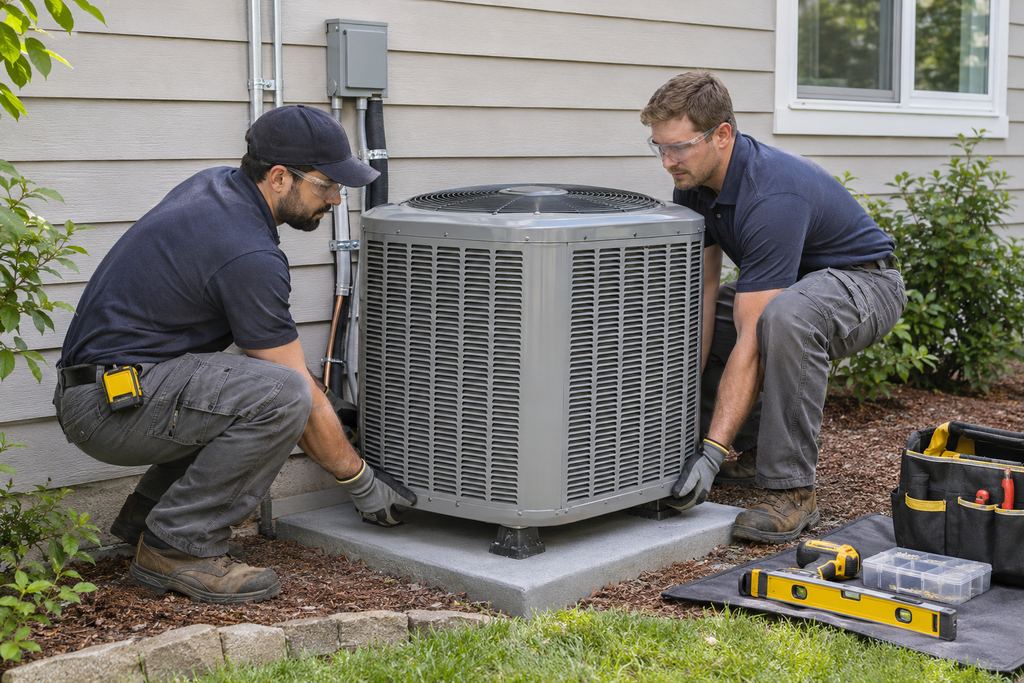
New equipment is set, connected to ducts, refrigerant lines, power, drain and venting. Most residential swaps take one to two days.
- Commissioning
The technician checks refrigerant charge, airflow, temperature split and safety controls, then sets up the thermostat.
- Inspection
A local inspector signs off on the permit.
Sizing and efficiency choices
Ask every bidder for a Manual J load calculation. It accounts for insulation, windows, air leakage and your climate, and it is how a contractor avoids an oversized system that short-cycles and leaves humidity behind.
Efficiency is the other big choice. Since January 1, 2023, AC and heat pump efficiency is rated in SEER2 for cooling and HSPF2 for heat pump heating, and federal minimums are higher in the South and Southwest than in the North. Above the minimum, a more efficient system costs more and saves more each month; how fast it pays back depends on your climate and energy rates. New equipment uses A2L refrigerants such as R-454B or R-32.
How to vet an HVAC installer
- Are you licensed for HVAC work in this state or city?
Licensing rules vary; look the license up with the state board or local building department. - Will you do a load calculation?
A quote based only on the old unit's size is a warning sign. - Are your technicians EPA Section 608 certified?
Required for handling refrigerant. - What exactly is in the quote?
Model numbers, ductwork, thermostat, permit, haul-away and cleanup. - What warranty and labor coverage apply?
Ask about registration requirements for the manufacturer's warranty.
Your part and theirs
Safe checks you can do
No tools beyond a flashlight. Turn the system off at the thermostat before opening any filter or access door.
- Clear a path to the furnace, attic and outdoor pad
- Gather past repair records and utility bills
- Decide on thermostat and air quality add-ons before install day
- Register the warranty once the job is done
Leave these to a licensed technician
These involve high voltage, refrigerant or sealed components. Refrigerant work requires EPA Section 608 certification.
- Load calculation and equipment selection
- Refrigerant recovery and charging
- Gas, venting and electrical connections
- Duct modifications and sealing
- Permits and inspection
Commercial HVAC installation
Small businesses face the same sizing questions plus ventilation requirements, rooftop access, crane lifts and scheduling around business hours. Ask commercial bidders about after-hours work and phased changeovers. See commercial AC replacement for more.
Cost and next steps
Price drivers are covered in the HVAC installation cost guide. If you are replacing a working but aging system, HVAC replacement covers timing. If you are still on the fence, HVAC repair can keep the old system going while you compare quotes, and yearly HVAC maintenance protects the new one.
How a service request works
AC Service Near Me is a referral service. We don't send our own technicians. We connect you with independent local contractors.
- Tell us what you need
Enter your ZIP code and choose the service. Add a few details about the problem or project.
- Your request is routed
It goes to an independent HVAC contractor or partner network that serves your area and handles that type of work.
- A contractor contacts you
The contractor reaches out to confirm details and schedule a visit.
- You decide
The contractor diagnoses the system and quotes the work. Pricing, scheduling and warranty terms are between you and them.
Frequently asked questions
How much does it cost to install a new HVAC system?
It depends on system type, size, efficiency, ducts and electrical work. See the cost guide and compare itemized quotes.
How long does HVAC installation take?
A like-for-like residential replacement often takes one to two days. New ductwork, a system type change or a commercial job takes longer.
How often should a residential HVAC system be serviced after installation?
At least once a year. Many owners book cooling service in spring and heating service in fall.
Which AC brand lasts the longest?
Installation quality, correct sizing and maintenance affect lifespan more than the badge. Compare warranty terms and local service support for the brands you are quoted.
What qualifications should an HVAC installer have?
A state or local contractor license where required, EPA Section 608 certification for refrigerant work, and insurance. Verify the license with the issuing board.
- Air Conditioning Contractors of America (ACCA)
- Section 608 Technician Certification (U.S. EPA)
- Energy Saver (U.S. Department of Energy)
- Technology Transitions under the AIM Act (U.S. EPA)
Last updated November 24, 2026. Editorial policy · Report an error
Related guides and services
Planning a new system?
Tell us about the building and what you want installed. Independent local HVAC contractors can assess it and send written quotes.
AC Service Near Me is an independent referral service. Work is performed by independent, locally owned contractors. How we earn money
Tell us the building type, square footage, current system and what you want installed.
Please keep this page open.
- Your request is matched with an independent contractor or partner network that serves your ZIP code.
- The contractor contacts you to confirm details and schedule a visit.
- They diagnose the system and quote the work. You decide whether to go ahead.
Read how requests are handled.
We're still setting up the contractor network that receives online requests, so your details were not sent to anyone and were not stored. Please call to request service, or check back soon.
Call (888) 555-0199