AC Installation in Fort Worth, Texas
A good AC installation in Fort Worth is sized for long stretches of triple-digit afternoons, mounted to survive spring hail and shifting clay soil, and paired with heat that can carry the house through a hard freeze. Tell us about your home and the system you have now, and we pass the request to an independent installer serving your ZIP code when one is available.
- Air conditioning installation for houses, additions and first-time central air
- Questions about permits, TDLR licensing and equipment placement
- A checklist for comparing written quotes line by line
Square footage, the age of your current system and where the indoor unit sits help an installer prepare.
Please keep this page open.
- Your request is matched with an independent contractor or partner network that serves your ZIP code.
- The contractor contacts you to confirm details and schedule a visit.
- They diagnose the system and quote the work. You decide whether to go ahead.
Read how requests are handled.
We're still setting up the contractor network that receives online requests, so your details were not sent to anyone and were not stored. Please call to request service, or check back soon.
Call (888) 555-0199What North Texas weather asks of a new system
Fort Worth summers are hot and often breezy, with afternoons that climb past 100 degrees during heat waves and nights that stay warm into the 80s. The air is usually drier than on the Gulf Coast, but muggy spells roll in from the south. A new air conditioner here needs enough capacity for the hottest week of August without being so oversized that it short-cycles in June and leaves the house clammy.
The same house also has to get through winter. The February 2021 storm kept the region below freezing for days, and a few hard freezes arrive most winters. That is why the heating side matters even on an AC project: many Fort Worth homes pair the air conditioner with a gas furnace in the attic or a hall closet, while newer houses often use a heat pump with backup electric heat. Ask the installer how the system you choose will handle a cold snap, and whether a heat pump is worth considering on your home.
Spring storms bring the third local factor. Tarrant County sees frequent hail, and hailstones can flatten the thin aluminum fins on a condenser coil. Some installers offer coil guards or louvered panels; ask what the manufacturer allows so the guard does not choke airflow or affect the warranty.
What a full installation usually includes
A line-item quote should cover each of these, or explain why one is not needed in your house.
- Load calculation: A room-by-room Manual J style estimate based on windows, insulation, orientation and duct location.
- Matched indoor and outdoor equipment: Condenser, evaporator coil and furnace or air handler that are rated to work together. You can check the match in the AHRI directory.
- Line set and refrigerant work: New or flushed copper lines, a pressure test, evacuation and a charge set to the manufacturer's method.
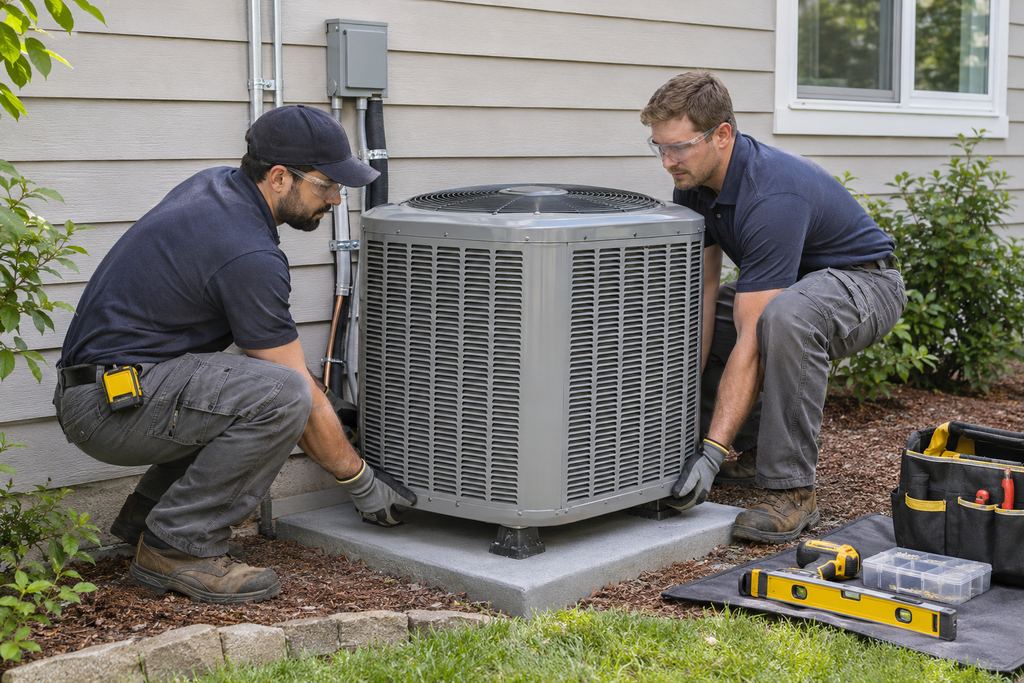
- Pad and placement: A level pad that will not sink into shifting clay, with clearance around the unit for airflow.
- Condensate safety: Primary drain, secondary pan and float switch when the coil sits in the attic above living space.
- Electrical and controls: Disconnect, correctly sized breaker and wire, and a thermostat compatible with the new equipment.
- Permit and inspection: The contractor files for the mechanical permit and schedules the city inspection.
- Removal and startup: Old equipment hauled away with refrigerant recovered, then a startup check you can see recorded.
Equipment choices for Fort Worth homes
Permits and licensing in Fort Worth
In Texas, air conditioning and refrigeration contractors are licensed by the Texas Department of Licensing and Regulation (TDLR). Before you accept a quote, look up the company's license on tdlr.texas.gov and make sure the name matches the business on the proposal. Technicians who do the hands-on work must also be registered with TDLR and work under a licensed contractor.
Installing or replacing a central system inside the city normally requires a mechanical permit from the City of Fort Worth Development Services Department, followed by an inspection. If you live in one of the separate cities around Fort Worth, that city's building office issues the permit instead. A contractor who suggests skipping the permit is asking you to carry the risk if something fails inspection later, for example when you sell the house.
Why Fort Worth installation quotes differ
We do not set prices. These are the items that most often explain a gap between two written quotes.
Texas is in the federal South region, where new split air conditioners under 45,000 Btu/h must meet at least 14.3 SEER2. Higher-efficiency equipment costs more up front and less to run through a long cooling season.
Attic ducts that are leaking, crushed or undersized can undo a new system. Some quotes include sealing or replacement; others leave the ducts as they are.
Equipment in a tight attic with a pull-down ladder takes more labor than a closet or garage installation.
Replacing the furnace or adding a heat pump with backup heat at the same time changes the scope a great deal.
New systems use lower-GWP refrigerants such as R-454B or R-32, which can change the coil, line set and tools required.
Questions to ask a Fort Worth installer
- Can I see the load calculation?
Ask for the numbers, not just a tonnage. Copying the old unit's size can repeat an old mistake. - Is this a matched system?
Ask for the AHRI reference number for the outdoor unit, coil and furnace or air handler combination. - What will you do about hail and the pad?
Ask how the unit will be leveled and whether a guard is allowed by the manufacturer. - Who files the permit, and when is inspection?
Have the answer written on the quote. - What warranty applies, and who registers it?
Manufacturer parts warranties often depend on registration within a set period. Ask about the installer's own labor terms too. - Are rebates available?
Utility and state programs change. Check the ENERGY STAR rebate finder and ask your retail electric provider.
How a service request works
AC Service Near Me is a referral service. We don't send our own technicians. We connect you with independent local contractors.
- Tell us what you need
Enter your ZIP code and choose the service. Add a few details about the problem or project.
- Your request is routed
It goes to an independent HVAC contractor or partner network that serves your area and handles that type of work.
- A contractor contacts you
The contractor reaches out to confirm details and schedule a visit.
- You decide
The contractor diagnoses the system and quotes the work. Pricing, scheduling and warranty terms are between you and them.
When installation is not the right request
If your current system is less than about ten years old and still mostly works, a repair may make more sense. Start with AC repair in Fort Worth, or use emergency AC repair if the house is heating up and someone at home is at risk. The national AC installation guide goes deeper into sizing and equipment, and the installation cost guide explains price factors. For other services in the city, see the Fort Worth page.
Other AC services in Fort Worth
AC Installation in other Texas cities
Frequently asked questions
Do I need a permit to install central air in Fort Worth?
Usually yes. Inside city limits the mechanical permit comes from the City of Fort Worth Development Services Department, and an inspection follows. Suburban cities issue their own permits. The installing contractor normally applies.
How do I check an AC contractor's license in Texas?
Search the company or person on the TDLR website at tdlr.texas.gov. Texas licenses air conditioning and refrigeration contractors through TDLR, not through the city.
Should I choose a heat pump or keep a gas furnace in Fort Worth?
Both work here. A heat pump handles most winter days efficiently; a furnace or dual-fuel setup gives strong heat during rare deep freezes. Ask the installer to compare operating costs for your home and gas availability.
How long does an AC installation take?
A straight replacement of matched equipment in an accessible location is often a one-day job. New ductwork, an attic relocation, electrical upgrades or permit scheduling can add days.
What size air conditioner does a Fort Worth house need?
It depends on the house, not on a square-foot rule. Insulation, west-facing windows, attic duct location and ceiling height all change the load. Ask for a Manual J style calculation.
- Air Conditioning and Refrigeration Contractors (Texas Department of Licensing and Regulation)
- Appliance and Equipment Standards Program (U.S. Department of Energy)
- Manual J Residential Load Calculation (ACCA)
- Technology Transitions (U.S. EPA)
- ENERGY STAR Rebate Finder (ENERGY STAR)
Last updated November 24, 2026. Editorial policy · Report an error
Related guides and services
Get Fort Worth installation quotes
Tell us the size of the house, what is installed now and what you want to change. If an independent installer serves your ZIP code, they can reach out to set up an in-home estimate.
AC Service Near Me is an independent referral service. Work is performed by independent, locally owned contractors. How we earn money
Square footage, the age of your current system and where the indoor unit sits help an installer prepare.
Please keep this page open.
- Your request is matched with an independent contractor or partner network that serves your ZIP code.
- The contractor contacts you to confirm details and schedule a visit.
- They diagnose the system and quote the work. You decide whether to go ahead.
Read how requests are handled.
We're still setting up the contractor network that receives online requests, so your details were not sent to anyone and were not stored. Please call to request service, or check back soon.
Call (888) 555-0199